



The illusion of safer infrastructure
For many years, U.S. Treasuries have been considered the safest asset in worldwide finance. They are the foundation of the banking system, collateral markets, and risk-free return benchmarks. The arrival of tokenization into the picture brought with it the promise of quick settlement, wider access, and integration into the digital financial infrastructure as the modernization of that foundation. However, the efficiency narrative is only a facade for a more delicate reality. Tokenized Treasuries are not just “better bonds,” they are also a leveraged duration trade incorporated in a swift and reflexive financial system. This transition involves systemic risks that are likely to exceed the capacity of most markets to bear.
Duration risk moves at blockchain speed
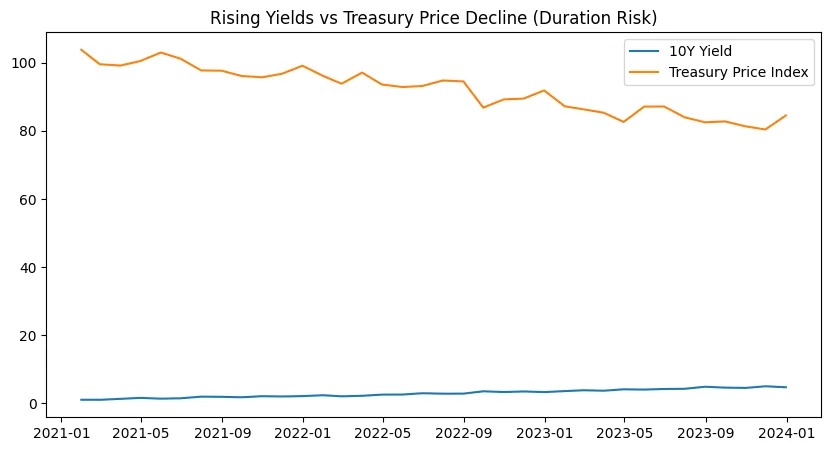
Tokenized Treasury products are, in a sense, the financial instruments which by virtue of their very nature that have instant transferability and are highly mobile. The very nature of their mobility involved the financial products to be very volatile in terms of interest rates. With the increase in yields, the prices of Treasuries drop. In the conventional system, this adjustment in price takes place through the slow institutional channels. In a tokenized atmosphere, the same adjustment can be done instantaneously over different platforms, automated trading strategies, and liquidity pools of various venues. The outcome is not simply a faster market but a faster market under stress.
Duration risk that used to be concentrated in banks and large asset managers is now spread across wallets, protocols, and on-chain liquidity systems. When there is a sudden change in rates the repricing pressure does not stay confined. It spreads through the values of collateral, margin requirements, and the mechanisms of automated liquidation. Tokenization is the process element that roughly turns a passive bond exposure into an active volatility amplifier.

When safe assets become leverage
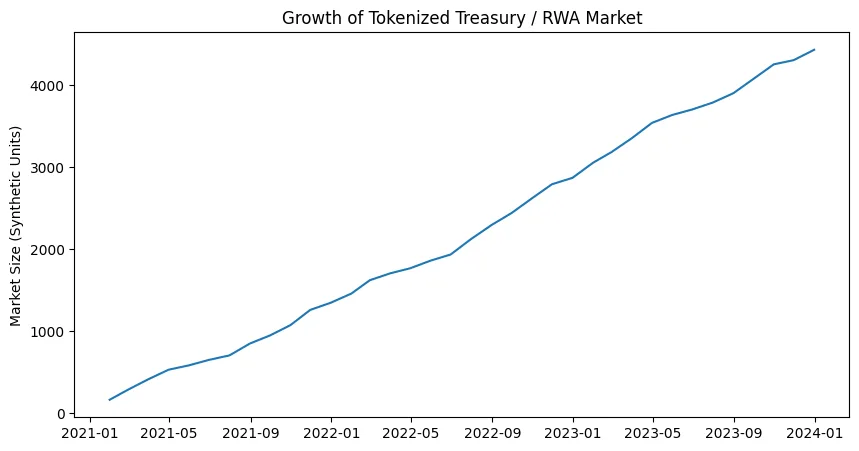
The importance of this structural transformation lies in the fact that Treasuries are not in isolation anymore. Their use as collateral for digital leverage is becoming the main function of them. The digitized T-bills are responsible for or are backing up stablecoins, yield-bearing crypto products, and DeFi lending systems. The weakening of collateral quality occurs as the prices of the Treasuries drop.
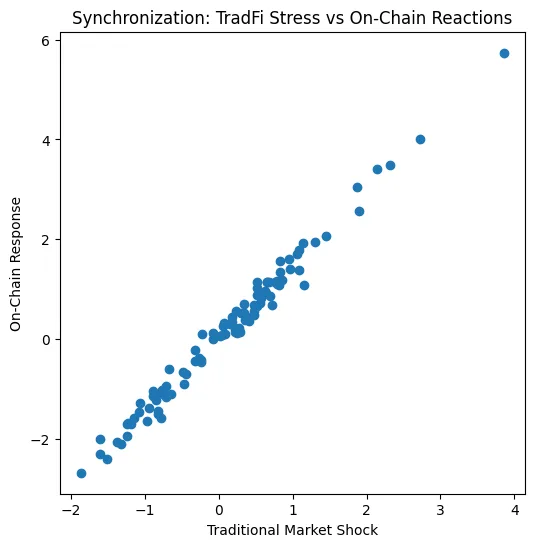
The process of de-leveraging follows at a faster pace on the blockchain when collateral is of poor quality. In traditional finance, balance-sheet constraints and regulatory buffers slow this process. On the stock token markets, code is used instead of discretion. Liquidations are set into motion automatically. Yield strategies are rebalanced in real-time. The migration of capital is without any resistance. The gradual adjustment in the past has turned into a synchronized response now.
The correlation trap
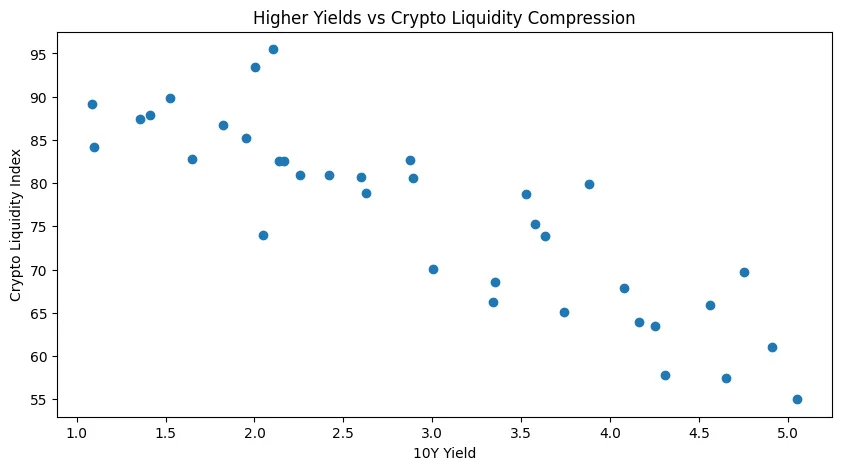
Actually, the synchronization is the main risk. When a lot of systems react to one signal at the same time, the stability is replaced by correlation. Tokenized Treasuries are combining the fixed-income markets with the crypto liquidity cycles. A sudden change in yields might affect the stablecoin reserves, the decentralized lending platforms, and the synthetic yield products at the same time. The diversification illusion disappears right at the moment when it is the most wanted. The expected distribution of risk is transformed into actual concentration of risk.
The political and psychological shift
Additionally, there is a political aspect. When governments depend on elevated interest rates to manage inflation, the worth of current debts decreases. Owners of tokenized Treasuries feel these losses firsthand and in full view. A problem that used to be an institutional balance-sheet issue now becomes a retail-facing one.
The trust in “safe” assets turns down not because Treasuries default, but due to their price fluctuations being impossible to overlook. The story of stability vanishes as the market gets sensitive to the prices. This is not a question of creditworthiness crisis. It is a crisis of structure.
Efficiency without resilience
Tokenization does not alter the basics of the government debt. It merely affects the way this debt interacts within the contemporary financial ecosystems. By facilitating price discovery, reducing time for settlement, and inserting bonds into programmable liquidity systems, tokenization raises the speed of stress transfer. In tranquil situations, this appears as efficiency. In turbulent situations, it appears as fragility.
The infrastructure designed for cryptocurrencies is very good at managing risky volatility. But it is not as experienced when the volatility comes from the sovereign debt markets.
A systemic experiment
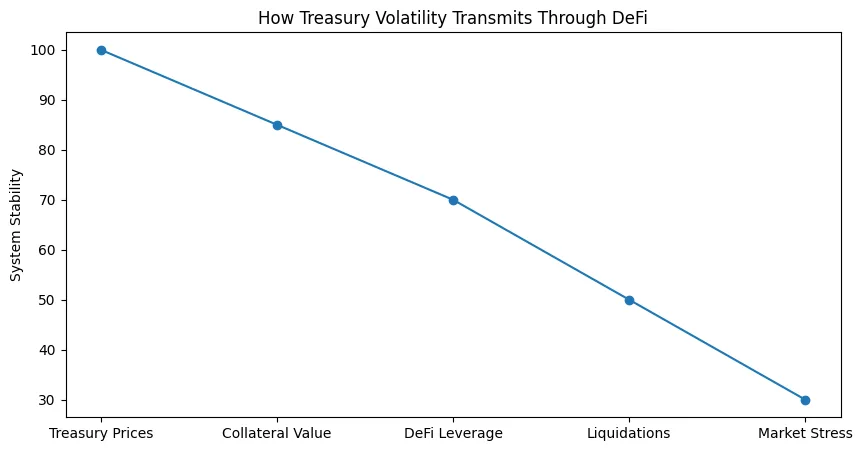
The financial system is gradually changing from one supported by institutional buffers to one reacted to automatically, as more dollars are invested in the tokenization of real-world assets. The old financial shock absorbers are giving way to codeless, fast, and composable methods. This not only marks tokenized Treasuries as an innovation but also as a systemic experiment.The future of finance can be really tokenized.
However, if the world’s most significant asset class is to be a part of that change, then the risks involved must be given the same considerations as the rewards. Efficiency without resilience should not be regarded as progress. Rather it is like speeding up the process without being able to control it effectively. The risk within the system is not eliminated by the tokenized Treasuries. Rather, it is transferred speedily.