
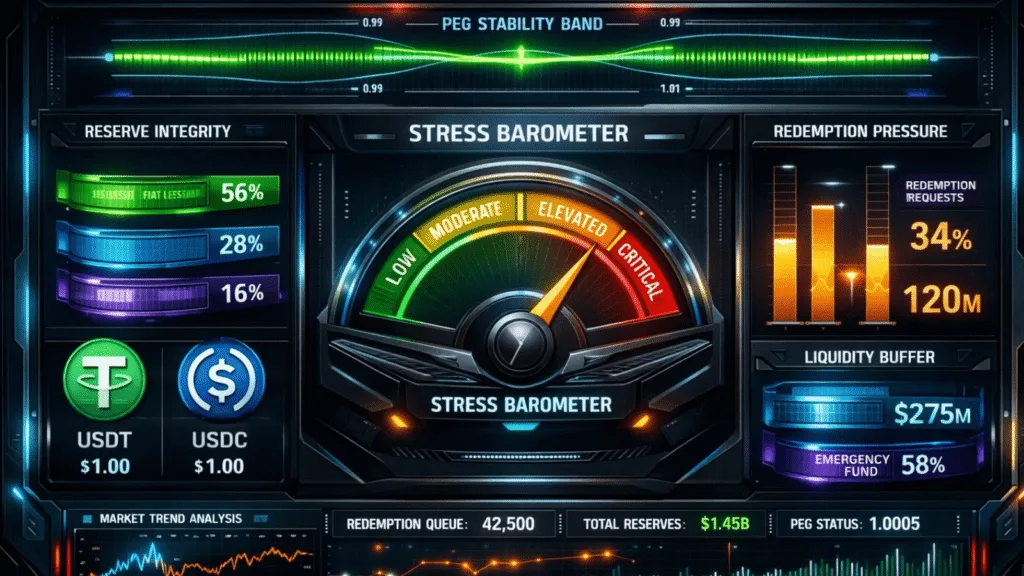



Crypto costs experience their first major movement when market liquidity begins to change. The stablecoin layer experiences hidden stress development which starts before Bitcoin reaches a critical market point and altcoins start their downward spiral and market funding rates start to show extreme negative values. The following signals appear when supply changes and exchange balances shift and redemption processes speed up and peg mismatches start to occur.
The Stablecoin Stress Barometer functions as a macro-overlay system which assesses systemic pressure through analysis of stablecoin patterns. It does not track price. It tracks liquidity conditions. Stablecoins function as the core settlement system and primary asset backing and main liquidity source for the cryptocurrency market. The system enters a new operational mode when stablecoins start to function in an unexpected manner. This property shows that stablecoins function as active financial instruments which monitor economic stress because they need a universal currency system.
Supply delta: Expansion vs Contraction of liquidity
Tether and USD Coin control dollar liquidity in both centralized and decentralized market spaces. The combined supply delta shows whether the market experience liquidity expansion or liquidity contraction. Stablecoins increase their total supply during periods of expansion.

The growth demonstrates that organizations are bringing in new funds while moving treasury assets and market makers are increasing their operational capacity and investors are developing new market strategies. Market recruitment occurs when supply levels maintain continuous growth throughout market activity.
The two groups experience different patterns during their respective periods of economic decline. The decline of total supply shows that redemption processes occur with capital leaving the system and institutional investors reducing their asset holdings. Supply contraction often begins quietly during consolidation phases. The price appears stable while the market removes its liquidity from the system.
The key variable is acceleration.
The gradual decline of the system appears to show standard operational behavior. The financial system is experiencing liquidity problems because of the sudden drop in money supply which occurred within the past hour. The historical record shows that these periods of time have always come before market turbulence instead of coming after it.
The market system maintains a constant supply of liquidity which only stops when there is a complete market shutdown. The market system experiences a gradual reduction of liquidity which proceeds until all available liquidity becomes exhausted.
Exchange inflow spikes: Deployment or Defense
The movement of stablecoins into centralized exchanges shows users’ trading intentions. Traders use large fund movements to identify their upcoming risk activities. Institutions transfer stablecoins to exchanges as their first step before they start trading on spot markets and creating derivative positions. The market situation shows that incoming funds match the increase in open interest and the better market performance.
Market participants use inbound funds to create protective strategies. The market environment causes participants to transfer stablecoins to exchanges for three purposes which include protecting their assets and reducing their market exposure and preparing for upcoming market fluctuations. The combination of inbound funds with reduced leverage and diminished market activity results in a defensive signal which opposes positive market indications.
Context determines meaning.
The timing asymmetry of exchange inflow spikes creates powerful effects at their peak times. The capital movements begin to emerge before market prices start to rise. Investors shift their money to new destinations before the price movements become evident. Institutions make their moves before price fluctuations begin to occur. The balance of stablecoin exchanges serves as a predictive measure of upcoming market liquidity conditions.
Redemption velocity: Measuring exit speed
The need for urgent action exists because supply contraction does not provide an adequate explanation. The rate of redemption shows how fast stablecoins are being switched back to their original fiat currency. The measurement indicates how fast institutions reduce their risk exposure. The process of internal capital rotation results in gradual supply reductions. The market shows signs of systemic exit through increased redemption velocity. The situation shows reduced trust in the liquidity layer of the market.
The process of redemption acceleration began before both spot and derivatives markets experienced their subsequent volatility expansions during previous periods of market stress. The behavior showed that major market participants were trying to protect their assets. The complete departure of liquidity from the ecosystem occurs when exchange balances drop while redemption velocity increases. The internal capital movement occurs when exchange balances increase while redemption velocity increases. The identification of these two regimes which exist simultaneously is necessary to comprehend the operational status of the system during times of stress.
Peg micro-deviations: The early fracture signal
Stablecoins are designed to maintain their value at a fixed exchange rate. The system treats even minor price differences as important. The market fails to detect smaller price changes that range between 10 and 30 basis points. The analysis of multiple stablecoins shows that their price deviations create signs of market disturbances which include reduced trading activity and difficulties in executing arbitrage trades. The Tether price drops below its fixed value while the USD Coin price rises above its value which creates a market condition that shows uneven demand between the two assets.
The simultaneous market movement of both assets leads to a situation that affects the entire market. The system experiences peg breaks because of financial pressure which progresses to an extreme point that results in multiple asset liquidations. The market experiences these minor fractures which become visible during periods of low trading activity when the market shows minimal price changes. The peg represents more than a price point. The peg serves as a measurement of public trust.
Liquidity compression index: A composite stress overlay
The Stablecoin Stress Barometer aggregates four core dimensions which include Supply delta momentum and Exchange balance shifts and Redemption acceleration and Peg deviation clustering. The two variables show negative alignment which indicates that liquidity compression has started. The market experiences liquidity compression but this process does not lead to immediate price collapse.
The process creates range contraction which results in decreasing volatility and less active market participation. The markets show a tranquil appearance. The market depth decreases while. The market shows increasing correlations. The market experiences a sudden expansion of volatility. The compression regime detection system identifies that compression phase which exists before the expansion phase starts.
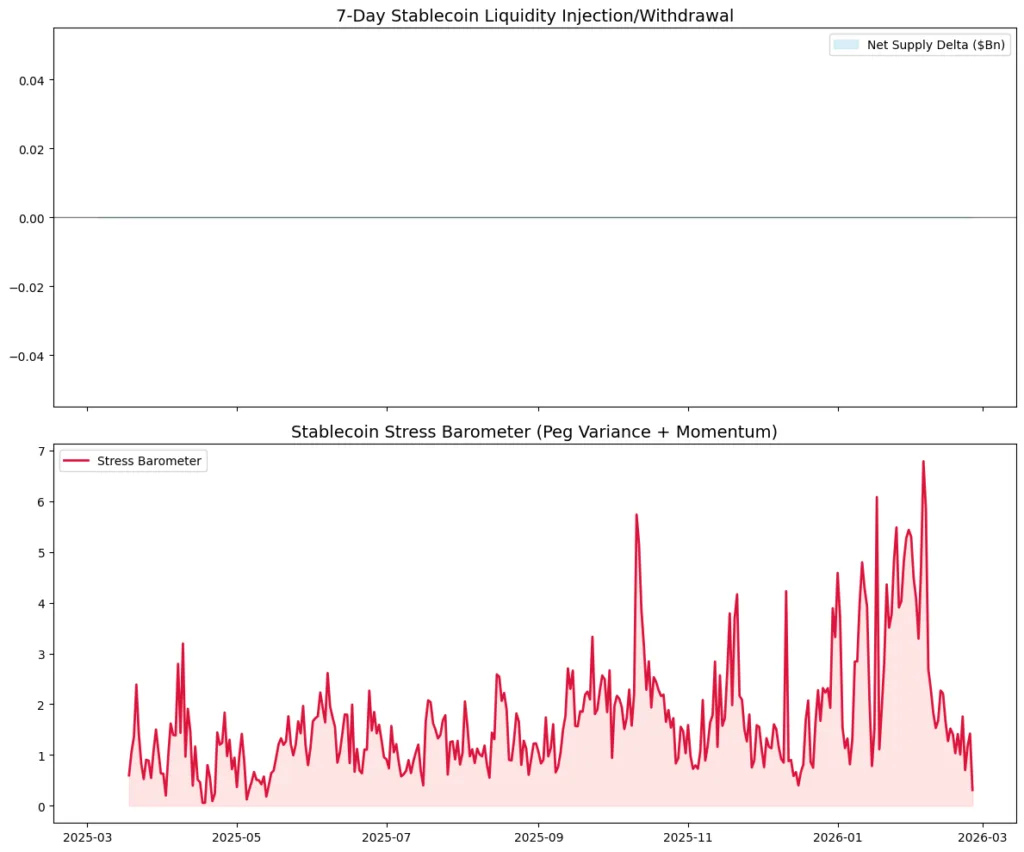
Institutional implications why this matters now
The institutional allocators need to understand liquidity cycles because they need to assess their timing risk exposure. The expansion regimes create better performance conditions for beta exposure and leverage strategies and altcoin rotation. The compression regimes cause a decrease in diversification and an increase in correlations and a loss of depth. The Stablecoin Stress Barometer serves no purpose as a directional indicator. The system functions as a detector of fragile elements.
When liquidity compresses, fragility rises.
Financial markets experience increased volatility whenever they encounter higher levels of fragility. The macro overlay system delivers signals about changes in market conditions to asset managers because it does not function as a price forecasting mechanism. The system determines optimal times for reducing leverage and hedging risks and implementing options-based strategies. Institutions that monitor both liquidity and price movements can anticipate market disruptions instead of waiting to respond during those events.