




FOMO isn’t random it’s predictable
The most significant error which people make in cryptocurrency occurs when they refuse to accept their mistakes. The main problem exists because people fail to arrive on time. The market changes when people acquire new knowledge simultaneously with their intelligent responses to information.
The market changes because people respond to market events with different speeds and different time preferences. Some people begin their response when they experience doubt about market conditions. The second group responds to evidence. The third group enters the market when prices reach their highest levels. The first group which purchases products at prices which exceed their actual value creates FOMO.
Emotional buying actually follows a specific pattern which people mistakenly perceive as disorderly behavior. The process develops through three distinct stages which include gradual development followed by rapid growth and then complete termination. The observation of multiple cycles gives a clear understanding of retail market participation which takes shape as a curve.

The path of development does not follow a direct route. The structure exhibits a curved pattern which contains defined timing elements and organized components together with an expected physical form.
FOMO is delayed participation
People commonly believe that FOMO creates feelings of panic. The actual experience involves postponing activities. Retail investors decide against purchasing stocks during market downturns because the current low prices make them feel uncertain about future market directions. At the beginning of a move, narratives are weak, confidence is low, and risk feels high.
The emotional response creates a perception that actual chance of success is greater. People use time as a method of measurement. People wait for price to change. They wait for proof. They wait for other people to show them that the change actually happened. The move had already started when they reached their decision to take action.
This main concept represents the first essential idea. FOMO functions as an purchasing behavior which occurs without any specific pattern. The buying process begins after the chance to purchase has already become available.
People don’t buy value, they buy proof
The reason retail flows do not reach their lowest point exists because retail flows remain present at their lowest point. The lowest point of a market experiences no excitement according to market behavior. The absence of excitement shows through the disappearance of both screenshots and viral content and stories about making quick profits.
The situation develops into two separate states which people experience through their feelings of doubt and uncertainty. Retail needs proof before acting. The proof people need to see comes in three different ways. The price starts to rise which eliminates all customer fear.
People begin discussing the topic on social media platforms which increases its public awareness. The appearance of other people making profits creates a situation which makes people want to compete. The alignment of those three components triggers a mental transformation.
The fear of missing out on an opportunity becomes more intense than the fear of losing money. The moment emotional buying starts its process. The reason retail investors enter the market after all other traders have started their buying activities.
The shape of emotional buying
The process of retail market entry shows non-linear development through its various stages of progression. At the beginning, only a small number of people join the process. The move to this location occurs without attracting any attention because people either ignore or doubt its existence.
The initial stages of the process require only a limited number of participants. The situation experiences a major development. The price information becomes accessible to people. Increased dialogue establishes better distribution of the story. People start to follow the story.
People start to join the activity at a rapid pace. People experience emotional purchasing behavior during this time which results in buying through this period. The easily persuaded people exist in the market now. The process of finding new customers becomes increasingly difficult. The rate of participation growth experiences a second period of decline.
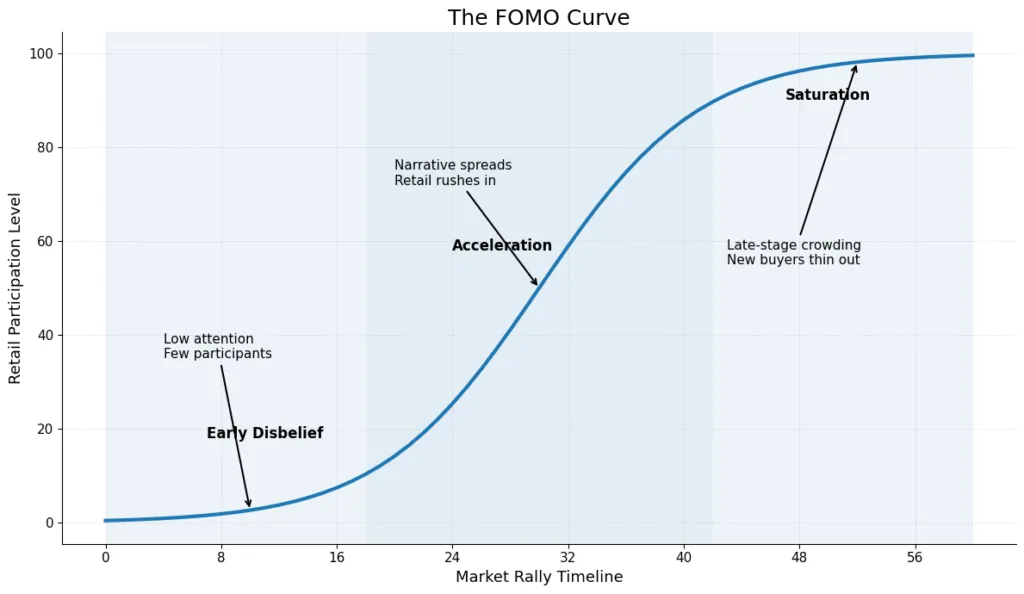
The period after peak excitement shows elevated energy levels but businesses suffer from restricted demand.Two distinct processes exist because they create a curve which shows both fast initial progress and slow final progress. The process establishes an initial slow period which progresses into middle fastness before reaching its final slow period. The moment you detect it, you begin to see it in every location.
Why the middle of the curve feels like a “Perfect Market”
The most deceptive moment in any rally is not the bottom. The middle of the rally serves as the most deceptive point of the rally. The market shows positive price movement because of good news and active social media and people who demonstrate confidence in the situation. The market shows signs of working properly.
The actual situation develops as the emotional component of the market increases at its highest rate of speed. The situation seems safe because users can view everything that exists instead of facing unknown circumstances. The present situation allows people to observe things yet it creates challenges because most potential options have already been utilized. The present situation functions as a trap. The market reaches its simplest point but this time customers begin to buy products.
The inflection point where FOMO begins
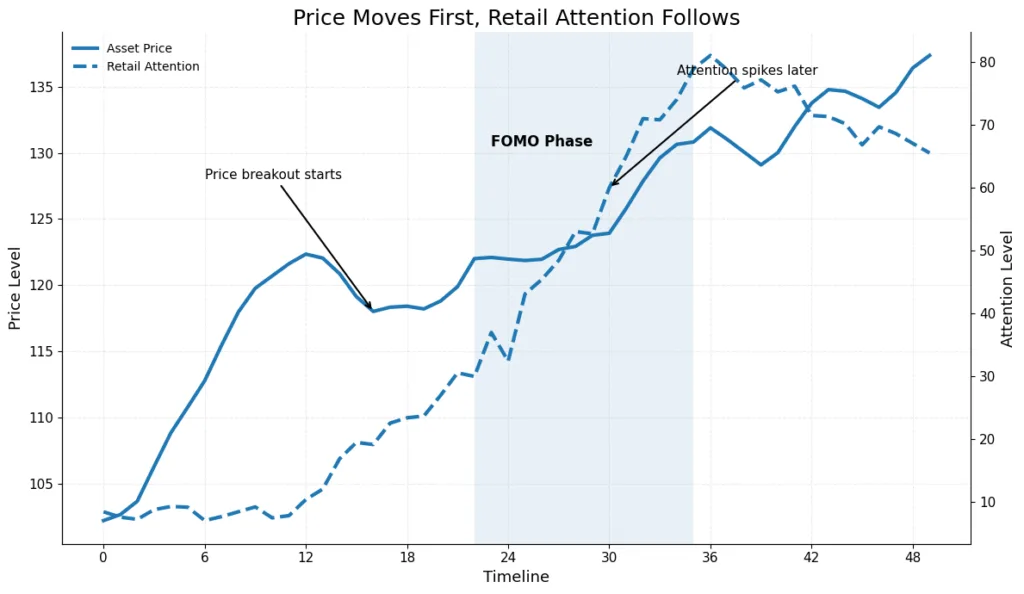
The market shifts from complete obscurity to active pursuit at a specific time which does not occur by chance. The event occurs when three elements which include price movement and market attention as well as the market narrative reach their peak together. The breakout creates a situation which draws attention to it. The raised interest level establishes a base for people to create discussions.
People develop trust through their discussions about the subject. Trust enables people to take part in the activity. The market transforms into a continuous observation system which people need to enter as their new space. The point where FOMO starts to build up.
The process begins with FOMO. The process continues until it reaches its natural end point. The initial price increase leads to more customers who drive prices upward which creates a continuous cycle. The process operates until it reaches its final stopping point.
Why the end of the curve is the most dangerous
The market shifts from complete obscurity to active pursuit at a specific time which does not occur by chance. The event occurs when three elements which include price movement and market attention as well as the market narrative reach their peak together.
The breakout creates a situation which draws attention to it. The raised interest level establishes a base for people to create discussions. People develop trust through their discussions about the subject. Trust enables people to take part in the activity. The market transforms into a continuous observation system which people need to enter as their new space.
The point where FOMO starts to build up. The process begins with FOMO. The process continues until it reaches its natural end point. The initial price increase leads to more customers who drive prices upward which creates a continuous cycle. The process operates until it reaches its final stopping point.
FOMO concentrates where narratives spread fastest
Different assets generate different levels of emotional attachment from investors. FOMO tends to concentrate in places where the story is simple, visible, and easy to repeat. When an idea spreads quickly, participation can scale faster. The retail market shows strong interest in specific sectors while other sectors remain in a state of low interest. The evaluation process consists of two components which include fundamental analysis and basic market understanding.
The evaluation process depends on how quickly a particular story spreads. The process of emotional purchase increases when a story achieves widespread cultural acceptance. The process of the curve reaches its most rapid growth stage. Different assets generate different levels of emotional attachment from investors.
FOMO tends to concentrate in places where the story is simple, visible, and easy to repeat. When an idea spreads quick, people join the movement at an increasing rate. The retail market shows strong interest in specific sectors while other sectors remain in a state of low interest.
The evaluation process consists of two components which include fundamental analysis and basic market understanding. The evaluation process depends on how quickly a particular story spreads. The process of emotional purchase increases when a story achieves widespread cultural acceptance. The process of the curve reaches its most rapid growth stage.
The difference between understanding FOMO and becoming it
The curve provides two methods for user interaction. Some people in the study can identify the established pattern. They understand that emotional buying comes in waves. The traders enter before or during initial market activity and they decrease their market presence when more traders enter the market. The others perceive the curve yet they do not see the pattern.
The traders first wait to watch until they see clear movement, which they follow. The two groups differ through their understanding of time, which shows intelligence. Market participants receive rewards when they can recognize upcoming market trends while those who enter after market growth reaches its peak face penalties.
Turning emotion into a signal
FOMO does not need to be avoided completely. FOMO can be observed and measured and used as a tool. When attention starts increasing faster than price, it signals that participation may still be building. When price and attention both start to increase, people experience their highest state of emotional buying. The combination of peak attention and declining price creates a signal that indicates exhaustion. The market’s emotional cycle can be estimated through behavior tracking, which goes beyond price analysis. FOMO becomes a weakness which transforms into a signal.