


The collapse of financial silos
The global financial system maintained separate operational components during its first three decades of existence. Traditional finance maintained control over all financial operations through its power to manage capital movements and establish regulatory frameworks and build trust with financial institutions.
Decentralized finance created an open access system which enables users to view all operations and use digital currencies as programmable assets. The development of artificial intelligence created tools for prediction and automation which enabled decision-making without needing to be embedded in financial systems.
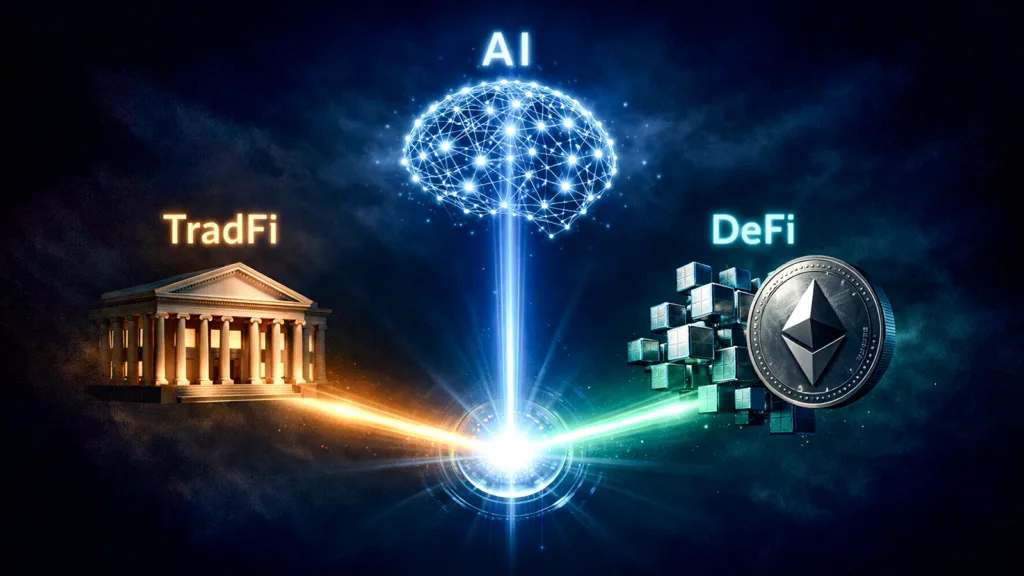
The existing separation between two entities has started to dissolve. The systems that exist in 2026 will not compete against each other but instead will develop into a unified system. Financial institutions have started to use blockchain technology as their core operating system.

Financial institutions have begun to use decentralized finance protocols which enable their operations to follow institutional standards. Artificial intelligence functions as the intelligence system which enhances both components. The current situation does not represent a passing fashion. The entire system experiences a fundamental transition. The financial system now undergoes a process that transforms its entire structure.
The institutionalization of DeFi
The institutions first began to adopt DeFi after their initial resistance ended. Financial institutions have moved beyond their initial questioning of decentralized systems. The organizations now seek methods for system integration which will not compromise their operational control or regulatory compliance or financial productivity.
Real world asset tokenization has established itself as the primary entry point. On-chain issuance now includes government bonds private credit and money market funds, which operate as expandable products rather than experimental projects. Traditional clearing systems no longer restrict liquidity flow. The process of settlement has achieved immediate execution.
Market hours, which existed as a separate concept, have evolved into a system that enables continuous worldwide trading. DeFi has lost its original ideological meaning of decentralization in this particular situation. The system has transformed into an institutional infrastructure which operates silently through its embedded components. The most important shift is not technological. It is psychological. Trust now moves from institutions toward digital systems.
Banks are becoming protocols
The banking industry is undergoing a transformation process that creates major changes which most people do not see. Trust functions as the fundamental element which banks need to complete their main operations. Banks accept customer deposits and they handle financial risks while they enable people to conduct monetary transactions.
Smart contracts and decentralized systems now perform these banking functions with their advanced operational efficiency and reduced operational obstacles. The response is not disappearance it is adaptation. Banks are beginning to resemble protocols. The company provides digital asset storage solutions which it combines with blockchain-based settlement systems and on-chain liquidity testing.
The company develops its own blockchain platform while it also works with existing blockchain networks. The competitive edge has moved away from physical locations and traditional systems towards companies which use technology and can work faster. The current situation makes it difficult to identify what sets banks apart from protocols.
Both institutions have the same function of managing liquidity. Both institutions are responsible for overseeing potential financial risks. Both institutions serve as entry points for accessing financial resources. One entity is currently transforming into the other entity.
AI as the intelligence layer of finance
The blockchain functions as infrastructure while AI serves as the intelligence which operates the system. Artificial intelligence has expanded its applications beyond trading algorithms and predictive models. The technology has evolved into the primary decision-making system which operates throughout the entire financial ecosystem. AI systems which analyze extensive and current data streams now control portfolio allocation and risk assessment and credit scoring and liquidity optimization.
DeFi systems use AI technology to create adaptive yield strategies which automatically adjust their positions while managing their risk levels through dynamic controls. AI technology creates improvements in traditional finance by transforming processes that include fraud detection and macroeconomic forecasting.
The transition leads to complete operational independence for organizations. Financial systems now progress toward automated self-optimization processes. The markets now respond to both human choices and automated trading systems which operate at speeds that exceed human abilities. The market now operates under a new framework which combines rapid execution with efficient processes but creates complicated systems that can easily break down.
The unified liquidity layer
The blockchain functions as infrastructure while AI serves as the intelligence which operates the system. Artificial intelligence has expanded its applications beyond trading algorithms and predictive models. The technology has evolved into the primary decision-making system which operates throughout the entire financial ecosystem. AI systems which analyze extensive and current data streams now control portfolio allocation and risk assessment and credit scoring and liquidity optimization.
DeFi systems use AI technology to create adaptive yield strategies which automatically adjust their positions while managing their risk levels through dynamic controls. AI technology creates improvements in traditional finance by transforming processes that include fraud detection and macroeconomic forecasting.
The transition leads to complete operational independence for organizations. Financial systems now progress toward automated self-optimization processes. The markets now respond to both human choices and automated trading systems which operate at speeds that exceed human abilities.
The market now operates under a new framework which combines rapid execution with efficient processes but creates complicated systems that can easily break down.
Systemic risks in a converged system
Financial systems face new hazards from their evolving progress yet this risk remains true for convergence. The implementation of artificial intelligence creates unprecedented model risk for organizations. Algorithms which operate without transparency create market instability through their risk assessment flaws. Decentralized finance platforms enable users to create smart contracts which contain security flaws and introduce risks from their management systems. Financial institutions must follow regulations which limit their operations while maintaining financial systems through their use of leverage.
A combination of these elements results in a risk assessment which generates unpredictable outcomes. The use of leveraged decentralized financial positions together with an AI model which operates incorrectly will cause a complete liquidation process. The liquidity of on-chain markets will experience disruption from different regulatory initiatives which affect traditional financial markets.
The system achieves its most efficient state through interconnectedness which simultaneously creates its most vulnerable points. The process of convergence leads to a paradoxical situation. The system develops greater complexity which results in unpredictable behavior.
One system, not three
The distinction between TradFi, DeFi, and AI is becoming obsolete.The emerging financial system provides decentralized infrastructure and global access and automated intelligence. Institutions now function as part of existing protocols. AI has developed into a fundamental component which drives all decision-making processes. Financial systems are established through this merger which creates new forms of financial operations. Financial systems operate as an ongoing system which combines three fundamental elements capital code and computation.