



Market overview
Cryptocurrencies have developed into a trading system which uses macroeconomic factors instead of single stories to value its assets. The asset now exhibits behavior of macroeconomic instruments which depend on movements of liquidity interest rate changes governmental rules and institutional financial activities. The transformation which occurred now enables more people to access the system compared to its previous state.
The United States crypto market has begun to abolish its main regulatory constraint which has kept digital currencies from achieving their full value potential. Investors who bought into crypto throughout most of its existence paid a permanent regulatory discount to their holdings. The market value of their investments now exceeds 500 million dollars through the maintenance of three core operational platforms and one governmental partnership.
The market operates today through two different approaches which produce prices of companies in the market. Crypto markets depend on new incoming funds which create prices for the asset since this process determines market value for all investments. The process of accessing capital investment through platform expansion occurs in multiple layers which proceed to build up. The current market phase will create a major positive impact because it brings about fundamental changes to existing structures.

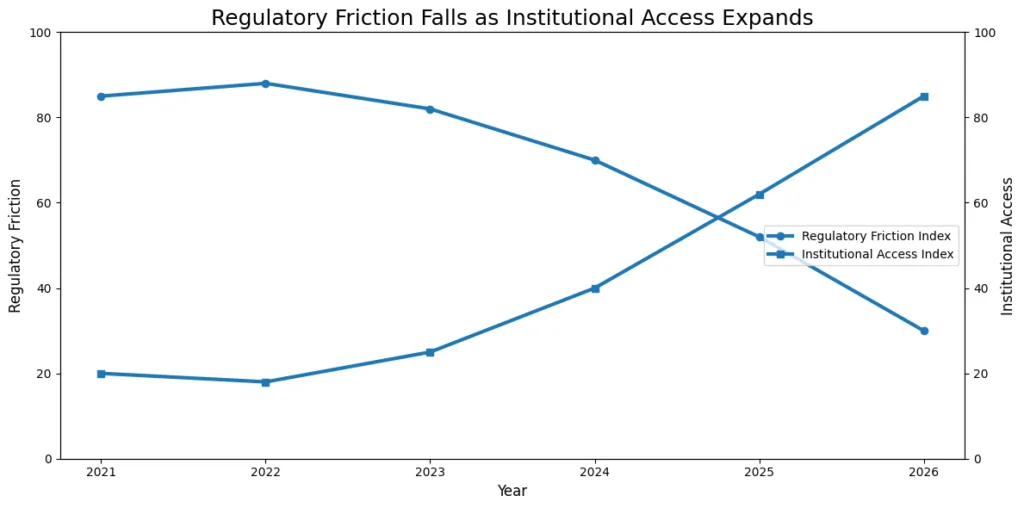
The structural logic of the deregulation trade
The deregulation trade operates through a process which allows markets to establish new risk valuations. The necessary return which investors demand for holding crypto assets decreases when regulators exhibit less opposition to digital assets. The financial markets value the company at a higher position because of the single factor.
The process of deregulation enables different groups to enter the market. Under restrictive regimes, crypto was largely confined to native participants retail traders, crypto funds, and a limited set of offshore institutions. Under a more open framework, the universe expands dramatically. Asset managers from traditional finance banks payment networks and corporate entities can now invest without facing major restrictions.
The second-order impact of this phenomenon shows that crypto assets start to determine their future value before actual inclusion happens. Markets anticipate capital before it arrives. Deregulation trade moves faster than fundamental movements because traders expect their trading rules to return sooner than actual market conditions. The system measures future accessibility because people need to make current system usage decisions. The system opens new investment opportunities while current vertical markets maintain their accessibility.
Stablecoins progress from being a trading instrument to becoming a complete payment system. Custody transforms into an institutional service that can handle multiple clients at once. Tokenization establishes a pathway which connects traditional financial systems to digital finance. Exchanges change their role from high-risk trading platforms to become institutional finance partners. The process of deregulation brings positive effects for all digital assets while it benefits token markets through its impact on the entire digital asset economic system.
Why crypto is becoming the most leveraged macro asset
The deregulation trade operates through a process which allows markets to establish new risk valuations. The necessary return which investors demand for holding crypto assets decreases when regulators exhibit less opposition to digital assets. The financial markets value the company at a higher position because of the single factor. The process of deregulation enables different groups to enter the market. Under restrictive regimes, crypto was largely confined to native participants retail traders, crypto funds, and a limited set of offshore institutions. Under a more open framework, the universe expands dramatically.
Asset managers from traditional finance banks payment networks and corporate entities can now invest without facing major restrictions. The second-order impact of this phenomenon shows that crypto assets start to determine their future value before actual inclusion happens. Markets anticipate capital before it arrives. Deregulation trade moves faster than fundamental movements because traders expect their trading rules to return sooner than actual market conditions.

The system measures future accessibility because people need to make current system usage decisions. The system opens new investment opportunities while current vertical markets maintain their accessibility. Stablecoins progress from being a trading instrument to becoming a complete payment system. Custody transforms into an institutional service that can handle multiple clients at once.
Tokenization establishes a pathway which connects traditional financial systems to digital finance. Exchanges change their role from high-risk trading platforms to become institutional finance partners. The process of deregulation brings positive effects for all digital assets while it benefits token markets through its impact on the entire digital asset economic system.
Liquidity, ETFs, and reflexivity
The current cryptocurrency market demonstrates increasing dependence on market movement. The introduction of ETFs has fundamentally changed how capital enters the space. Crypto now absorbs traditional portfolio flows because demand from exchanges no longer serves as its only source of market demand.
The reason for this significance exists because ETF flows display permanent differences from standard market patterns. The market exhibits two different types of behavior because investors use their assets to generate profits through their main allocations. Institutions use systematic methods to increase their market exposure which they base on major economic indicators that show declining interest rates and rising investor confidence.
The availability of crypto assets to users maintains its current restricted condition. The combination of increasing ETF demand and decreasing exchange supply creates a situation where prices experience extreme upward movement. The market experiences significant price shifts from minor capital inflows. The reflexivity of the system produces two conflicting outcomes. Deleveraging together with outflows during risk-off periods leads to sudden liquidation events.
Declining asset prices decrease collateral assets which creates a need for additional asset sales because collateral functions as a system component. Cryptocurrencies experience extreme price changes because their system design causes continuous feedback cycles.
Banks, stablecoins, and transmission channels
Deregulation encompasses more than asset control because it extends its reach to all infrastructure systems. Traditional financial systems need to establish connections with crypto assets to enable crypto to operate as a macro asset. Banks and stablecoins establish their essential functions at this particular point.
The banking system can start handling cryptocurrencies after it receives permission to store digital assets and execute transactions through digital currencies. The system enables capital movement in a more effective manner.
Market conditions become more favorable for businesses to operate in their field. The usage of stablecoins functions as the main element that drives this shift. Stablecoins function as the connection point between cryptocurrency markets and US dollar markets. When stablecoin usage increases, cryptocurrencies become part of regular payment systems, which operate beyond normal market trading.
The development enhances its global economic importance. Deregulation creates an open financial system through which cryptocurrencies exit their restricted realm. The system functions as a macro asset through its integrated components.
Macro alignment
The current phase of this cycle demonstrates that crypto assets have developed higher sensitivity toward macroeconomic factors which disrupt their normal operation. Institutional ownership of cryptocurrency assets causes the market to display the same financial performance indicators which drive traditional markets including market interest rates and available funds and inflation predictions and investor risk tolerance.
The previous belief held that cryptocurrencies would ultimately separate from traditional financial systems. The opposite is happening. The process of integration between two entities results in stronger connection between them while their relationship becomes more crucial.
Crypto markets now demonstrate themselves as financial instruments which investors use to bet on worldwide economic patterns. The asset outperforms during liquidity expansion periods while it underperforms during liquidity contraction periods.
The movement reaches greater levels of intensity during both events. Crypto markets possess unique characteristics which set them apart from other markets. The asset operates as a macroeconomic asset which functions as a leveraged instrument throughout the entire macroeconomic cycle.
Investor psychology
The market has shifted from assessing cryptocurrency restrictions to examining the limits of its full recovery. The market behavior changes because participants stop reacting to policies. Participants start to predict upcoming policies instead of waiting for them to be established. Investors move their money before they receive confirmation about market developments.
The market transitions from a defensive viewpoint to embrace new business opportunities. The system develops new weaknesses through this process. A market that expects deregulation can experience sudden drops when development reaches a standstill.
Legislative delays and regulatory disputes along with macroeconomic restrictions have the ability to create unexpected disruptions. The deregulation trade offers substantial benefits to traders yet it remains a dangerous endeavor.
Forward-looking outlook
The future of cryptocurrency must be evaluated as a macroeconomic system that responds to policy changes. Bitcoin serves as the most accurate measurement for both market liquidity and institutional investment patterns. Ethereum operates as the primary infrastructure platform which enables its users to create digital assets and conduct settlement transactions.
Higher-beta assets deliver superior potential returns according to their relationship with ongoing regulatory developments. The core investment opportunity exists in stablecoin infrastructure systems together with tokenization technologies and financial operational networks. The components build financial systems which enable operations between traditional finance and other sectors.
The general outcome remains obvious. The process of deregulation does not only enhance access to cryptocurrency but also enables users to express their financial systems more completely. The asset class has developed into a trading mechanism which enables users to react more quickly to macroeconomic developments while increasing their trading capacity.