



Market overview
The end of every bull market creates one question that remains unanswered yet people keep asking it. The market operates on a fundamental premise which requires perpetual demand existence but actual demand functions as a limited resource. The market operates through three distinct phases: provinces which define its boundaries and its full operational capacity.
Price discovery within markets undergoes disruption when marginal buyers stop participating because markets shift their focus from growth to shutdown phase. The current cryptocurrency market creates an environment which worsens this existing issue.
Cryptocurrency markets lack the stabilizing mechanisms of traditional markets which include liquidity providers and institutional mandates and regulatory frameworks. The system functions through a process where exits create non-linear transitions which lead to complete system transformations.

Selling activity creates a situation where people cannot determine a company value because they must assess how much market exists to handle their product. The Great Exit Problem requires people to understand that they must identify market peaks. The state of the market determines how liquidity exists and operates. Liquidity exists in large quantities during optimistic times but it completely disappears at the moment when people need it the most.
Technical structure
Markets maintain their structural integrity because they do not experience random crashes. The process progresses through four distinct phases which include compression and break and acceleration and exhaustion. The compression phase shows low market activity because traders maintain their positions within narrow boundaries.
The market shows stable conditions because traders maintain their positions in narrow price ranges while liquidity remains constant. The situation appears steady to observers but actually contains hidden dangers. Traders create imbalanced market conditions which lead to extreme position building.
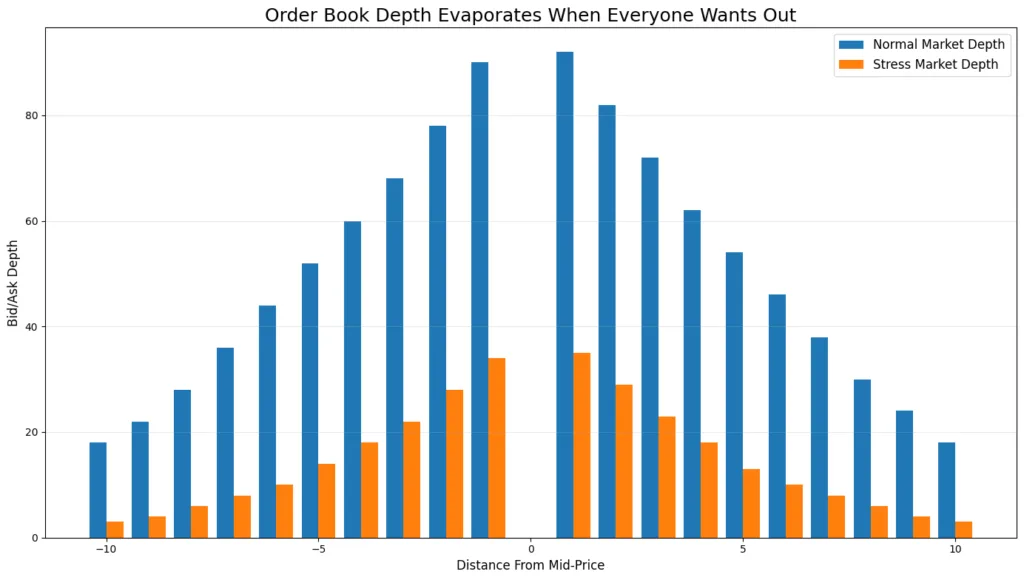
The process of selling creates more selling because market conditions require it to happen without any new information. The process begins when traders hit their stop points and exceed their margin limits which leads to obligatory market selling. The market enters into its next phase after this point. The existing liquidity which traders recognized as deep during compression now experiences major reduction.
The order book system cannot handle the excessive volume of transactions. The market experiences higher slippage while the trading spread becomes wider and price changes occur more quickly than traders are able to respond. The market reaches its final phase when all mandatory sellers have stopped their selling activities. The market has not reached its lowest point yet because sellers who have the least influence have stopped selling which lets prices remain steady.
Derivatives & positioning
The current cryptocurrency market operates through derivative instruments instead of direct spot trading. The combination of perpetual futures together with leverage and funding rates creates a system which transforms market corrections into cascading price declines.
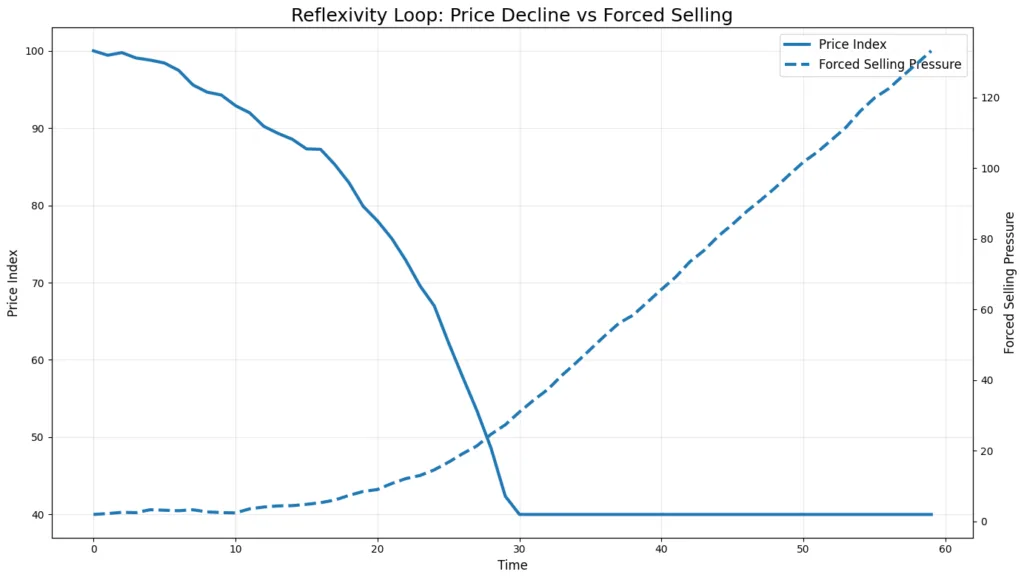
The system requires traders to use leverage because their current positions determine price movements instead of market supply and demand. Market participants who use high leverage will experience major financial losses because their positions will automatically close when market prices change even slightly.
A market movement between 3 and 5 percent will force liquidation of billions worth of notional assets which results in increased selling activities that drive down market prices. This demonstrates reflexivity through its practical demonstration. Price changes lead to new positioning which, in turn, results in price changes. The system establishes a cycle which strengthens itself over time.
Funding rates provide a window into this dynamic. The funding rate shows persistent positive values during late-stage bull markets because traders maintain long positions which have reached overwhelming levels. The situation shows weakness because it lacks strength. The funding rate, which becomes negative when the market unwinds, leads to a total collapse of open interest while liquidation events take control of market activity.
The “Great Exit Problem” is most visible here. The situation forces all participants to exit the market when everybody adopts the same position. Market participants who must exit their positions will not wait for buyers to arrive.
On-chain & liquidity reality
On-chain data presents an alternate narrative which conflicts with price movements. Large holders start to sell their holdings at distribution phases while their true selling activities remain concealed within constant market price intervals. The market experiences rising exchange inflows which subsequently delay any price changes. The situation creates an appearance of market strength. The cryptocurrency market operates with divided liquidity.
The market distribution exists between centralized exchanges and decentralized trading venues and multiple trading pairs. What appears as deep liquidity is actually the combination of multiple shallow liquidity sources. The system experiences its most serious problems when market pressure testing occurs. Stablecoin liquidity functions as a second vital element.
The system depends on stablecoin liquidity because it serves as the main purchasing power source. The system loses its ability to handle sales when stablecoin supply experiences either a halt or a decrease. The hidden constraint limits various drawdowns in financial markets. The core understanding shows that liquidity requires both volume and system strength to be operational. People experience their highest confidence level when they have the least ability to endure difficulties.
Macro alignment
The presence of cryptocurrency depends on its connections to global financial markets. The market performance of cryptocurrencies depends on the existing conditions of global financial liquidities. When central banks implement tighter monetary policies, market assets undergo a process of revaluation. The market for cryptocurrencies experiences price changes because the marginal buyer now evaluates different asset classes.
The dollar strength together with interest rate predictions and worldwide risk perception creates a single equation which determines who possesses both buying ability and buying intent. The answer to this question becomes more difficult to determine during this phase. Market participants shift their capital to less risky assets while companies reduce their use of borrowed funds and investors stop making high-risk investments.
The number of investors who enter the market during price declines becomes lower which leads to more difficulties in exiting investments. The process of liquidity expansion during monetary easing periods leads to increased purchasing by marginal buyers. The liquidity patterns of the macroeconomic system create the same cycle of cryptocurrency market patterns. The exit problem exists as a macroeconomic issue that extends beyond the boundaries of cryptocurrency.
Investor psychology
Markets function as both mechanical systems and psychological systems. Market participants experience a sudden shift when they move from their state of greed to their state of fear. Market participants in bull markets establish their price expectations based on previous price highs.
Market participants treat dips as buying opportunities while their confidence in the market remains intact. The process of buying creates a continuous cycle that keeps generating more purchases. The initial story about upcoming events results in all investors becoming sellers. People experience a psychological transformation because they fear losing what they have. Investors give priority to capital protection instead of seeking investment returns.
The exit problem becomes understandable at this particular point in human experience. All market participants wish to sell their assets, but only some of them can achieve that goal at identical prices. The final seller in the market establishes the price which all other sellers must accept. Panic occurs as a result of residential structural factors which control the entire process. The situation arises from a system that restricts liquidity access while creating crowded market conditions.
Forward-looking outlook
The “Great Exit Problem” exists as a continuous occurrence which happens in all speculative markets. The problem exists at all times but its severity changes according to different circumstances. The structure of exits will change because crypto is becoming more institutionalized. The combination of ETFs and market makers with advanced liquidity providers creates market conditions which reduce price fluctuations.
The process of reflexivity remains present in markets because essential market components become divided into various market segments. The key variable remains leverage. The markets will keep functioning until they reach a point which enables traders to use extreme leverage while making focused trades.
The system will always be vulnerable to sudden shifts in sentiment. Participants must understand that they need to manage their risks because it serves as their only method to protect themselves. The only viable protection against a system that experiences rapid transformation from stable conditions to chaotic environments requires this defense mechanism.