




The invisible sell wall
Your main danger stems from two supply chain issues which remain concealed from your view. Your visual perception of candles and your belief in narratives do not represent the complete reality.
The market has not launched these tokens yet because they need to complete their launch process. In the crypto market prices only decrease when all available supply becomes accessible to the market.
The illusion of scarcity
Markets evaluate what they can see through the existing available supply.However, cryptocurrencies function based on concealed supply distribution schedules.Each token exists within two simultaneous states.The first state represents the visible float which consists of all active market assets that determine current market prices. The second state represents future float which consists of all restricted assets that will be released into the market according to their predetermined schedule. Most pricing errors develop because people fail to understand the two different market realities that exist.

Projects present their limited resources to the public through aggressive marketing while they display their current asset base and advanced technical capabilities. The story creates a hidden truth which shows how dilution will occur according to a predetermined schedule.
The structure creates an opposing force because a token displays technical strength while its fundamental value faces pressure from upcoming supply. Scarcity exists within the present moment as a temporary condition of existence. Scarcity exists as a temporary stage of existence.
Vesting schedules the silent market makers
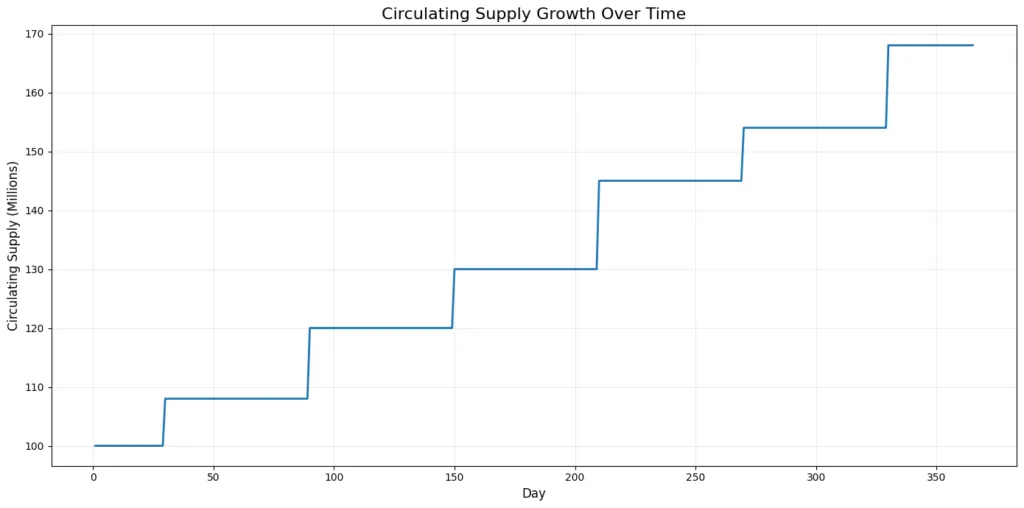
Vesting is often framed as alignment. In practice, it functions as a system that controls token release into the market. The unlock events create new marketable tokens which also bring forth a different category of market participants. The market participants do not respond to price changes. The market participants follow a specific operational plan. The market participants intend to sell their assets because they have a much higher purchasing price.
The process of vesting creates a definite pattern that produces selling pressure. The market does not wait for the unlock to react. The market starts to evaluate the event before its scheduled time. The market sees asset compression because participants try to forecast upcoming supply changes which leads them to change their investment strategies. The market operates through vesting schedules which function as unseen market makers that maintain price equilibrium by adding new supply to the market.
IVC vs Retail the structural asymmetry
The distribution of tokens in cryptocurrency markets results in a permanent structural imbalance. The initial investors, which include venture capital firms, team members, and strategic partners, acquire their stakes at much lower company valuations. The company manages their investment risk through portfolio-based controls, while their token sale exit plan gets established before the token launch in public markets. Retail participants operate in a completely different framework. They respond to narratives, momentum, and visible price action.
Their entries occur at a later time, and their decisions operate as responses to situations instead of planned actions. Retail demand creates a situation which allows early investors to access the necessary funds for their investment exits. The two groups meet at unlock events to conduct their business.
The first group enters based on their strong beliefs, while the second group leaves because of established system requirements. The market fails to provide equitable conditions for all participants. The market operates on a schedule which determines trading activities.
Emissions vs Demand the core mismatch
The central principle of tokenomics begins with an essential imbalance between two opposing forces: continuous supply expansion and limited demand which appears at specific times.Projects produce tokens through various methods which include vesting schedules and staking rewards and ecosystem incentives. The emissions proceed through either linear paths or pre-established paths which lead to ongoing increases in their available supply.
Demand exists as a highly unstable force. The forces which drive it forward include market narratives and liquidity cycles and macroeconomic situations and speculation activity. The process begins with fast growth during hype periods and ends with rapid contraction when public interest fades. The market experiences a delay before it begins to decline because emissions exceed natural market demand. The market enters a phase where it produces results which consistently fall below expectations.
Price movements encounter difficulties to maintain upward drive while market breakouts experience complete failure and market uptrends are met with selling pressure from investors. People use the term volatility to describe a situation which actualizes as a fundamental system distortion.
Real market behavior why price feels “Heavy”
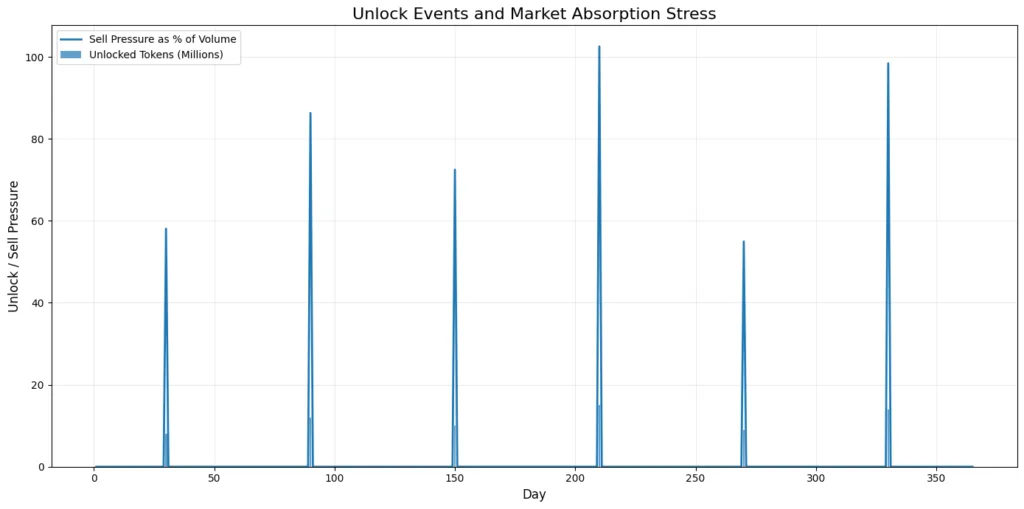
The price development in unlock-driven environments creates a unique market pattern. The market shows strong asset movements when they reach important price points but the upward trends ultimately stop. The initial strength of rallies disappears when their energy starts to fade. The system undergoes repeated tests of resistance points which leads to structural damage because each test weakens its integrity.
The market misinterprets this phenomenon as weak demand together with poor fundamental performance. The market shows an increase in concealed supply which enters the trading system. The concept of heavy price action does not represent a psychological state. The concept operates through a mechanical system. The system activates when selling activity driven by unlocks and emissions reaches or outpaces buying activity. The market process accepts higher prices while it continues to take in available supply.
The liquidity absorption phase
Markets enter a phase of compression which precedes their major unlock events. Market participants experience reduced volatility while price movements become restricted to small price ranges. The phase which follows this phase shows accumulation characteristics although it serves as a preparation period. The liquidity providers together with informed market participants start their positioning activities before the unlock process begins.
The objective requires market liquidity to handle incoming supply without creating any price disturbances. The system constructs a controlled setting which enables effective distribution processes. The market shows a peaceful appearance because it secretly undergoes a process that prepares for upcoming supply changes. The unlock itself is not the event. The preparation for it is.
Advanced layer modeling the unlock shock
The process of understanding unlocks needs to change because it requires supply-based analysis instead of price-based evaluation. An unlock event can be conceptualized as a supply shock. The size of the unlock in relation to circulating supply and market liquidity capacity and token ownership distribution all determine the impact of the event.
Price displacement occurs when the market cannot handle the volume of newly unlocked tokens which exceeds its capacity. The displacement process takes time to develop because it happens during failed rallies and ongoing declines. The market will maintain price stability through a range when it can handle new supply but unlocking will only create a price ceiling.
Continuous unlocks lead to a market phase which experiences constant downward movement because of ongoing selling while showing little potential for price gains. The main discovery shows that markets treat unlock events as separate occurrences. The way they answer to supply expectations shapes their behavior before the actual event takes place.
The psychology of unlock cycles
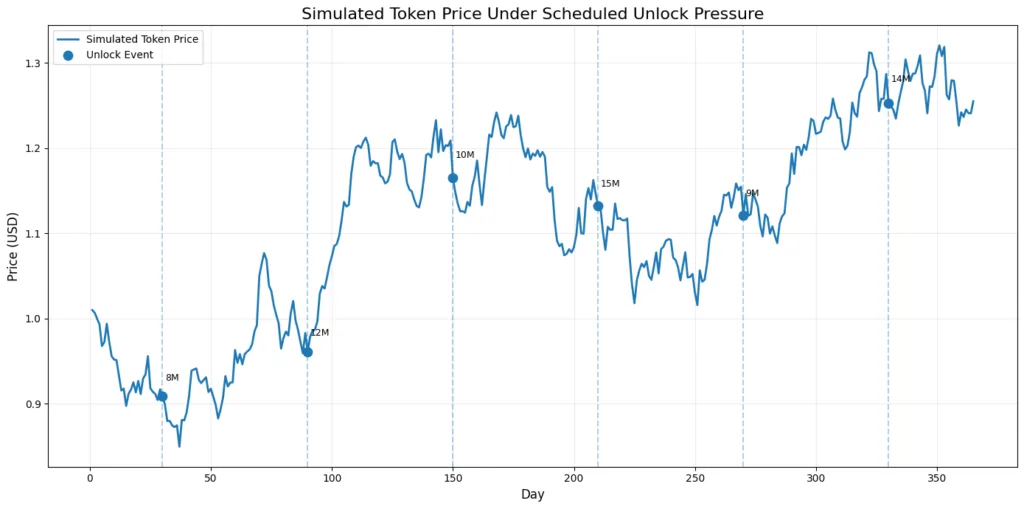
The markets which operate through unlock mechanisms establish a predictable sequence of emotional changes. The participants begin with optimistic expectations which two factors drive their beliefs and the initial price movement. The asset experiences its initial price increase but then drives people into confusion. The price does not change while the narrative continues to exist.
The failure to achieve performance targets causes people to lose patience until they finally stop trying. Investors start to doubt the core business elements and the executive team and the general market conditions. People tend to miss the fact that this cycle operates through mechanisms which extend beyond emotional responses. The system establishes persistent downward pressure on prices through its ongoing supply distribution patterns. The market appears weak because excessive supply exceeds existing demand, not because people lost their trust.
The new framework trading supply, not price
Traditional analysis methods need tokenomic factors because they serve as essential components for evaluation in contemporary cryptocurrency markets. The market exhibits three types of information which include price movements together with technical indicators and market stories. The missing layer is supply.
A more effective framework begins with understanding who holds the tokens, when they will be unlocked, and how those holders are likely to behave. The process determines whether the market possesses adequate demand and liquidity to handle the upcoming supply. The method changes market focus from price reaction to upcoming market structural developments. Tokenomics exists as an essential element in this specific situation. Market activity depends primarily on this factor.
Outlook the era of programmed pressure
The current industry development process has created longer and more frequent unlock cycles. The distribution of tokens has become more complicated at the same time that organizations handle larger financial resources. The market system now operates through its predetermined supply distribution schedule which controls all market movements.
The price of an asset depends on three factors, which include time and market access and trader distribution, instead of relying on market sentiment and technological advancements. The next generation of market participants will not rely solely on technical indicators or narratives. The market must be studied to determine when supply distribution begins and which forces control market behavior during these periods. The current trading environment requires traders to understand that their most critical trades will come from future developments instead of present market conditions.