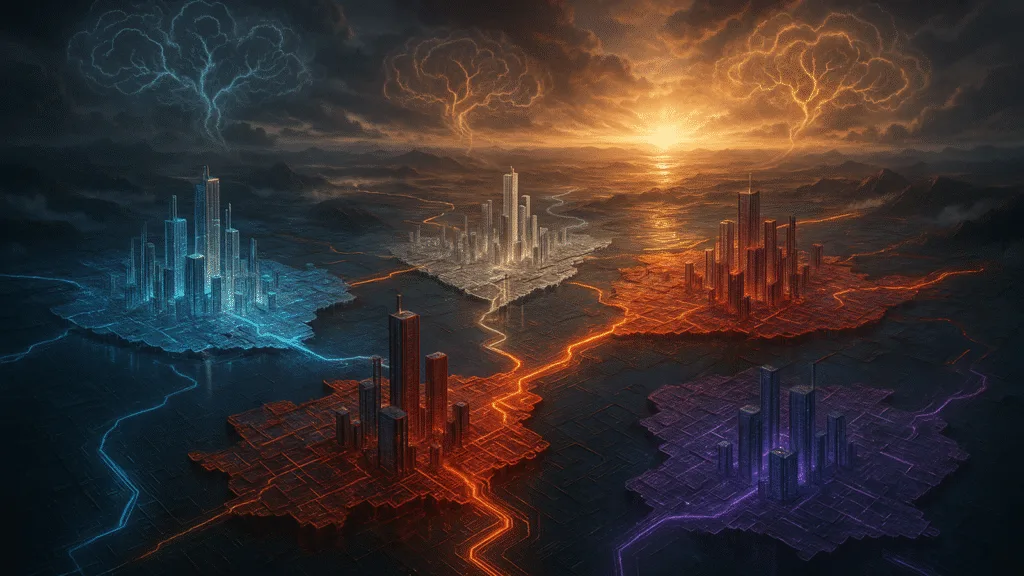



From empires to ecosystems: The emergence of modular sovereignty
The narrative of human civilization is characterized by the conflict between empires and their territories. That identical story is emerging in crypto. Ethereum, formerly the dominant empire controlling all within its vast confines, is now transforming into a federal constitution an unbiased framework of governance and resolution. Surrounding it, a network of Layer-2s has developed as autonomous entities, all vying for residents, investment, and cultural uniqueness.
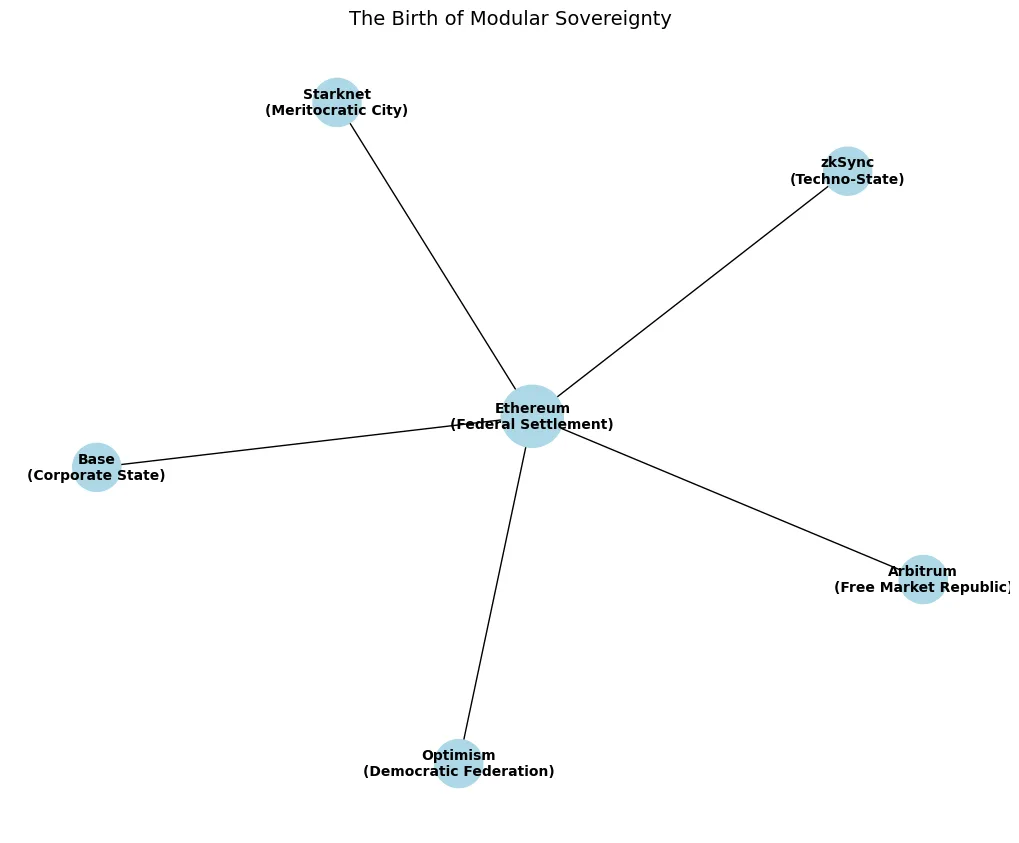
These L2s are not just tools for scaling. They are autonomous entities with self-sufficient economies, financial strategies, and belief systems. Optimism claims to be a democratic federation, Base serves as an economic center supported by Coinbase’s diplomacy, and zkSync operates as a technocratic city-state governed by zero-knowledge principles. United, they form a novel political framework: modular sovereignty.
This shift reflects the Enlightenment era when trade unions and republics supplanted monarchies. Ethereum continues to be the realm that ensures safety and regulation yet the control has moved beyond. In the modular age, sovereignty is no longer enforced from above; it is collectively formed from all sides.

Economic autonomy and fiscal power: The rise of layer-2 treasuries
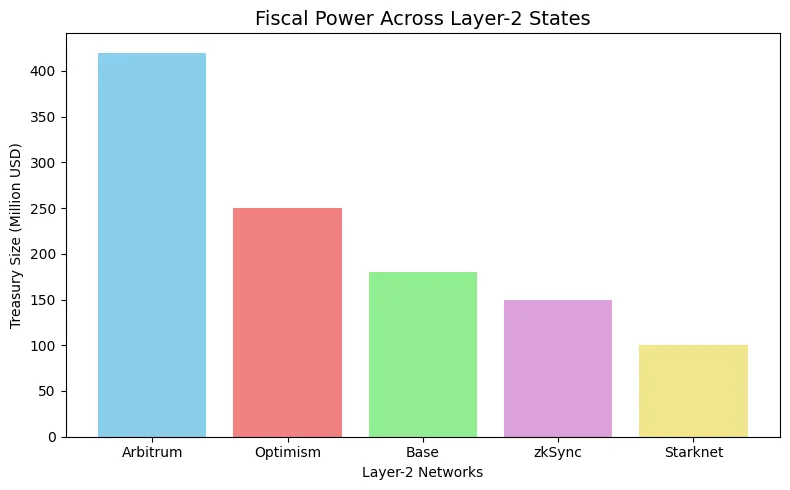
Each new country needs a treasury. In the modular ecosystem, fees from sequencers, MEV extraction, and token distributions have turned into the essence of economic independence. The financial autonomy of every Layer-2 now influences its capacity to support development, provide user subsidies, and vie for liquidity, similar to how states depend on tax income to pursue their goals.
Arbitrum’s DAO manages one of the largest treasuries in cryptocurrency history, surpassing hundreds of millions in ARB tokens. Optimism reallocates sequencer earnings to public goods via its “RetroPGF,” akin to a social-democratic budget. Base returns its profits to Coinbase, marking the initial instance of a corporatized city-state. These differing models show that fiscal design has turned into a reflection of ideology.
The higher the fees an L2 keeps, the more independent it becomes from Ethereum’s influence. As Ethereum gathers its “federal tax” via gas fees, L2s are progressively accumulating local incomes, creating self-sustaining economies. What started as enhancing infrastructure has evolved into an experiment in digital macroeconomics, where treasury policy determines survival, partnerships, and the next stage of rivalry.
Citizens, migration, and diplomacy in the layered world
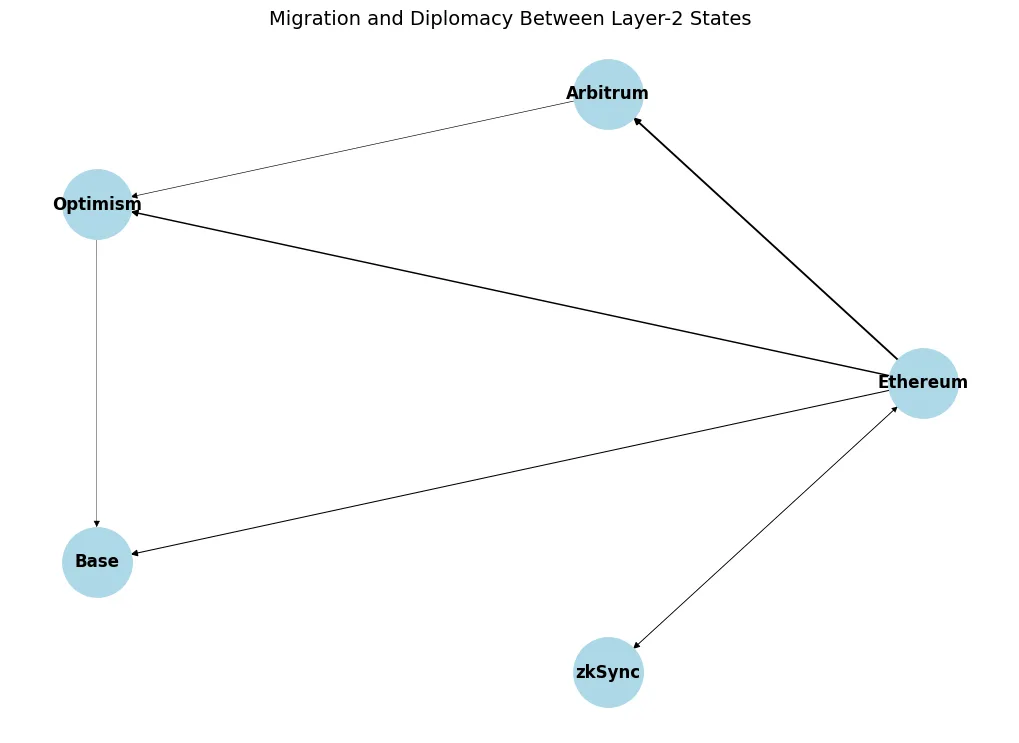
In conventional geopolitics, power shifts to areas where individuals and investments move. The identical dynamic now characterizes the modular blockchain environment. Layer-2 is not just competing for developers anymore, it is vying for “citizens,” users whose liquidity, identity, and loyalty determine network sustainability. The indicators of this new diplomacy are not demographic surveys but financial transactions, overall locked value, and inter-chain connections.
Liquidity incentives have taken the place of visas, while airdrops now serve as stimulus checks for online residents. When Arbitrum introduced its ARB token, millions moved instantly, resembling a population surge triggered by financial policy. Optimism’s governance grants function similarly to social welfare programs, aimed at keeping productive residents instead of speculative visitors. Bridges now serve as diplomatic pathways and safe trade routes connecting independent economies.
This developing diplomacy has ignited coalitions: Optimism’s Superchain seeks to unify L2s under common regulations, while zkSync’s ZK Stack promotes independent entities to work together via shared proofs. Every network finds a balance between openness and security, innovation and control the perpetual challenge for nations. Inhabitants of this tiered realm carry passports in their wallets, and the agreements they make are transactions.
The modular future: Fragmentation, federation, or empire reborn?
Every empire ultimately encounters its constitutional dilemma. Ethereum’s modular structure is not different. As Layer-2s progress from devoted regions into independent states, the question arises: will they come together under common governance or split into rival sovereignties? The solution depends on how modular incentives interact or conflict.
The Optimism Superchain presents a federation concept: a network of compatible rollups bound by a shared legal and economic structure. In contrast, zkSync and Starknet advocate for autonomy via zero-knowledge proof systems, where validation supersedes trust, embodying a technological assertion of sovereignty. Base, on the other hand, connects with Coinbase’s framework, representing the emergence of corporate nations where constitutions are defined by terms of service rather than by community votes.
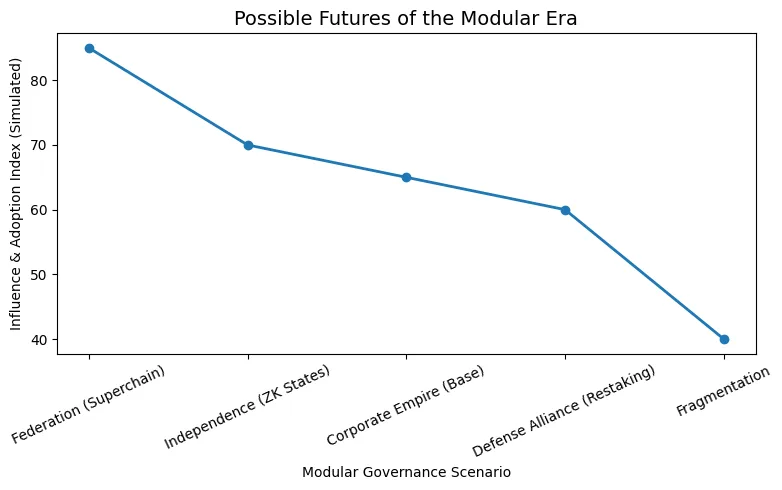
Restaking protocols, such as EigenLayer, create a fresh dimension of geopolitics for the defense coalitions of the modular age. They enable L2s to utilize Ethereum’s security while preserving their financial independence, merging the distinction between reliance and resistance. The outcome of this situation, whether it results in collaboration or a cold war, will shape the future era of blockchain society.
Ultimately, the Modular Wars are not solely focused on expansion; they concern dominance as well. Every L2 is creating its own nation, economy, and identity. Similar to the empires of the past, their future will rely not on who advances more rapidly, but on who rules more effectively.