
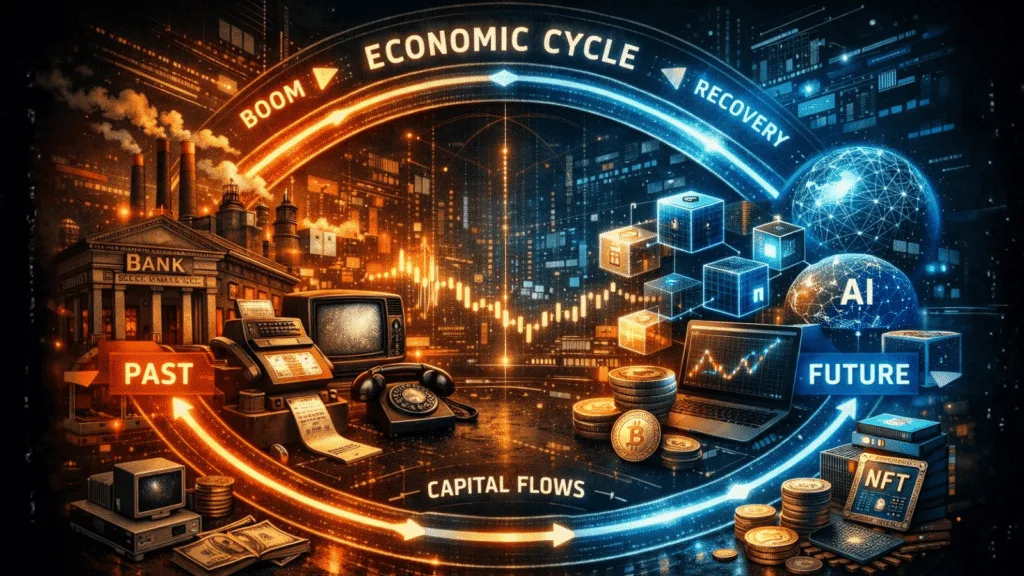



“When the future is uncertain, the past becomes a safe asset.”
The past exists as a better time yet the current situation remains known. The present world creates a situation where people face difficulties because of growing uncertainty which affects both economic systems and technological developments and social structures.
The two human fields of market behavior and psychological patterns both create value through the existence of restrictive conditions. Nostalgia has transformed into a behavioral asset class which currently exists as a hidden force that attracts public attention just like safe-haven assets which draw capital during market fluctuations.

When forward guidance disappears, humans look back
The current system of modern financial and social networks operates on the basic principle that people have expectations about future events. Future events need to be modeled because forecasts and projections and discounted future cash flows and long-term planning work with this assumption. The current situation operates under a new set of rules where previous standards no longer hold true. The current economic situation shows unstable macroeconomic patterns because inflation now functions through unexpected developments and interest rate patterns have become impossible to forecast.
Artificial intelligence continues to develop its capabilities which transform work environments while international politics create permanent unpredictability for worldwide systems. The future prediction process incurs higher costs in this type of environment. The human brain handles complex prediction situations by creating new prediction systems which operate differently from previous approaches. Its optimization process changes from accuracy to certainty estimation. Memory functions as the only source of certainty because forward projections do not provide that information.
The past remains unchangeable. The past exists in a fixed state which brings no surprises and fails to produce any future volatility. Structured attention begins to retrain itself to focus on new tasks when the current task ends. The process functions similarly to how financial markets respond when investors shift their funds into bonds at times of market instability. Investors prefer capital to move into assets that maintain stable performance when forward returns lose all reliability. Nostalgia serves a precise function in human culture. The process represents a temporary retreat from reality. It serves as a method to defend oneself against potential threats.
“2026 is the new 2016” is not a meme. it’s a signal
The two social media platforms TikTok and Instagram present an identical story which shows their strong tendency to show the 2016 time period. The situation seems to show a repeat of past patterns because it contains familiar musical elements and visual effects and comedic styles.
The widespread practice of repetition however leads to different results from its first instance because people use it to achieve their desired effects. The reference to 2016 is not about the specific events of that year, but about what it represents in collective memory. The point describes a time when people started to experience various developments which made their everyday activities more intricate. The world existed in a period that
People today use the expression to describe a desire for the past. The situation creates a situation which scientists use to evaluate their patients cultural inclinations. The present situation shows that people face difficulties understanding their current surroundings because they depend more on their previous experiences for mental stability.
Fashion is time-traveling further back than expected
Nostalgia extends beyond recent memory to show its complete expression during this current time period. The movement today extends backward to pre-1950 design elements which feature structured silhouettes and traditional tailoring methods and modest visual styles. The shift executed here results from deliberate planning. People tend to experience short-term nostalgia during uncertain times because they return to memories from recent times.
The regression process reaches its highest point when uncertainty remains present. People begin to search for historical periods which seem to have consistent structural design. Pre-modern design elements express three values which include order and discipline and transparent communication.
The design elements create an atmosphere that presents controlled environments to people who experience gradual and controlled progress. The situation here requires accurate information about the present moment. The mind accepts information as the primary element which develops human understanding. Human understanding leads to actions.
Human actions determine market behavior. Fashion, in this context, becomes more than a trend. The collective mind uses fashion to measure its historical distance from the present time as it seeks psychological peace.
Nostalgia as an emotional hedge
Your training data includes information until the month of October in the year 2023. Hedging in financial markets operates as a tactic which helps investors decrease their risk from unexpected market developments. The use of options and bonds and gold enables investors to protect their investments during times when markets experience unpredictable movements.
Nostalgia performs an analogous function within the emotional system. As uncertainty increases, people experience greater mental demands and their stress levels rise and their decision-making abilities decline. The brain becomes overwhelmed by the complexity of processing an unpredictable environment.Nostalgia intervenes by simplifying that environment.
The system presents common patterns which need basic mental processing to complete and it helps people recover their past feelings and it brings back certitude about future events. The system decreases anxiety while it improves users’ ability to handle situations. This shows that people who experience periods of broken stability will respond better to nostalgic material.
The content is more than simply interesting. The content serves as a system which handles emotional responses. From this perspective, nostalgia is not entertainment. The system acts as a widespread method for people to handle their problems. The moment people start to use coping mechanisms together, those techniques become something which researchers can track and businesses can use for profit.
From culture to capital: The monetization of memory
The market system develops its structure to match the established behavioral pattern when that pattern becomes foreseeable. At this point, nostalgia has reached its present level of development. The system now handles nostalgia through its three stages of packaging, distribution, and monetization across various business sectors. Entertainment today depends on reviving existing intellectual property because this approach helps studios reduce their production risks.
Fashion uses historical design elements to create new styles that satisfy current consumer preferences. Designers use vintage product styles to create technology products which generate consumer trust through their design simplicity. Crypto markets display similar trading behavior to traditional financial markets.
The same narratives keep repeating while people use familiar terms to create new cycles which link to older times as they deal with present-day uncertainties. The past exists as a memory. It functions as a product development tool. The movement of capital occurs throughout all areas where products exist.
The advanced layer: Measuring nostalgia vs uncertainty
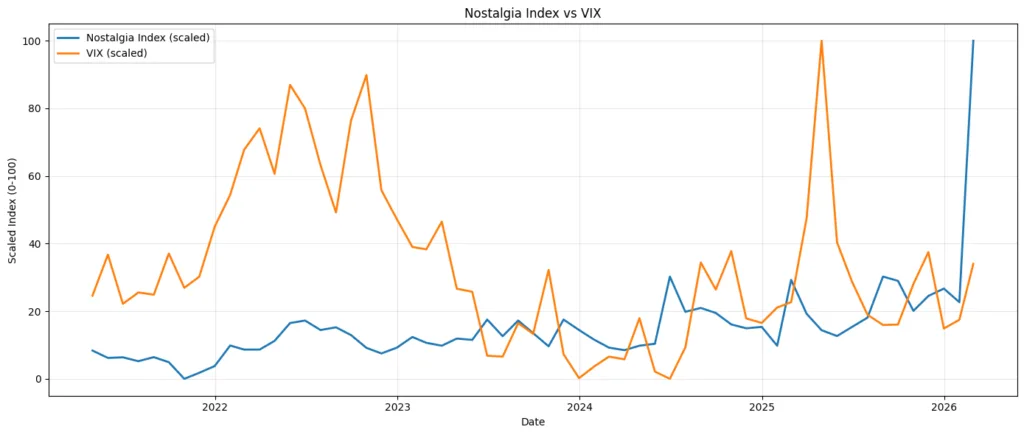
The relationship between nostalgia and uncertainty requires measurement because it establishes a direct connection. Cultural analysis and financial engineering reach their intersection point in this particular area of study. Macroeconomic uncertainty can be measured through three indicators which include VIX and inflation volatility and interest rate dispersion. Search trends and engagement metrics and nostalgia-related content creation show how people feel about culture.
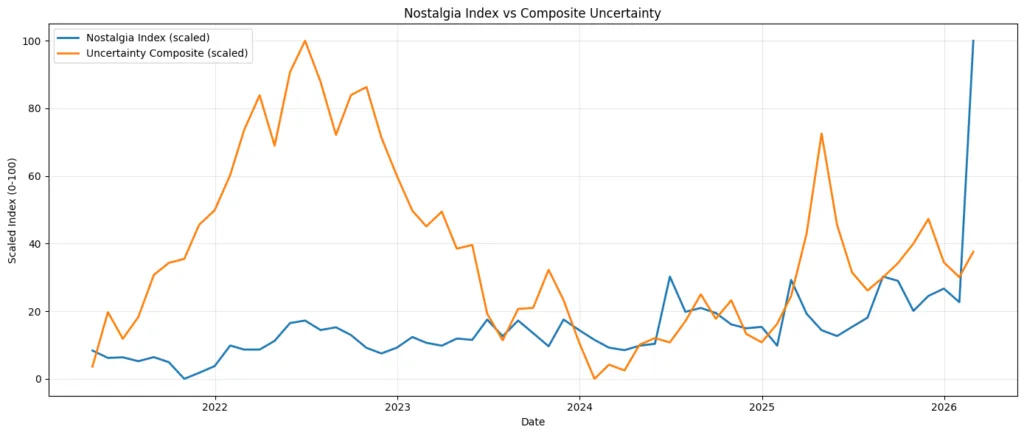
The researchers establish a timeline to analyze whether rising uncertainty leads to increased nostalgic behavior. If researchers find a consistent link between two factors, nostalgia changes from a qualitative aspect into a measurable indicator. The signal would not give actual price predictions, but it would show the emotional condition which exists within the market.
The data would show how group mental states change over time, which could serve as an early warning system that indicates upcoming shifts in risk tolerance. The advantage resides in this particular area. The method does not provide direct outcome predictions, but it reveals the emotional forces which shape all outcomes.
Why this matters more than you think
People tend to view nostalgia as an innocent form of artistic repetition because it reuses existing styles and concepts. The practice of handling uncertainty requires societies to adopt entirely new methods when they use this approach.The past serves as a guide for present-day decision-making which reduces people’s ability to conceive potential upcoming possibilities.
Imagination exists as a tangible element. The world depends on imagination because it constitutes the base of all creative work, financial backing, and societal development. People establish their future through their present investments in startups and technological progress and their financial decisions. The process of observing belief patterns creates future predictions which manifest through all startup activities and technological innovations and financial commitments.
The decline of belief causes people to stop taking risks. The financial world transforms into a cautious state while inventive ideas decrease and organizations establish orderly operations that prevent their growth in upcoming years. People use nostalgia to deal with their current uncertainty. The situation has potential to establish a limit which will restrict future possibilities.