




The high-rate interlude
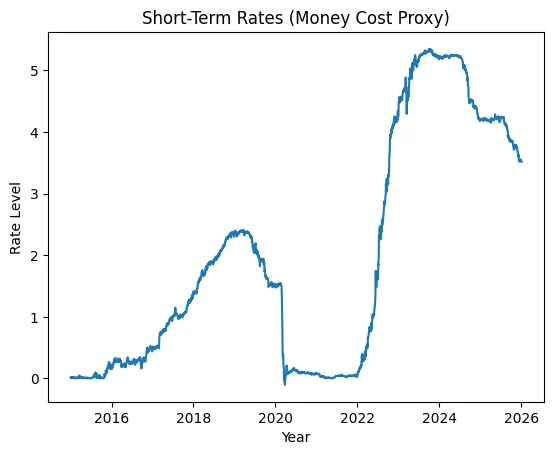
Over the last four years, crypto was forced to adapt to an environment that it was never meant to co-exist with. The cost of capital was high, cash was giving returns merely for the time being, and taking risk was a constant justification. Markets operated from 2022 to 2025 under the strict military rule of high-interest rates, bled-on asset tightening, and a global monetary policy that curtailed duration, optionality, and speculative excess. Crypto was not completely wiped out through that process, but it was definitely put on a halt. Prices did not reach their targets, the stories lost their charm, and many confused the self-restraint with loss of strength.Well, that’s not the perspective to take. Crypto was not in a bad state when it was underperforming. In fact, it was in a good position, just like everybody else, because of the expensive money.
The situation is different now as we are preparing to welcome 2026. The tight regime, under which we have been living, is being loosened. Interest rates are moving down, constraints on liquidity are being lifted, and the world financial system is discreetly going back to the scenario of cheap money, which is definitely a positive one. The transition is more significant than any other single factor or news event that could possibly take place. It will change the whole picture of capital and its conduct, what institutions will consider as valuable, and which assets will come to the market again.
What cheap money really changes
A world of cheap money is not simply one with lower borrowing costs. It is a world in which cash loses its appeal, bonds struggle to compensate for inflation, and capital is forced back out the curve in search of growth, convexity, and asymmetry. When money is cheap, optionality regains value. Assets that can surprise to the upside matter again.The high-rate era was historically unusual. Cash became an asset class. Short-term Treasuries offered real yield. Risk assets had to compete with certainty.

Crypto, which offers neither guaranteed income nor short-term stability, was structurally disadvantaged. Its value proposition relies on duration, network effects, and long-term adoption characteristics that are discounted aggressively when the opportunity cost of holding cash is high.As rates compress, that calculus flips. The question investors begin to ask is no longer where capital is safest, but where it still has room to grow.
Bitcoin’s role in a low-rate world
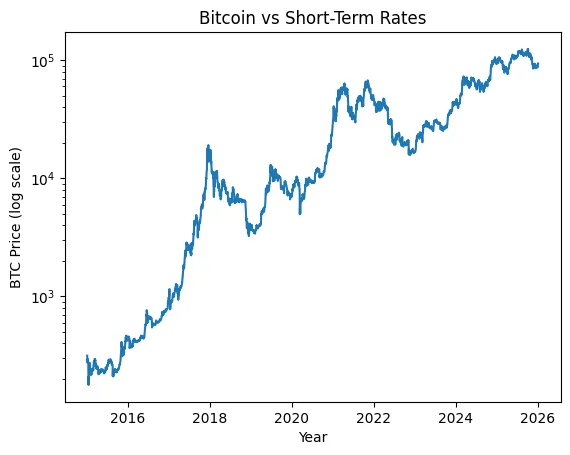
The most noticeable shift in Bitcoin’s behavior occurs during this transition. Under high-interest conditions, Bitcoin trades just like a risk asset, being affected by the dollar’s strength, funding situation, and general economic disruptions. However, the low-rate scenario which is characterized by continuous government deficits and negative real interest rates brings about a different Bitcoin behavior. Governments choose to refinance their debts rather than pay them off, and the rise of debt is quicker than that of productivity. The loss of the monetary trust is gradual and not catastrophic.
Under such circumstances Bitcoin is no longer fighting with tech stocks but rather with government guarantees. It turns into a non-sovereign duration hedge but not because it brings extra cash flow but because it is immune to the inflation process.This explains the resilience of institutional demand for Bitcoin even in times of price stagnation. As liquidity conditions get better, that demand does not need new stories to come back, it just require cheaper money to stop working somewhere else.
Stablecoins after yield compression
The return of cheap money to consumers is also changing the stablecoin spot. The high rates enabled the issuers to take enormous value by collecting interest on their reserves while at the same time not paying anything to users. That model was really good in a front-end rates hiked world. But with yields getting compressed, the economic situation changes and the carry gets smaller.
Moreover, the users become more conscious of their opportunity cost. Besides, the distribution partners are asking for a bigger chunk of the value chain. Stablecoins start their progress towards being financial infrastructure rather than trading utilities. Payment tokens, yield-bearing wrappers, and dollars based on institutions start to compete for the same settlement. The banks, fintech companies, and even governments are realizing that it is more important to control the distribution of dollar than to control deposits in a low-rate world. Thus, stablecoins are no longer considered as a side effect of crypto adoption, but they are recognized as one of the primary global liquidity transmission mechanisms.
When fundamentals finally matter
Cheap money perhaps leads to several significant changes, the most prominent being the application layer. Crypto applications when the rates were high produced real revenues but could not value themselves. The unclear regulations stopped distributions, buybacks, and yield. Tokens were influenced by stories rather than by their very fundamentals since the latter could not be legally expressed.
As the rates drop and the regulatory clarity increases, duration gets rewarded again. Cash flows become very important. Growth assets that have real users, real fees, and real moats start to get their prices adjusted upwards. Crypto applications are already looking like early-stage fintech companies instead of being just governance experiments.
This whole situation does not lead to a tumultuous altcoin season but rather a selective repricing of assets that is based on their revenues, customer retention, and capital discipline. The disparity between economic activities and market valuations begins to narrow.
Why the next bull market will feel different
The forthcoming bull market will differ starkly from the previous one. The passive investment flowing into major benchmarks is a factor that stabilizes the top of the market and at the same time decreases its volatility. Institutional investors allocate their resources to Bitcoin and Ethereum, but through structured vehicles that are price-insensitive and long-term-oriented, meaning they do not care about the price of the asset until maturity. Meanwhile, the value is being created at an uneven pace in different sectors. The digital platforms with the right kind of economic model not only survive but even thrive, while others remain stagnant.
Low-interest loans do not create an even playing field, they only shift the focus of discrimination. The times of “everything goes up” are over. A market where there’s plenty of liquidity but still the need for discretion is the one that takes its place.
The risk of misreading cheap money
It is easy to fall into the trap of considering declining rates as a signal for extravagance. Such an error has closed down market cycles in the past. Low-interest loans do not ensure money to be spent without care. It is a patience, not a quickness that gets the reward. Liquidity increases over time, not in a sudden way.
Those who take easing as a sign of euphoria might get the wrong idea about the situation. The worst scenario is not the one in which cheap money causes all the cryptos to get inflated at the same rate. The worst scenario is reapplying the old thinking patterns to a fundamentally different situation.
Crypto was built for this world
Crypto did not fail the high-rate experiment. Rather, it was an experiment from which crypto came out victoriously. What follows next, however, is not a past event but rather a new valuation of the surviving ones.As the cost of money decreases, the assets which are based on scarcity, optionality, and connections, then they are the ones who will regain their importance. Crypto was meant for such a world. It just had to be patient before it could get back to the world of its own.