



The illusion of safety
The most dangerous leverage is the one you cannot see.Modern markets operate under a system which they call deleveraging but which actually functions as a process of moving debt into financial instruments that financial experts cannot track and which companies do not disclose and which will reveal their actual risk only during times of market turmoil.
The current financial system exhibits stable operations through its orderly functioning and sufficient capital reserves yet it consists of a tightly controlled network which depends on synthetic financial instruments and collateral assets and future financial commitments. The silent leverage cycle operates in silence.
The system does not make itself known through increasing margin debt or through visible increases in borrowing. The system develops through its gradual process of expansion which occurs within derivatives contracts and repo networks and tokenized collateral systems and off-balance-sheet financial instruments.

The system operates effectively during periods of low market volatility because market stability serves as the basis for companies to expand their financial exposure. The system stays hidden until market conditions change which leads to a system shift from secure operation to required system synchronization. The market does not become fragile when leverage is high. The market reaches a point of fragility when people use hidden leverage.
The evolution of leverage from visible to synthetic
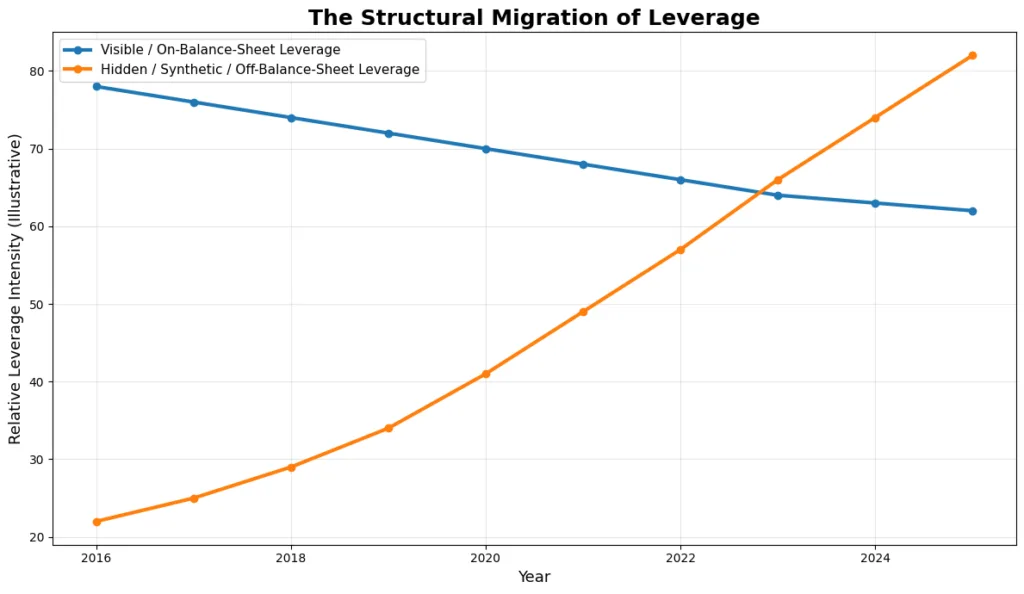
The past shows that leverage used to be a simple concept. The method involved increasing balance-sheet assets through debt financing. Banks used borrowed funds while institutions applied leverage which allowed partial risk assessment through their capital ratios and loan exposure. The existing system has moved away from this particular model.
The current financial system uses synthetic leverage for its operations. The system uses derivatives and swaps and structured trades and financing methods which create economic exposure without increasing their standard balance sheet assets. A hedge fund does not need to borrow explicitly to achieve leverage. The company uses futures and options and total return swaps and basis trades which they finance through repo markets to establish their leverage position. The result leads to a major system change.
Accounting records now show different exposure levels to danger than actual exposure. The situation creates difficulties for evaluation. The conventional measurement methods only show what has been documented. The construction process produces synthetic leverage which can be found in developed systems. Systemic risk builds up in the space that exists between the two. The system appears more organized because it no longer considers leverage as a component of its system.
The non-bank amplification layer
The past shows that leverage used to be a simple concept. The method involved increasing balance-sheet assets through debt financing. Banks used borrowed funds while institutions applied leverage which allowed partial risk assessment through their capital ratios and loan exposure.
The existing system has moved away from this particular model. The current financial system uses synthetic leverage for its operations. The system uses derivatives and swaps and structured trades and financing methods which create economic exposure without increasing their standard balance sheet assets. A hedge fund does not need to borrow explicitly to achieve leverage.
The company uses futures and options and total return swaps and basis trades which they finance through repo markets to establish their leverage position. The result leads to a major system change. Accounting records now show different exposure levels to danger than actual exposure.
The situation creates difficulties for evaluation. The conventional measurement methods only show what has been documented. The construction process produces synthetic leverage which can be found in developed systems. Systemic risk builds up in the space that exists between the two. The system appears more organized because it no longer considers leverage as a component of its system.
DeFi and the compression of financial risk
Decentralized finance developed as a transparent financial system which provides a better alternative to the secretive nature of conventional banking. The system intended to enhance leverage visibility through its on-chain data and open ledgers and its programmable contracts.
DeFi has transformed financial systems through its ability to create faster interconnected networks which deliver less complex operations. The DeFi system creates continuous leverage for its users because all its assets remain in circulation. Users in the system maintain control over their assets through multiple platforms because they can use their collateral for different purposes. Users of the system operate through multiple layers of smart contracts which enable asset deposits and borrowing processes and asset redeployment and rehypothecation functions. Stablecoins function as instruments which provide funding for the system.
Liquidity pools function as engines which create market liquidity. The system uses automatic liquidations to manage risk instead of letting human operators decide which risks to take. The process achieves operational efficiency but it creates system vulnerability. The system creates safety through overcollateralized lending but it can develop systemic stress when asset prices change quickly and essential liquidity resources become unavailable. The system contains established mechanisms which lead to liquidation cascades. DeFi systems enable users to take on leverage risk which they can transmit to other users.
The mechanics of the silent leverage cycle
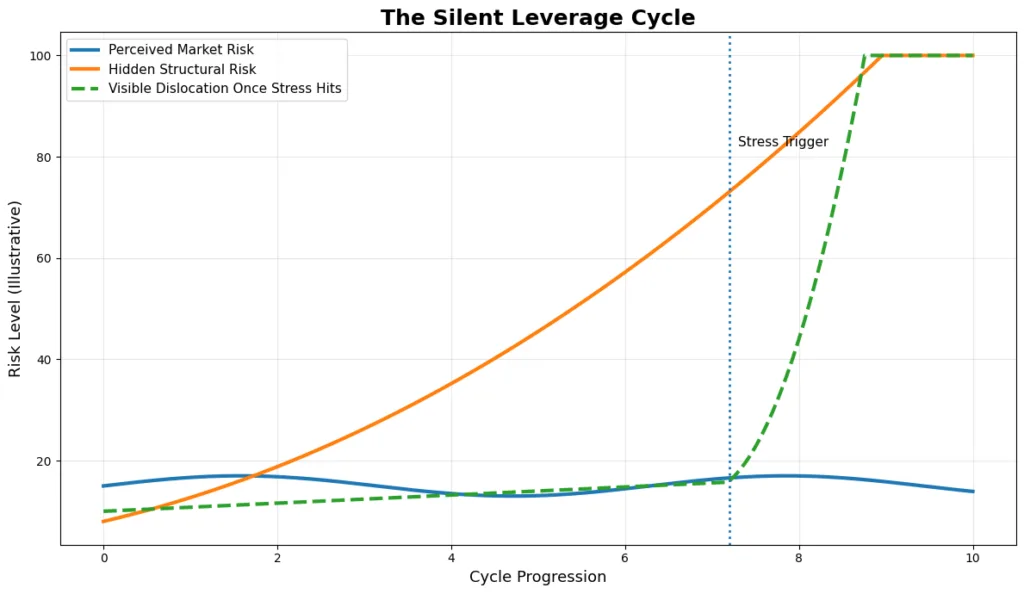
The silent leverage cycle follows a predictable but misunderstood structure.The cycle starts with a period of low market volatility. The market experiences price stability which decreases risk estimates. Risk models compress. Margin requirements stabilize. The market provides funding which becomes both cheap and accessible. Capital investments search for efficient solutions to their operations. Institutions start using leverage to optimize their investment returns. They achieve this by creating synthetic exposure instead of using direct borrowing.
The traders establish multiple layers of their positions. The same collateral assets get reused multiple times. The company retains its balance sheet stability while experiencing increased market risk exposure. The market conducts itself in a way that people mistakenly believe shows healthy market operations. Investors maintain low volatility levels because they hedge their positions. The market shows high liquidity levels because it handles equal incoming and outgoing financial transactions.
The market maintains tight spreads because it handles risk through a systematic method. The system accumulates leverage, which operates under hidden conditions. The system experiences a transition period when external factors lead to changes. The market experiences higher volatility. The market experiences decreased availability of funding. The market experiences fluctuations in collateral asset values. The market requires higher margin requirements.
The system reaches a point when it stops growing and starts contracting. The process of deleveraging starts. The positions which were previously independent now show a direct relationship. The protective measures which were established no longer serve their intended function. The entities who provide liquidity now demand liquidity from the market. The system conducts simultaneous efforts to decrease its risk exposure. The system shows its concealed leverage through this particular mechanism. The market demonstrates the existence of hidden assets through price movements instead of official statements.
Collateral chains and the fragility of liquidity
The central principle of the silent leverage cycle depends on the need for collateral to function. Financial systems function through two fundamental components which include capital and collateral as their essential driving force. The system operates through the process of assets being pledged and reused and transformed and circulated throughout its multiple operational components.
The structure of collateral enables multiple exposures to be backed by a single unit which operates in accordance with its specific deployment method. The system establishes an interconnected sequence. The system maintains its operational continuity through the ongoing maintenance of collateral value and liquidity. The system breaks down when the worth of collateral decreases.
The system contains its main weak point. The definition of leverage encompasses both existing market exposure and the methods used to finance and protect that exposure. The entire structure becomes unstable when there are doubts about collateral quality and when collateral markets experience reduced liquidity. The system operates normally because of its existing leverage. The system collapses because the fundamental assumptions which enable its leverage mechanism have lost their validity.
Tokenization and the next layer of hidden risk
Tokenization represents the upcoming financial infrastructure advancement according to its proponents. The solution delivers operational efficiency together with transparent systems and composable components. The system introduces an innovative element which enables users to access additional financial resources. Users can utilize tokenized assets as collateral for both on-chain and off-chain platforms.
They possess the ability to connect with standard financial institutions, decentralized finance systems, and mixed systems that utilize both approaches. The connection between two different systems creates a bridge. Bridges create operational advantages for systems. The system introduces new pathways which enable infection to spread.
The use of tokenized collateral in financial systems creates a situation where traditional finance and decentralized finance begin to merge. Financial risk has moved from being contained within separate areas to now existing throughout all operational environments. The new silent leverage cycle will start at this point. The intersection of multiple domains which share their collateral and liquidity and exposure creates an operational space beyond single domain boundaries.
Why calm markets are structurally dangerous
The markets function today under a system that maintains both controlled price fluctuations and visible market stability. The situation lacks risk decreases as proof because it shows hidden danger which has built up over time. Investors use their capital more aggressively when market conditions show low risk. Investors take on more risk because they see tight spreads as opportunities to make profits.
Financial institutions keep their operational costs low while they build complex systems. The system achieves greater operational capacity while it needs specific conditions to keep running. This represents the situation which creates two opposing outcomes.
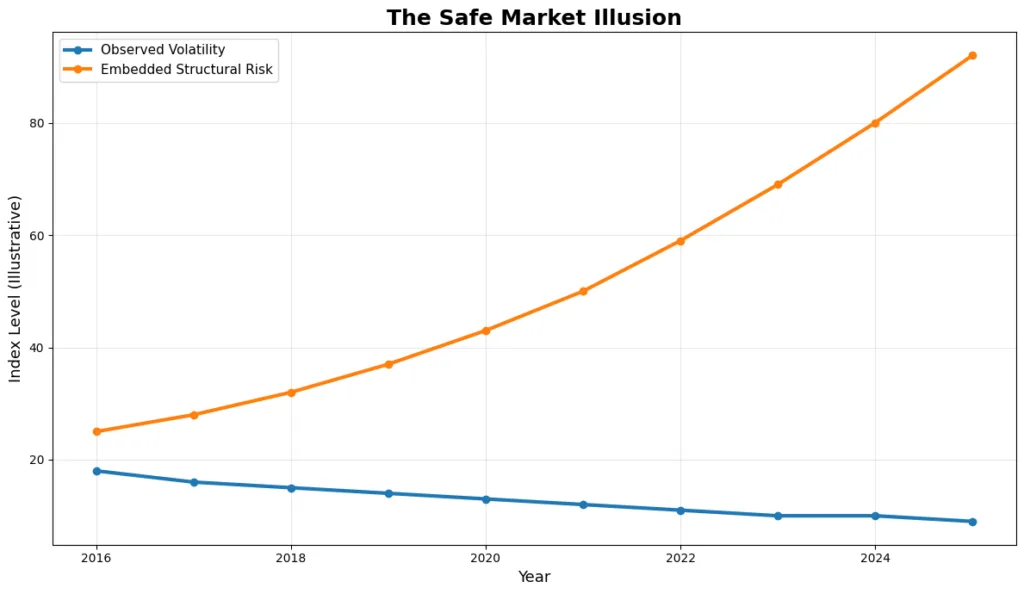
The presence of stability creates conditions which lead to instability. The system gains additional capacity to handle more leverage as it remains operational without any interruptions. The system becomes more vulnerable to disruptions because it increases its capacity to handle more leverage. The connection between two points happens through an immediate sudden change that exists in the system. The process occurs through a sudden event which happens in a nonlinear motion that becomes more intense because of the systems that had kept things in balance.