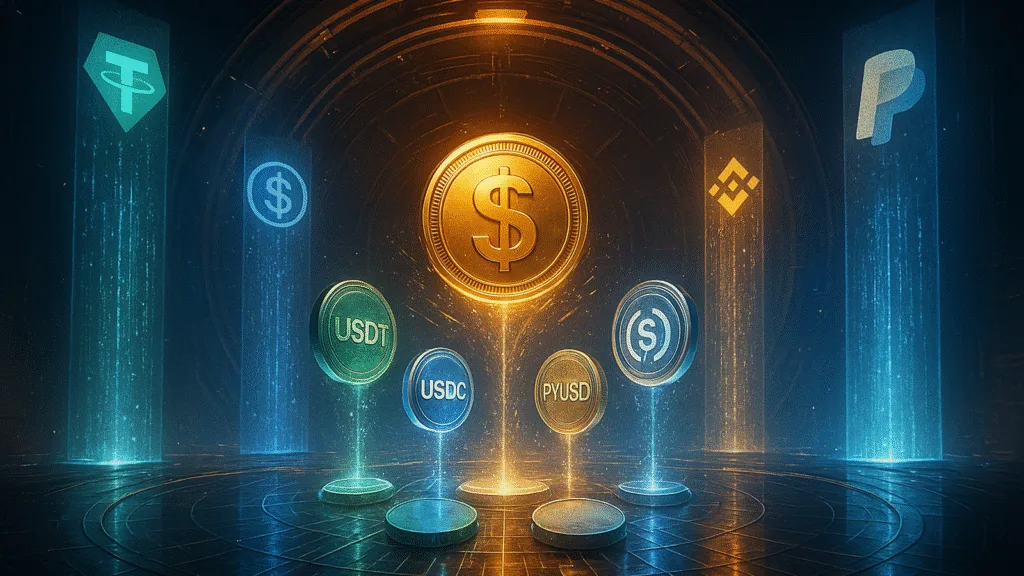



The rise of digital dollars
Stablecoins have silently emerged as the core of the cryptocurrency economy. Previously regarded as mere tools for traders, these digital currencies now transact more than $10 trillion each year, competing with the transaction volume of Visa’s network. While traditional finance (TradFi) faces challenges in modernization, the crypto sector has swiftly established a parallel dollar system that is faster, more economical, and without borders.
However, underneath the placid exterior exists a conflict that decides who governs the future of digital currency.Tether’s worldwide supremacy, alongside Circle’s drive for institutional adoption and PayPal’s delayed yet tactical involvement, signals that the contest for the digital dollar now centers on trust, regulation, and global influence.

The titans of trust: Tether vs circle
At the forefront stands Tether (USDT), a project that has overcome every forecast of failure. Even with concerns regarding transparency, Tether dominates more than 65% of the total stablecoin supply, primarily supported by U.S. Treasuries and short-term assets. Its power is found in distribution and leadership in developing markets, particularly in Asia, Latin America, and Africa, where USDT frequently serves as the sole available “dollar.”

Conversely, Circle’s USDC embodies the compliant aspect of stablecoins. Supported by American banks and subject to audits, USDC has emerged as the top option for institutions and DeFi protocols. After the depegging event in 2023 and the departure of important banking partners, Circle has redirected its attention to tokenized Treasuries and international collaborations.
The ideological clash between offshore liquidity and regulated transparency defines the ongoing stablecoin conflict.

The institutional intrusion
The upcoming stage of the conflict is being waged not by crypto enthusiasts but by major payment companies and financial institutions.
PayPal’s PYUSD, Stripe’s USDC integration, and Visa’s stablecoin settlement trials indicate that digital dollars have moved beyond a crypto niche they are evolving into a framework for standard payments.
Established firms possess regulatory strength and distribution channels that cryptocurrency companies cannot rival. Nonetheless, they also create centralized risks and confined ecosystems, possibly compromising the open-source principles that rendered stablecoins revolutionary.

Regulation, CBDCs, and the global power play
Authorities are keeping a close eye. The U.S. Stablecoin Bill, the EU’s MiCA framework, and Hong Kong’s licensing model seek to provide clarity and regulation. Simultaneously, Central Bank Digital Currencies (CBDCs) emerge as government-supported options that might rival private stablecoins.
The geopolitical implications are evident: the entity that governs the digital dollar governs the movement of value throughout the internet.The issue isn’t if stablecoins will prevail but which regulations they will adhere to.

The next frontier: Tokenized money markets
The true endgame goes beyond stablecoins; it involves the tokenization of real-world assets (RWA).

Initiatives such as Ondo, Maker’s sDAI, and BlackRock’s BUIDL fund are merging the distinction between stablecoins and on-chain money market funds. These income-generating digital dollars are transforming the capabilities of a “dollar”: earning, lending, and settling immediately all on-chain.The battle for digital currency will conclude when stablecoins turn into programmable assets integrated into every transaction, application, and agreement.