


Dogecoin (DOGE)
Market context
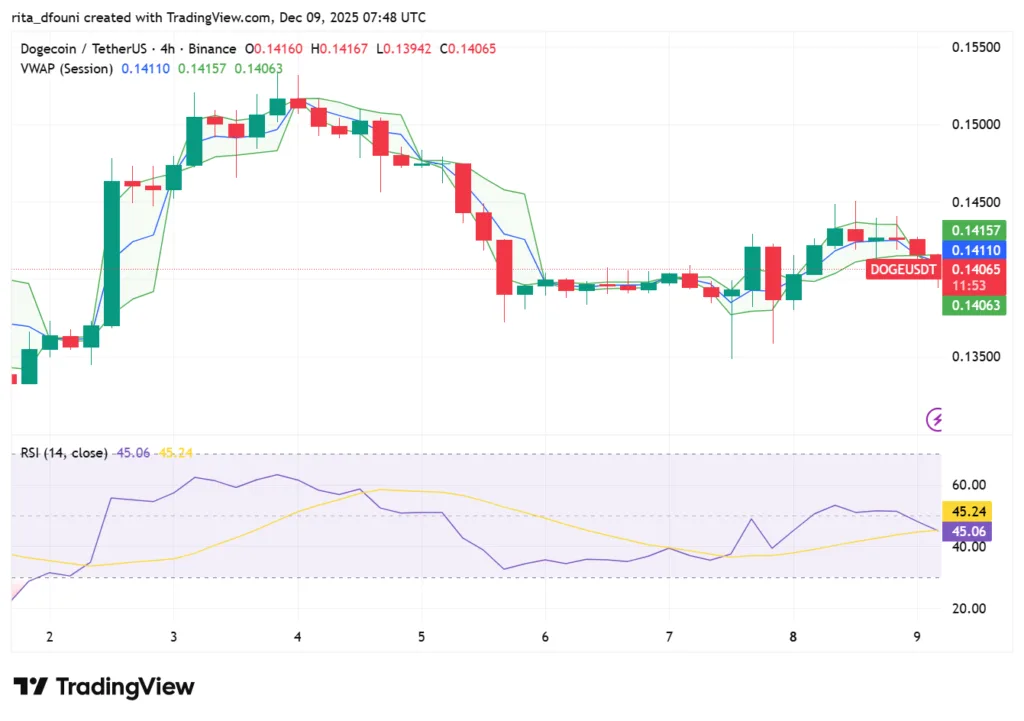
After last week’s volatility reset the entire meme complex, Dogecoin is still in post-correction rebuilding mode as of December 9. It is quietly revolving around the mid-fourteen-cent range. Today’s mood is more subdued: spreads have returned to normal, candles are smaller, and flows are once again cash-driven rather than liquidation-driven. While the market determines whether the wider altcoin bleed is approaching exhaustion, DOGE is successfully laying out a new base beneath the psychological $0.20 region that defined the October–November structure. Today’s price action supports the notion that $0.14–$0.15 is becoming the new gravity zone. Maintaining this area would keep the discussion positive; losing it would imply that the damage from November has not been adequately assessed.
Structure and levels
The short-term structure of Dogecoin is a multi-layered stairway of resistance and support blocks. The intraday shelf at 0.138–0.141, which absorbed the worst of the weekend rotation and is still drawing consistent two-way flow, serves as the first support. The protective floor, which is located between 0.132 and 0.134, is below that. Since the early month flush, responding buyers have been steadily stepping in. DOGE encourages a quick search into the high-$0.12s, where the July–August base left its final significant footprint, if that layer breaks on a closing basis.
On the plus side, the heavier distribution band at 0.158–0.162 is still the level that needs to be recovered before DOGE can even start reconstructing its previous $0.20 posture, and the early-week supply pocket at 0.148–0.153 continues to thwart early recovery attempts. Every rally within a corrective context is technically still a lower-high until that reclamation occurs.

Momentum, flow, and internal texture
After leverage unwound across the majors, participation is now cleaner, momentum is in the neutral corridor, RSI is hugging the midline, and MACD is drifting without slope. In order to create the compression base from which DOGE frequently initiates its subsequent directional leg, short-term moving averages are flattening and starting to cluster around spot price.
The book is neither panicked nor ecstatic, as evidenced by the lack of irregular wicks. Tradeability is being restored and slippage on longer timeframes is decreasing due to the recovery of liquidity on both sides of the book. This internal improvement indicates that the tape is healing and getting ready for the next impulse, but it does not ensure extension.
Scenario outlook and execution
If DOGE continues to hold above 0.138 on daily closes, the base case is a methodical grind back toward 0.148–0.153 where the first argument with supply sits. Clearing that band and then holding above it on a pullback is the earliest sign the market is ready to attempt a structural repair into the high-$0.15s.
Lose acceptance below 0.132 and the chart must re-test the $0.12s before any meaningful upside work can resume. In practice, DOGE remains a “trade the edges, not the middle” environment let it come to your numbers and avoid chasing movement inside the range’s center where expectancy drops sharply. A safe approach is to map DOGE as a base-building asset until it proves it can reclaim at least $0.158; until that happens, recovery talk is premature.
Shiba Inu (SHIB)
Market context
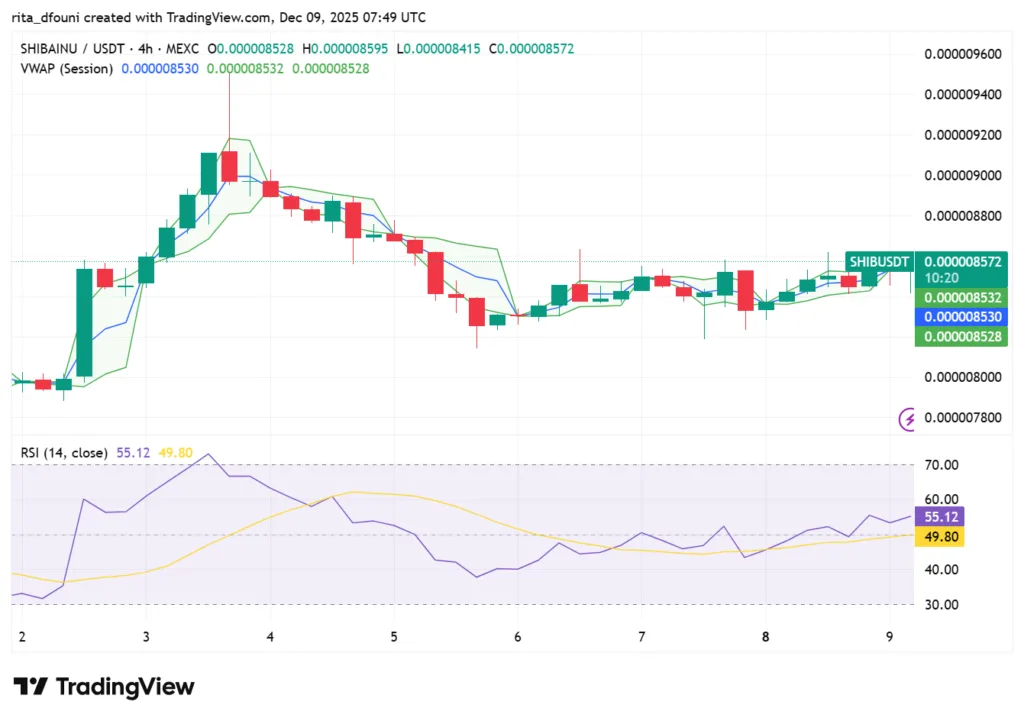
Despite ongoing softness throughout lower-liquidity alt markets, Shiba Inu is consolidating following last week’s deep-range rotation, holding the 0.0000079–0.0000083 zone. This stability is crucial since SHIB has a history of overshooting before rebalancing in response to cascading volatility after losing a shelf.
But today, SHIB is exercising restraint: sellers are unwinding at marginally lower highs, intraday lows are being bought more rapidly, and the orderbook appears re-centered following the early December sweep. This is the first stage of structural repair a token learning where actual buyers still exist but it is not yet a reversal.
Structure and levels
The 0.0000078–0.0000081 band, which was tried but rejected last week, continues to be the primary support. The penultimate structural defense before summer lows resurface is the 0.0000075 zone, which can be reached with a decisive closure below it. On the upside, stuck longs from the early-December rebound are unwinding in today’s revolving friction zone, which is between 0.0000086 and 0.0000088.
The door reopens toward 0.0000090–0.0000092, the band that formerly served as SHIB’s higher-timeframe pivot, if you reclaim and hold above it. This stays a range instrument until it can accept beyond these outside rails.
Momentum, flow, and on-chain posture
The tape acts like a token that has recovered its feet after stress, the RSI crawls back toward 48–50, short MAs flatten as volatility cools, and momentum is slanted somewhat soft but improving. SHIB’s odd duality a sizable, obstinate holder base coupled with transactional activity that fluctuates with story cycles is still evident in on-chain data. Consistency, not hype, is what matters for pricing right now. Until its burn and utility cadence result in quantifiable on-chain gains rather than sporadic surges, SHIB will not regain sustainable upside.
Scenario outlook and execution
Expect more attempts to rotate toward 0.0000086–0.0000088, where sellers will test the level of conviction, as long as SHIB keeps closes above 0.0000080. It would be SHIB’s first positive higher-low + higher-high series since late November if it were accepted above that area.
On the other hand, SHIB rushes downward into an illiquid pocket after losing 0.0000078 on a closing basis, inviting overshoot prior to stabilization. Practically speaking, this is still a patient trader’s environment: the middle is still risky, the edges are respected, and the structure is tidy. Let support and resistance do the heavy lifting until SHIB demonstrates that it can recapture 0.0000090 with confidence.
Pepe (PEPE)
Market context
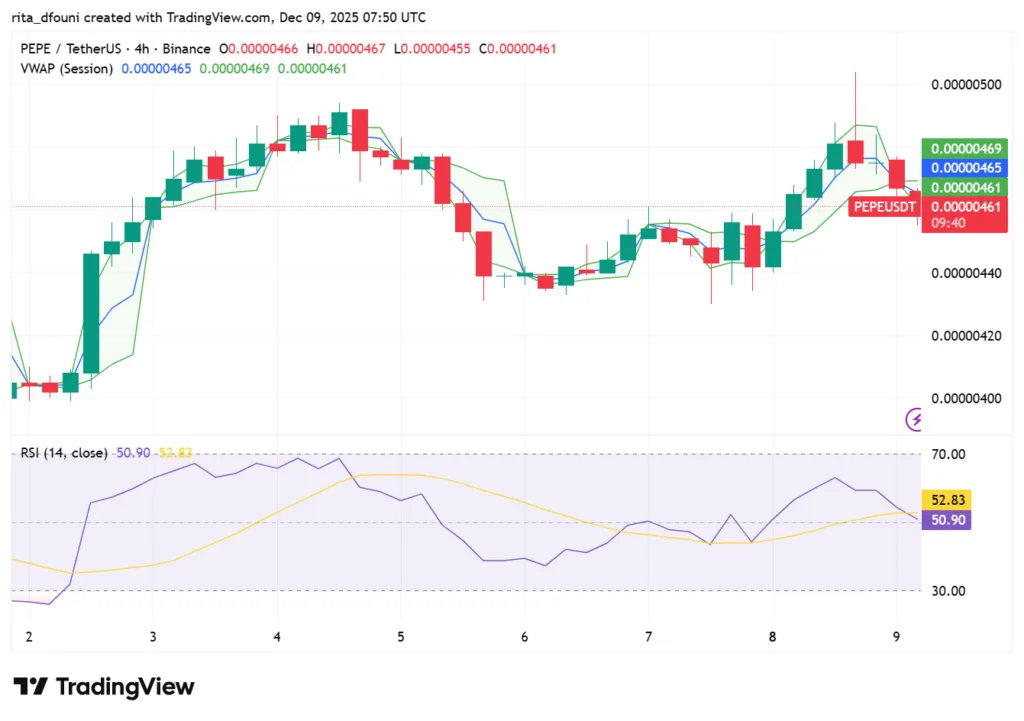
After the volatility flush in early December, Pepe is still compressing its trademark. Today’s price action is nearly textbook: clean rejections close to the mini-ceiling at 4.2–4.3e-6, tight candles, and quicker bounces off the lower band. This week’s action is precisely what you would expect when attention is neutral: a coil. PEPE is still one of the most reactive assets in the meme sleeve since its price reacts immediately to changes in social attention. It is hoarded potential that is only waiting for a spark; it is neither bullish nor bearish.
Structure and levels
Two lines continue to dominate PEPE’s entire map. The 4.00e-6 shelf, which is still defended on a daily basis, provides support. PEPE must look for liquidity in the high-3.8e-6s, a region that is infamously thin and where moves frequently overshoot before finding a genuine bid, if it loses and accepts below it. The narrow 4.25–4.35e-6 zone, where sellers frequently show up, indicates resistance.
A fundamentally significant shift toward 4.60–4.75e-6, where the next liquidity cluster is located, can only be unlocked by acceptance above that pocket. The eventual break will almost surely occur with speed and follow-through because these edges are clear and crisp.
Momentum, flow, and narrative mechanics
After the leverage reset, funding is steady, momentum is neutral, and open interest is still low. Since no one is over-positioned, the post-break move is likely to prolong rather than snap back forcefully, making this the perfect coil environment. The real forces behind PEPE are not coding updates but rather infectious energy, timing, and attention flow. Participants are trained to anticipate failure at both edges until one eventually fails, thus the more days price spends coiled between clearly defined edges, the more explosive the subsequent expansion is expected to be.
Scenario outlook and execution
Consider this as a binary coil with two clear triggers: acceptance above 4.35e-6 for a reflexive leg higher, or acceptance below 4.0e-6 for a quick liquidity grab lower. Wait for the tape to indicate direction rather than anticipating the break. Pressing the first pullback after the break is the right strategy as long as it stays above the breakout line. Reactive traders, not predicting ones, are rewarded by PEPE; wait for the level to confirm before acting.
MemeCore (M)
Market context
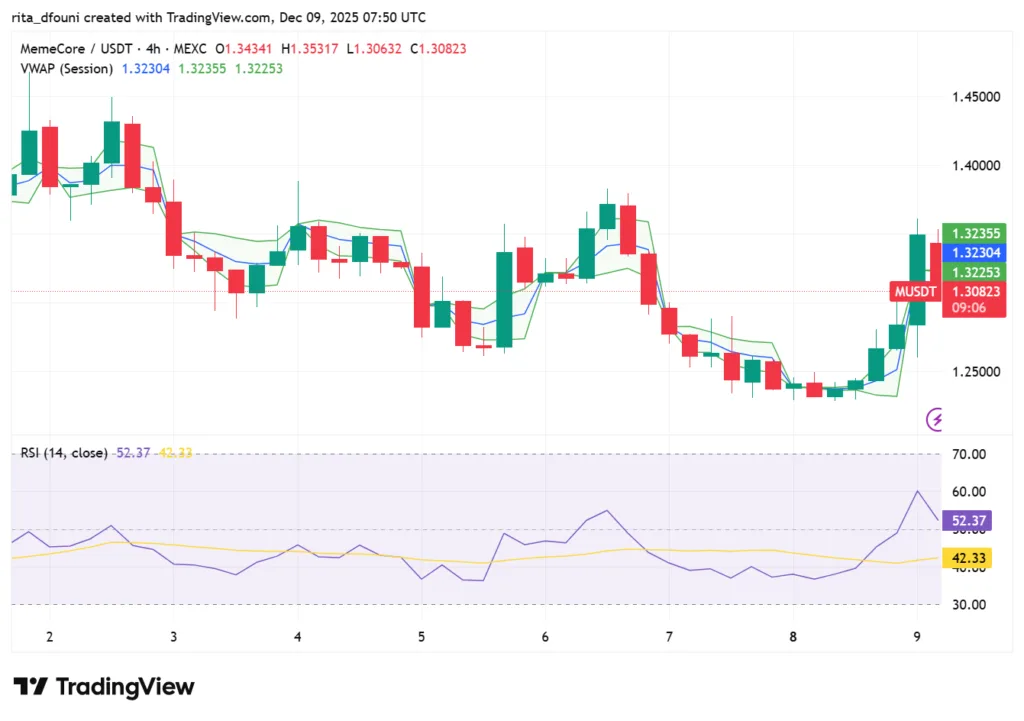
One of the cleanest base-building frameworks in the whole meme industry is still displayed by MemeCore. M is revolving in the high-$1.30s with amazing poise despite the volatility in early December. Instead than engaging in impulsive trading, the token acts like an asset whose holder base is in line with its long-arc story.
Early rises into the high-$1.40s are met by predictable cutting rather than fear-driven dumping, while dips into the mid-$1.30s continue to draw organized buying rather than speculative swings. That is the appearance of an accumulation base that is maturing.
Structure and levels
The current active shelf’s working support is between $1.34 and $1.38. The “do not lose this” zone, which is the source of the late-summer impetus and is necessary to maintain the multi-week accumulation thesis, is located beneath it. The $1.48–$1.52 hinge continues to be the key structural pivot above. The runway for a rebound toward $1.60–$1.70, with the September high zone beyond that, is cleared by acceptance above it, which turns resistance into support. The structure is steady, patient, and generating potential energy as long as M stays between these rails.
Momentum, flow, and holder behavior
Volume is constant, intraday ranges are small, and momentum is flat all of which are advantageous in a base. The lack of sharp volatility spikes indicates that the book is being controlled by actual buyers rather than short-term leverage. You can tell that accumulation is continuing every time a dip prints a clean wick that fills quickly. M’s tight range and good signal-to-noise ratio make up for its lack of volatility in terms of structural clarity.
Scenario outlook and execution
This is the group’s most pure “respect the range till acceptance breaks it” atmosphere. Purchase the tight stop base. Until the market indicates otherwise, fade the upper band. Be ready to press the initial continuation while incredulity is still high if you observe acceptance above $1.52. Once the door opens, constricted ranges frequently yield some of the cleanest breakouts. Do not be heroic if the lower shelf breaks on closing; instead of using the falling knife, let the tape find support deeper and enter on the first higher low.
Pudgy Penguins (PENGU)
Market context
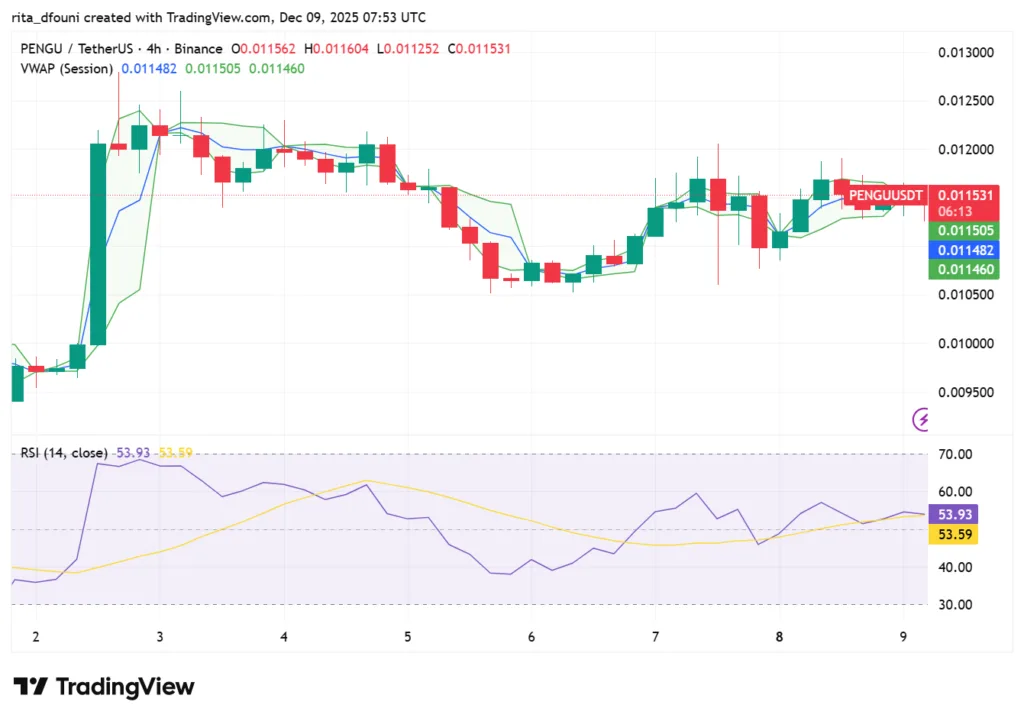
Pudgy Penguins remains one of the most structurally resilient meme-adjacent assets during this corrective phase. Price today is rotating just under a cent, supported repeatedly at $0.0094–$0.0097 as buyers with a brand-driven thesis continue to anchor the chart. Unlike pure meme tokens, PENGU enjoys a non-crypto feedback loop retail placements, brand partnerships, licensing, IP expansion all of which cushion volatility when crypto markets wobble. The result is a smoother tape even in chaotic environments.
Structure and levels
Support is the $0.0094–$0.0097 band, which has now undergone multiple tests without being accepted lower. If you lose it on a daily close, the chart will probably pull back into the late-summer base in a methodical, not panicky, manner. The hinge from which November’s lower highs were sliced was $0.0106–$0.0112.
Acceptance over that pivot expands the corridor toward $0.012–$0.013 and turns resistance into support. If market breadth improves, the higher-timeframe goal is $0.015.
Momentum, flow, and brand-cycle asymmetry
Compared to purely speculative tokens, the compression of intraday ranges is more beneficial here, momentum is steady, and short MAs are flat. PENGU’s distinct edge is its “brand asymmetry,” which allows it to soar on off-chain events even in the midst of a lackluster cryptocurrency mood.
Because of this asymmetry, traders must regard PENGU more like a growth-brand stock and less like a meme coin, respecting levels while keeping in mind that catalysts can emerge unexpectedly and from outside the cryptocurrency space.
Scenario outlook and execution
Execution is simple: do not pay the middle, let the base do its job, and only pursue after acceptance above the hinge has been established. A trend change is confirmed if the top band breaks and pullbacks start to bottom above it. This chart encourages patience more than knife-catching, so if support fails, move aside and allow the next bid come in.