


Dogecoin (DOGE)
Market context
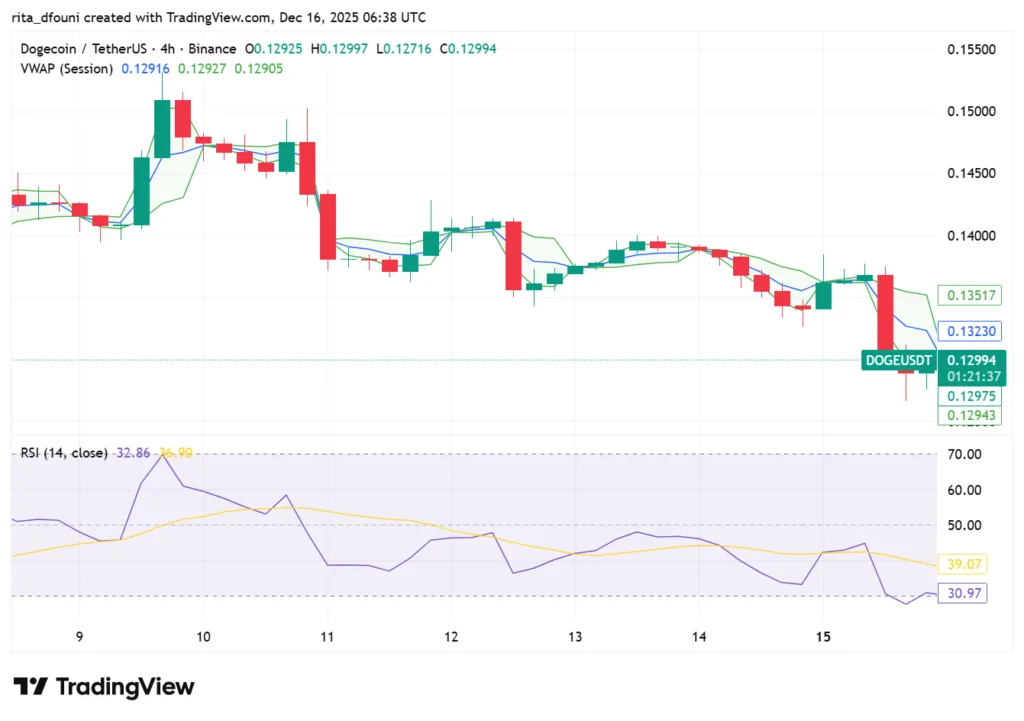
Dogecoin continues to be the liquidity engine of the meme market, making its behavior more instructive than most traders acknowledge. Smaller memes are no longer just spike-and-dump tools but can be traded once DOGE stabilizes. The remainder of the meme sleeve either performs poorly or becomes hyper-reflexive and brittle when DOGE is unstable.
Instead of starting a new trend on December 16, DOGE reads like a market still healing damage: candles are smaller, the price is spending more time inside a narrow corridor, and violent panic-selling is no longer responding to rebounds. That combination indicates that we have moved past the forced phase. What’s left is a protracted negotiation between two groups: buyers who think the dip reset risk sufficiently to resume increasing inventories, and sellers who bought higher and want exits on any comeback.
During corrective periods, DOGE also exhibits a significant behavioral change, beginning to trade more like a “beta proxy” to a wider risk appetite rather than as a stand-alone narrative asset. As a result, its rallies become less about excitement and more about positioning and liquidity returning to the alt complex, and it responds more to the sentiment of the market than to DOGE-specific stories. If you’re reading DOGE correctly today, you’re diagnosing the health of the meme sleeve in addition to studying DOGE.

Structure and levels
The easiest way to think about DOGE’s technical structure is as a base that is still being built, with the market always “checking” to see if purchasers would defend a new floor. The market continues to rely on the lower band around the low-to-mid $0.13s. It is the area where demand often shows up early enough to avoid a clean breakdown, not just a support level. When daily closing are accepted below that range, the market is warning you that a larger discount is necessary to draw in actual size.
Overhead, the mid-$0.15s represent a supply memory zone rather than just resistance. Many participants treat the price’s return there as an exit because it’s where former “dip purchasers” become bag-holders during the last trip down. This is the exact pattern we consistently observe: DOGE ascends, stalls, spins, and then determines if bids may ascend further without collapsing. Only when the market is able to retake that supply region and demonstrate it by remaining above it during pullbacks does a meaningful recovery phase start. Any upside is still structurally unstable without such “reclaim and retest.”
These days, momentum indicators are not the primary focus. Because the market spends so much time compressing in repair markets, RSI and MACD can appear unconvincing until the structure turns. The true narrative lies in microstructure: do bounces hold higher lows instead of snapping back into the floor, are downside wicks absorbed swiftly, and do books refill after pushes? These days, DOGE is exhibiting early indications of improved absorption. That is the real-time appearance of “base-building.”
The fact that DOGE is no longer trading like a liquidation instrument is its greatest advantage from a flow standpoint. Less vertical candles and fewer “one-minute crimes” typically indicate that leverage has reset and that the subsequent move is more likely to be sustained. The drawback is that DOGE may remain in this repair area for longer than traders would like in the absence of a wider market tailwind, and poor entries are frequently the result of boredom.
Scenarios and execution
Defending the $0.13s, probing the $0.15s, getting rejected, and so on until the market either runs out of sellers or loses buyer conviction is the fundamental scenario for DOGE. A clear recovery of the mid-$0.15s and, most importantly, pullbacks that end above the recovered zone are necessary for the bullish scenario. That indicates that the market is moving from repair to recovery. Since there isn’t much structure between those levels, the bearish scenario starts with acceptance below the $0.13 shelf, which would probably lead to a quick search into the next demand pocket.
Here, we provide a useful addition: considering DOGE repair regimens as “edge instruments” yields the best results. Owning clean entries at the floor and taking partials into supplies until the market shows it can hold higher is how you win, not by forecasting the breakout. DOGE will tax you with chop if you continue to try to catch the beginning of the fresh bull leg before the reclaim occurs.
Shiba inu (SHIB)
Market context
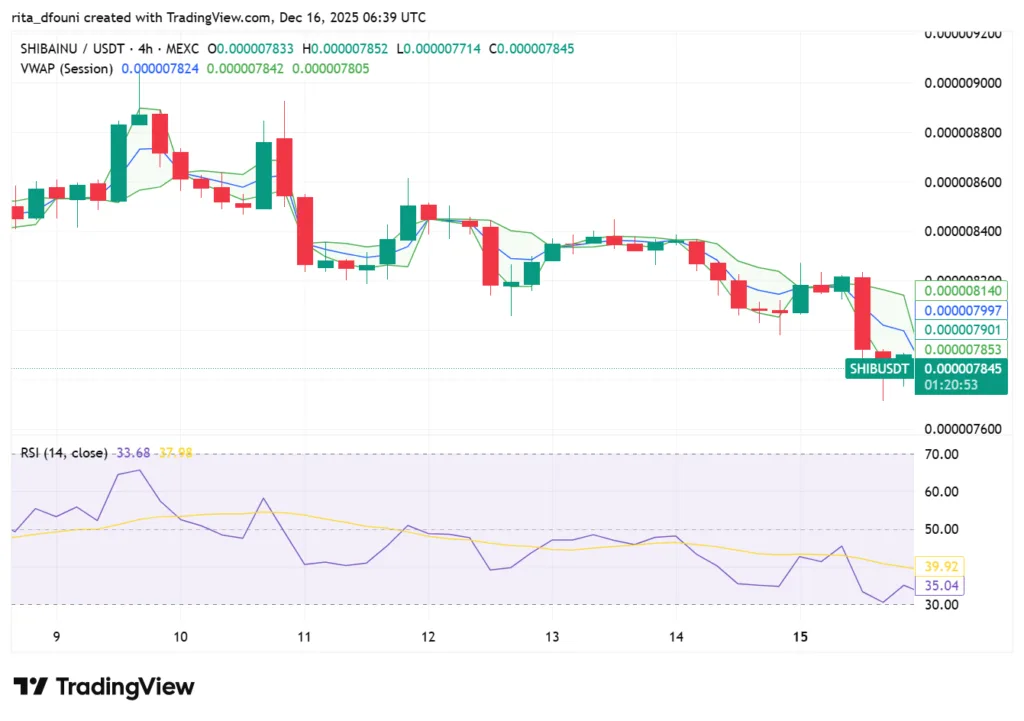
With sporadic spikes in volatility, SHIB continues to act like a range-first asset. That’s not an insult; rather, it’s the inherent state of a token whose power stems from a large number of holders and cultural stickiness rather than steady demand growth. SHIB frequently serves as a “pressure gauge” for retail patience during corrective regimes. Its community endures downturns, so it doesn’t collapse easily, but it also doesn’t trend cleanly unless the market offers a strong risk-on background or SHIB-specific triggers significantly alter perception.
SHIB feels steady but uninspired on December 16. That distinction is important. An active market is trendable, while a steady market can be traded. At the moment, range navigation is more important to SHIB than breakout conviction.
Structure and levels
The structure of SHIB is characterized by an above friction zone that consistently caps rallies and a defensive shelf that continuously stops declines. Because SHIB’s downward behavior tends to overshoot once a shelf is accepted below, the bottom shelf is crucial. Meme assets can have small liquidity pockets, and SHIB is no exception. Because the market is still clearing out inventory from investors who purchased prior recovery attempts and now want to exit at breakeven, overhead resistance is still strong.
“Can it hold a bounce” is more important for SHIB than “can it bounce.” The market must retake its friction zone before printing further lows above it in order for there to be a true rebound. If it can’t, the range stays the same, and buying support and selling into resistance continue to be the most effective strategy.
Ecosystem tone, momentum, and the reasons why traders continue to misinterpret SHIB
Traders frequently make the error of assuming that ecosystem narrative would inevitably result in price action when using SHIB. The tape is requiring quantifiable evidence in the present market environment, such as steady throughput, ongoing engagement, reliable burn dynamics, or usage indicators that cannot be written off as transient surges. When such aren’t evident, SHIB moves with the group, much like a macro-dependent meme.
Until the market finds a reason to re-rate SHIB, momentum indicators will stay “meh.” Understanding that SHIB’s upside is frequently delayed in comparison to DOGE during repair stages adds value. When the market feels that meme hunger is back, DOGE usually stabilizes first, followed by SHIB.
Scenarios and execution
The base case is ongoing range trading that is more stable than smaller memes, which means there is less tail risk but also less short-term explosive potential. Acceptance above the overhead friction zone and a successful retest that remains above it are necessary for the optimistic scenario. The only pattern that changes SHIB from a trading range to a trend leg is this one. Before stabilizing, the bearish scenario starts with acceptance below the shelf and subsequently overshoots into the next liquidity pocket.
The best SHIB technique under this regime is still disciplined: avoid paying the center, treat resistance as a true wall until the tape shows otherwise, and enter close to support when the market indicates that buyers are still present.
Pepe (PEPE)

Market context
PEPE continues to be the group’s most reactive asset, which means it may produce quick expansions following compression and is the most responsive to changes in attention. For impatient traders, it is also the most harsh. PEPE is still coiling on December 16: rejection close to the ceiling, range compression, and recurrent defense of the lower band. Participants become increasingly accustomed to expecting every attempt at escape to fail the longer this box is in place. When it eventually sticks, that training is what drives the actual breakout.
A lengthy thesis is not necessary for PEPE to advance. It requires a flow of attention. Because of this, PEPE can be peaceful for days and violent for hours at a time.
Structure and levels
The building is a simple box with a defensive floor and an unyielding ceiling. Acceptance is more important in these setups than the wick. PEPE can wick below support and still rebound, or it can wick over resistance and still fail. Whether the market closes past the limit and then acts differently afterward is what counts. The initial downturn, not the first candle, is the strongest indication of a real break. The market has altered if the retreat continues above the broken ceiling.
The reflex loop is crucial to PEPE. A move begins, is screenshotted, spreads, attracts more attention, increases liquidity, and then picks up speed. Conversely, pricing drifts back inside the box, attention wanes, and liquidity decreases. Positioning resets during compression periods, and constructive, clean positioning increases the likelihood of follow-through when the break occurs.
Here, our added value is tactical: you trade PEPE by responding to acceptance rather than by forecasting the break. The retest is frequently the highest-probability entry when PEPE breaks and then retests since it validates the market’s new behavior.
Scenarios and execution
Edge-to-edge trading and continuous coiling constitute the foundation scenario. Acceptance above the ceiling, followed by pullbacks holding higher, is a bullish scenario that might lead to a quick continuation leg as traders rush to realign. Acceptance below the floor and a swift decline in liquidity before buyers resurface constitute the bearish scenario. The approach is still the same: respect the box, stay out of the middle, and only press after being confirmed.
MemeCore (M)
Market context
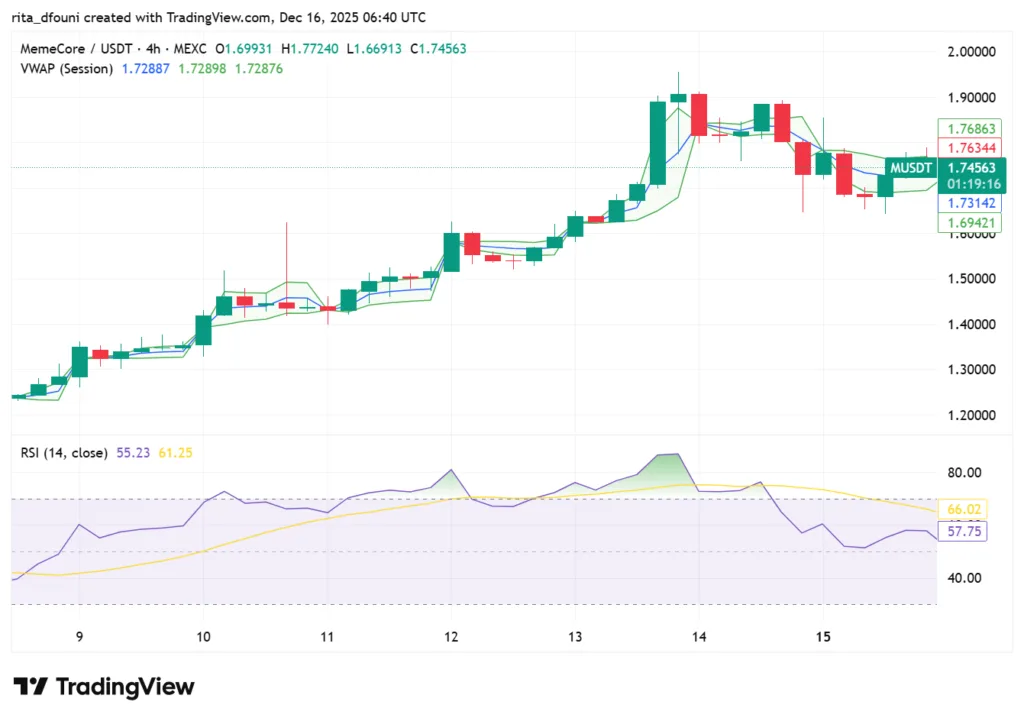
Because MemeCore trades with a more “planned” tempo than other memes, it nevertheless stands out. Instead of acting like a gambling chip, it acts like an asset with patient holders. That is useful in a market that is still recovering from previous volatility. It implies that the token won’t continuously bleed or spike while it bases and grows.
MemeCore is continuing in accumulation mode as of December 16; rallies are sold carefully, dips are bought cleanly, and volatility is kept under control. It’s not glamorous, but that’s how long-lasting trends start.
Structure and levels
M’s construction consists of a hallway with a distinct hinge above. The market must demonstrate that demand is strong enough to turn resistance into support at the upper hinge, while buyers frequently appear in the lower band. The market stays in a range until the hinge breaks and holds. However, the quality of the range is important: because the invalidation points are obvious and systematic buyers can intervene once the structure flips, tight, ordered ranges frequently break cleaner than chaotic ones.
Positioning, momentum, and the reasons this one can trend cleaner than the others
Momentum is neutral, but this is typical during base-building stages. The uniformity of absorption and the lack of panic tails are important. These are indicators of accumulation rather than dissemination. Because MemeCore already trades with a structured rhythm, it can become one of the cleaner continuation trades in the meme sleeve if it prints acceptance above the hinge.
Scenarios and execution
In the worst scenario, the corridor would continue until a catalyst or larger market tailwind compels a break. Acceptance above the hinge and a holding retest are the bullish scenario, which would cause the market to move from range to trend. The accumulation thesis is broken and a deeper rebuild is required in the bearish scenario, which is the loss of the bottom band.
Execution should be disciplined: only chase after acceptance and retest not on the first wick, decline into the hinge until it is proven, and accumulate near support with tight invalidation.
Pudgy penguins (PENGU)
Market context
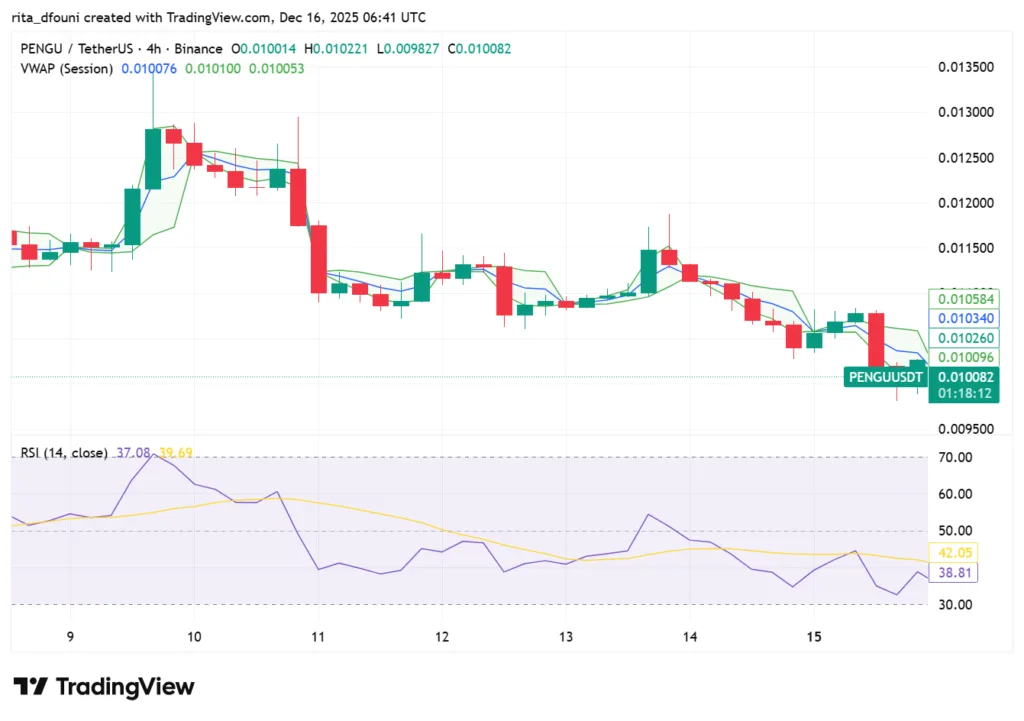
PENGU is still traded as a brand stand-in. That’s what makes this unique. Pure meme coins depend on cryptocurrency attention to survive, but PENGU’s off-chain feedback loop, consumer brand awareness, IP narrative, alliances, and retail presence may sustain the chart even when cryptocurrency isn’t operating at full risk. PENGU frequently prints smoother drawdowns and more organized recoveries because of this brand optionality.
With constricted ranges, frequent defense of the support shelf, and cautious probing into overhead resistance, the tape is nevertheless more stable than most on December 16.
Structure and levels
PENGU is honoring a support shelf that keeps drawing customers. There is still a hinge zone where supply appears above. The market’s message is straightforward: it is stable, but in order to become trendable, it must overcome obstacles. PENGU probably does a controlled backfill into its previous base rather than a spectacular collapse if support breaks on closes, but it would still postpone recovery and indicate that buyers require a larger discount.
Momentum and brand-cycle asymmetry
Momentum fits a base since it is steady and stable. Asymmetry is crucial because PENGU can use catalysts that don’t come from the cryptocurrency industry. Even when the rest of the meme sleeve is slow, traders that handle PENGU like a typical meme coin frequently overlook this and are taken aback by upward expansions.
Scenarios and execution
In the base situation, range trading and stabilization will continue until the shelf fails or the hinge breaks. PENGU can march into higher liquidity clusters in a more controlled trend in the bullish scenario, which is a recapture of resistance followed by pullbacks that hold above it. Acceptance below support and a backfill into the following base before stabilizing once more constitute the bearish scenario.
Positioning like a brand trader is the most successful strategy: buy measured support, stay out of the center, and only pursue once the chart indicates it can hold above the hinge.
On December 16, the meme-coin market is in a purposeful rebuilding phase rather than a state of fear or exuberance. While lesser names compress into tradable ranges, Dogecoin serves as the liquidity anchor, stabilizing the larger meme sleeve. While Pepe continues to store potential energy through tight compression, which typically precedes rapid swings, Shiba Inu is still structurally sound but lacks the momentum required for a clean trend shift. Pudgy Penguins retains resiliency driven by brand-level demand rather than pure speculation, while MemeCore distinguishes out with one of the simplest accumulation structures in the industry. Prediction is less important in this market than patience, level discipline, and confirmation.