




Dogecoin (DOGE)
Market context
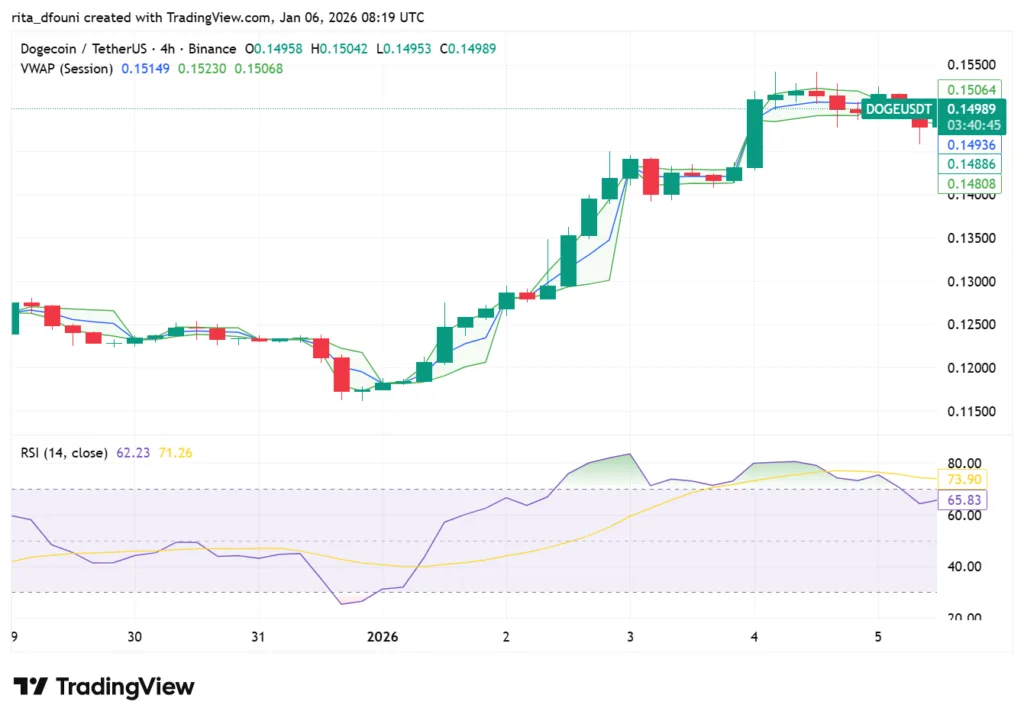
Dogecoin starts 6 January as the market’s liquidity anchor and sentiment indicator for the entire meme-coin range. The last few days have seen the market moving from the reactive sell-off and volatility spikes characterizing the late-December drawdown to a slow, conscious method of price discovery. DOGE is not going fast, but it is gaining stability, and this difference remains very important. The stability in DOGE makes the meme trade less fragile, thus allowing the small stocks to base, compress, and trade in a structural rather than emotional manner. DOGE still acts like a market that is fixing its structure.
The candle bodies are smaller, the intraday reversals are less extreme, and the downside probes are being absorbed rather than causing downstream sell-offs. This phase is not about speculative upsides, but about re-establishing the balance between supply holders looking for exits and patient buyers slowly building their positions. A DOGE chart that lingers here is not weak; it is simply resetting risk tolerance.
Structure and levels
The present formation is still characterized by a safeguarded lower level which keeps on stopping the price move downward into the discount area, and an upper supply zone which always blocks recovery attempts. The upper band is not only resistance but also a memory zone where early long traders who bought at the rebound are now choosing to sell on strength.

Until DOGE can manage to return that region and stay above it on a subsequent drop, the chart will still be a repair structure and not a confirmed recovery trend. The main indication is the way pullbacks act. In the beginning of the cycle, dipping into the lower level caused panic selling and aggressive wick extensions. Currently, the same dips are, however, met by earlier dip-buying and tighter recoveries. The change in behavior is as significant as any technical indicator; it is a signal of inventory transfer from reactive holders to more patient ones.
Momentum, positioning tone, and market psychology
The momentum indicators are still neutral and not remarkable at all, which is what one would expect in a consolidation phase. However, the liquidity quality is more important. Market orders are not immediately decreasing during stress anymore, the derivative trades are neutral rather than biased, and the margin trading seems to have been reset across the perpetual contracts.
This lowers the chance of rises and falls in price due to liquidation and at the same time makes the structural validation more acute.DOGE in this case does not behave like an asset that will probably break out soon and rather like an element that keeps the structure stable. The meme ecosystem is still tradable as long as it is orderly.
Scenario interpretation
The base-case remains the continued rotation within the current range as the market tests both supply and demand over and over again. The bullish structural transition necessitates the overcoming of the overhead band along with a retest that holds with no confirmation, upside remains cautionary.
The bearish transition does not start until the acceptance under the defended shelf, which would reveal a thinner liquidity pocket below and compel a deeper structural rebuild. In this phase, the trading outcomes of the highest quality still result from respecting the edges and avoiding the middle, where DOGE usually extracts unnecessary risk.
Shiba Inu (SHIB)
Market context
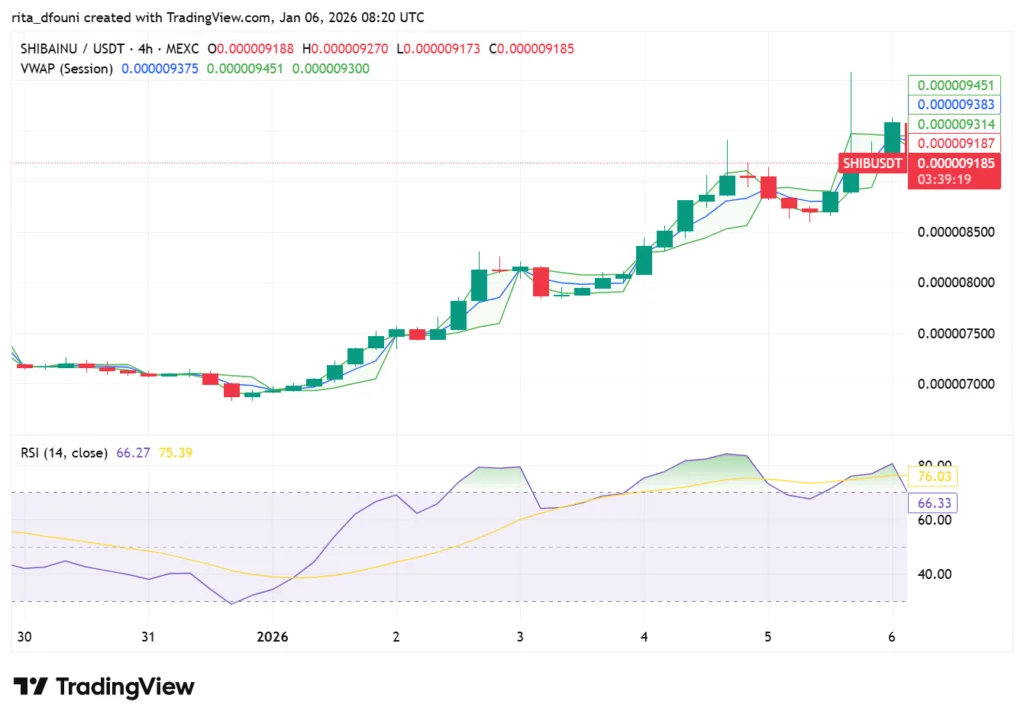
Shiba Inu is still the same as the rest of the meme coins: it has a stable structure, is undecided about the direction and the confirmation instead of anticipation is the main reason for its heavy dependence. SHIB has been constantly moving between a support level that is protected and a resistance level that is very strong, with the price changing hands between the two as the participants are rearranging their exposure without committing to a full trend. On January 6, SHIB has the character of being controlled and patient rather than speculative.
Accumulation from long-term holders who are not emotionally affected by short-term fluctuations continues to support the market while downside has been limited by cautious profit-taking from earlier investors. The outcome is that of a disciplined range which is a true reflection of equilibrium rather than of being weak.
Structure and levels
The defended shelf is still the structural base of the chart. Each successful defense only adds belief to the notion that SHIB’s downside risk is not by panic but rather by conviction-based participation. The upper resistance area is still the critical transition zone. The market has to take back that band, stay above it, and build higher lows over time before SHIB is no longer just a range-bound instrument.
The difference between “bouncing” and “recovering” is still very important. A bounce merely alleviates oversold conditions. A recovery marks acceptance above resistance and does not allow pullbacks to go back to prior lows. That pattern has not developed yet but neither has the breakdown of structure.
Momentum and ecosystem tone
Momentum stays neutral along with slight mean reversion. The market activity displays a preference for buying at the support levels and selling at the resistance levels. As for the ecosystem, the narratives are still perceived more as background signals rather than realizing the market has episodes of extreme doubts and needs sustained evidence. Hence, we often see that SHIB is slow to react during the recovery phases while DOGE is quick. It first consolidates the early trends and later moves with them.
Scenario interpretation
The base-case continues to picture edge-to-edge trading within the range as the market slowly tests whether the resistance area is losing its supply density. A bullish scenario needs the price to break above the resistance level with a confirmed retest thereafter.
A bearish scenario needs the price to break below the support level, which would probably lead to the price moving further down into the next liquidity pocket before stabilizing. Under these conditions, it is still difficult to make a profit from mid-range trading. SHIB is still a situation that requires the trader to be disciplined and will not reward those who are not.
Pepe (PEPE)
Market context
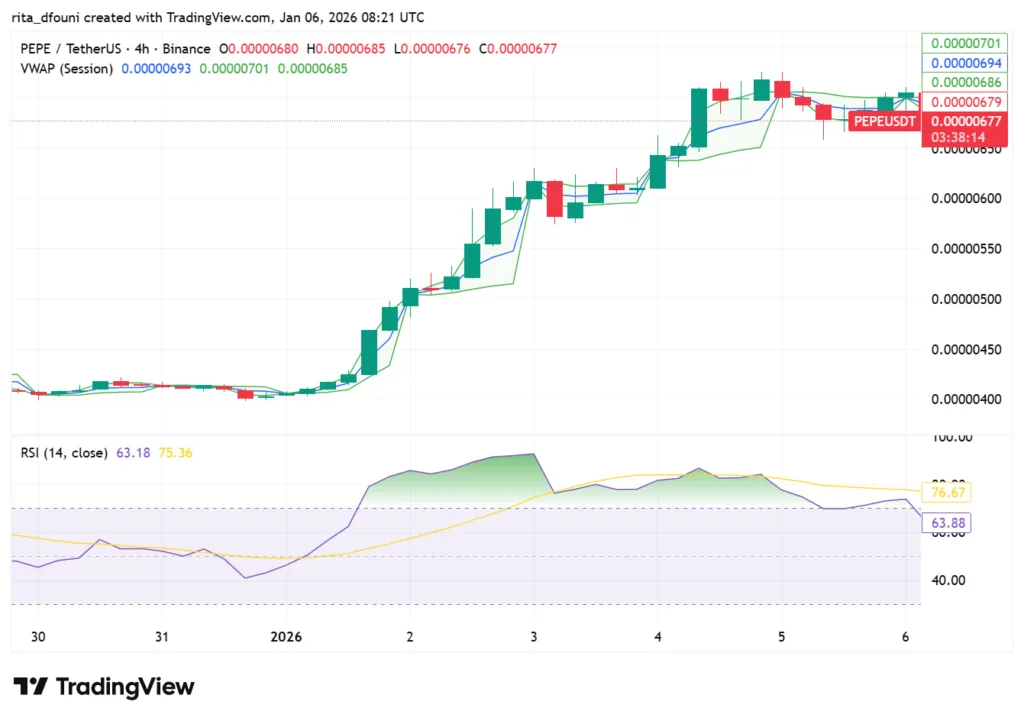
Pepe marks January 6 as the most reflexive asset in the sector, and at the same time, he is still locked in a tight compression pattern that has become even more structurally important over the last few sessions. The longer PEPE keeps on compressing without a solution, the more traders will be sticking to range behavior and the more drastic the forthcoming resolution will be when the market finally accepts and breaks through.
The main understanding is that PEPE is not losing slowly but rather storing a lot of tension. The price is consolidating in a controlled manner instead of bleeding, and the tests of the downside are met with strong demand of response rather than giving up. This dynamic is signaling participation that is still there but not quite active as opposed to one that has worn out.
Structure and levels
The chart is still characterized by a floor that is clearly respected and a ceiling that is repeatedly tested. Both ends are active and have their own significance. The lower zone still draws buyers at the beginning of each drop, whereas the upper limit keeps on negating attempts to break out early.
As it is the case with PEPE, the initial breakout candle is not a signal. The initial retest is. Cross the line and then pull back, but make sure the pullback holds above the line – this is the pattern that indicates a change in structure. All else is merely noise within the box.
Positioning reset and reflexive potential
The positioning is much cleaner than it was during past periods of volatility, as the leverage is not so high and the short-term directional exposure is lower than what is usually the case. In PEPE, this factor makes it more likely that the first direction to resolve will be followed by a sustained movement instead of just a stop-run.
The main characteristic of PEPE is still reflexivity: the more the market participants pay attention to the asset, the more its price moves and the more the attention is drawn to it. The process of compression is what builds that potential energy.
Scenario interpretation
The base-case scenario is to keep on compressing until a catalyst or wider flow rotation enables acceptance out of the range. The extremely bullish scenario offers a chance of acceptance above the ceiling and a subsequent higher-low confirmation. A bearish case calls for acceptance below the floor together with a liquidity sweep and a later reconstruction. PEPE is still a market driven by reactions. The benefits are for those traders who stay for acceptance instead of those who predict it.
MemeCore (M)
Market context
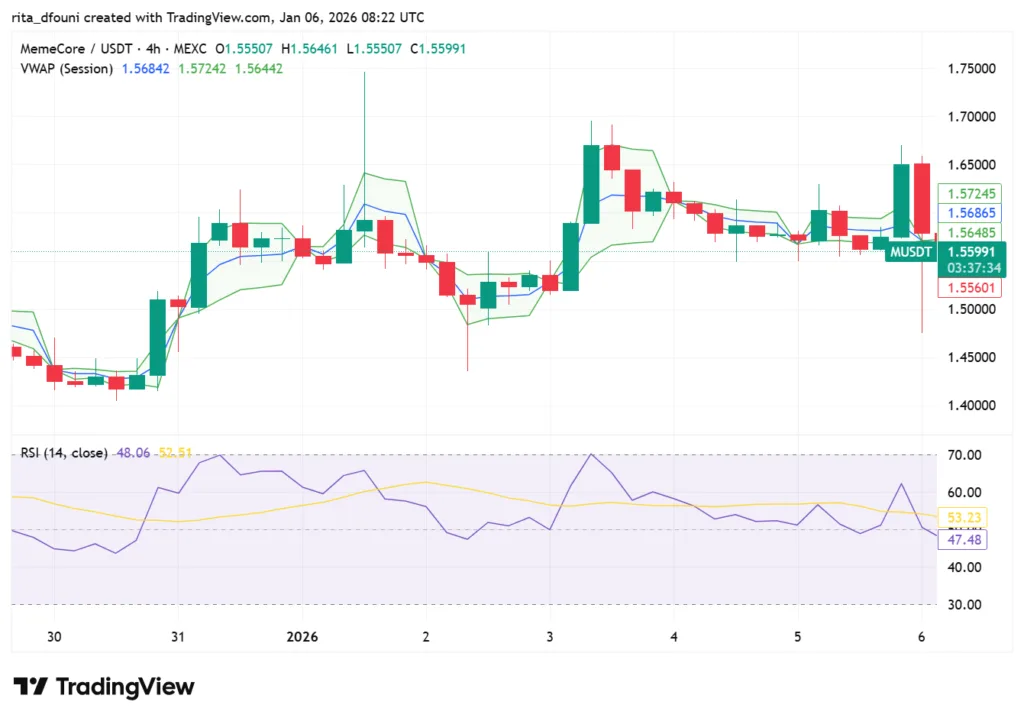
MemeCore still differentiates itself from the other meme coins by not letting emotional volatility influence its trading and instead using a methodical, accumulation-style approach. During the first part of January, M has been exhibiting a controlled consolidation pattern where the price drops are shallow, the price recoveries are orderly, and there are no liquidation-style spikes at all. This shows that the holder base is more oriented towards the long-term thesis than speculative trading, thus making M one of the meme coins with the coolest structural charts as the new month begins.
Structure and levels
The lower accumulation shelf is still protected very well, indicating that there is still a transfer of demand with every test. The structural hinge, on the other hand, is still the most important transition area between the base and the expansion. So far, that hinge has not been reclaimed and validated through a retest, therefore M continues to act as a high-signal consolidation environment rather than a trending asset.
The quality of interaction around support is what separates this base from weaker structures. Rebounds are not desperate but measured and pullbacks are not panic selling, which are evident signs of constructive ownership.
Momentum and structural credibility
The momentum is still neutral, and that is precisely the place it has to be in a controlled accumulation profile. The volume is consistent instead of being driven by spikes, and the price fluctuations have not exceeded the limits. All these characteristics usually come before the clean expansion phases when macro demand gets better.
Scenario interpretation
The lowest-case scenario is still that the structured consolidation will continue until either the macro risk appetite lifts the hinge or the local catalysts force the participation to be higher. A bullish transition needs resistance acceptance along with higher-low validation.
The bearish failure scenario starts just when the accumulation shelf breaks and closes under, which would disprove the base thesis and restart the process at a deeper level. Until that happens, M is still giving rewards to the patient accumulation near structural support rather than to the anticipation near resistance.
Pudgy penguins (PENGU)
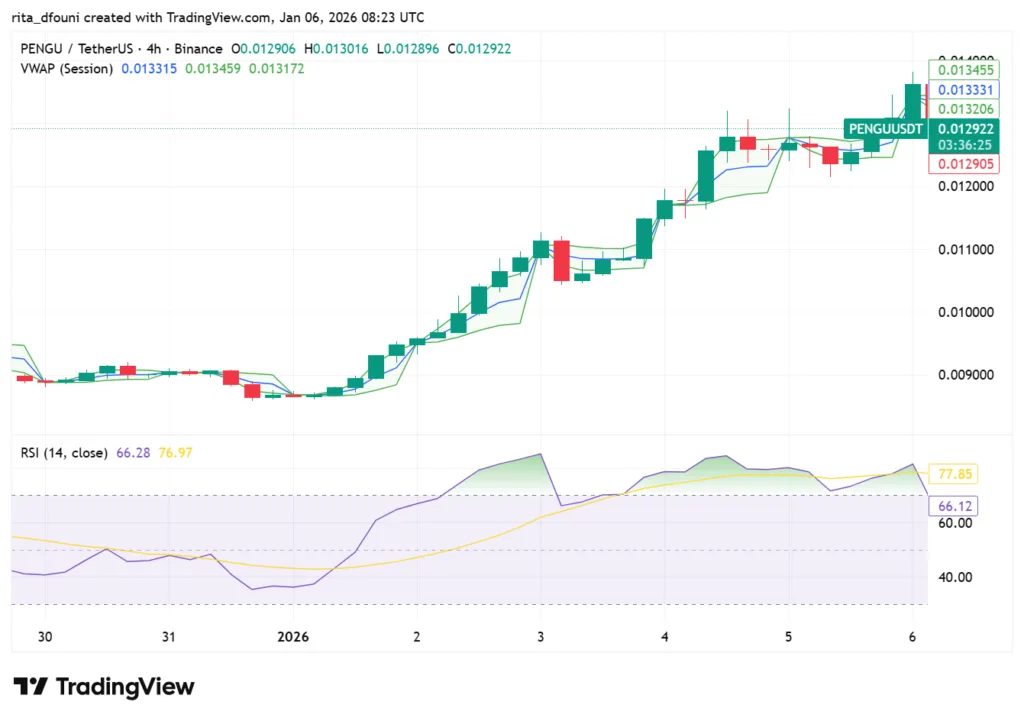
Market context
Pudgy Penguins is still the most asymmetric asset in the group, and this is due to its dual on-chain and off-chain identity. PENGU is supported by the brand presence, IP value, and external narrative visibility, which, together, mitigate volatility and assist in stabilizing drawdowns.
The 6th of January shows that the price chart has been resilient. The price is still within a stable corridor, the support tests are being carried out in a controlled manner, and the rebounds are taking place gradually rather than impulsively.
Structure and levels
The present structure is characterized by a defended support shelf that attracts accumulation constantly and an overhead hinge where supply pressure still comes out. The hinge continues to be the structural pivot for trend change.
Acceptance above it, followed by successful retests, would transfer PENGU from consolidation to a more directional posture. Until then, the market stays in a stable, brand-supported stabilization regime.
Momentum and asymmetric catalyst profile
Momentum is still in the middle range, but the asymmetry is still on the upside because PENGU has the ability to react to brand-level catalysts that do not need wider crypto participation to trigger repricing. This optionality is what allows PENGU to control downside transitions better than usual meme assets.
Scenario interpretation
The fundamental aspect remains the same – as far as the support maintains its strength the corridor stabilization will keep on being done. The bullish transition is first to regain the hinge and then to verify it by creating a higher low.
If the shelf is lost it will be the start of the bearish scenario leading to a measured backfill into the past structure instead of capitulation. PENGU continues to operate in an execution manner similar to that of a brand asset rather than a trading token where disciplined accumulation at support is more effective than aggressive chasing.