


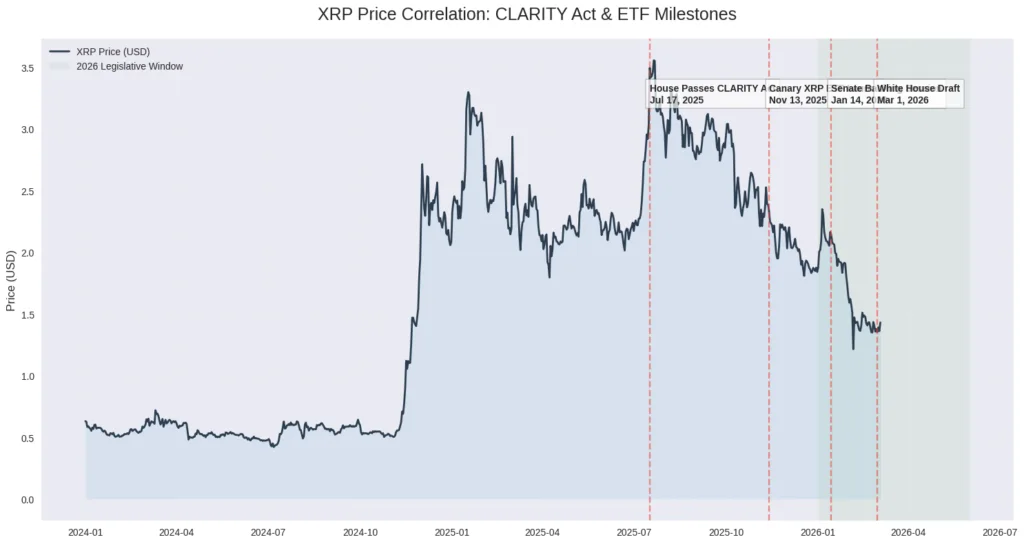
XRP price stands at approximately 1.41 dollars as of March 5 2026. The price increase that market experts anticipate from XRP exists far beyond the actual value which XRP traders establish when they assess positive developments from Washington. The primary element of interest for 2026 exists through its regulatory framework which determines future developments according to existing rules.
The Digital Asset Market CLARITY Act (H.R. 3633) already cleared the House 294–134 back in July 2025. The Senate path remains as the only remaining process because current political conditions serve as the new operational period. The bill will create market expectations for nothing to happen as it remains inactive because upcoming events will lead to sudden price changes.
What CLARITY actually changes
The primary goal of CLARITY is to create a system which enables identification of two distinct digital assets that the CFTC recognizes as marketable commodities and the SEC classifies as investment contracts. The bull thesis for XRP states that regulatory clarity decreases compliance risks and headline risks which prevent institutions from investing in digital assets that could be classified as securities.

The Senate process serves as the choke point. The Senate Banking Committee had an executive session scheduled to evaluate H.R. 3633 in January 2026 but the session got postponed because the political coordination problem had become a more significant obstacle than House passage. The March 1 “drafting” deadline has been reported as an internal effort to settle disputes which includes the stablecoin rewards issue so that a markup can be scheduled.
The probability market is already trading it
Prediction markets provide a clear method to assess the authenticity of this catalyst. Polymarket’s market for “CLARITY Act signed into law in 2026” has been hovering around the low-70% area. The assessment shows that traders believe the law will pass because they have assigned a probability of 90 percent to its success. Ripple CEO Brad Garlinghouse has gone further, publicly putting the odds of passage by end of April around 80%. Ripple has publicly tied its expectations to a date because people will likely change their opinions if April passes without results.Why the “infrastructure narrative” matters more than the headlineIn 2025, Ripple didn’t behave like a company waiting for permission.
The company purchased prime broker Hidden Road for $1.25B, which Reuters reported as a deal that enables Ripple to build its institutional stack with prime brokerage and clearing services. The company will buy GTreasury for $1B, which will give it access to corporate treasury tools and a substantial base of enterprise clients. The market during an event-driven repricing situation asks whether a token exists as a temporary trend or as an authentic asset with operational capabilities that can expand after policy restrictions are lifted. Ripple is trying to answer that question in advance.
ETFs: the strongest signal and the most misunderstood one
The spot ETF channel establishes XRP’s 2025-2026 timeline. Canary Capital introduced its spot XRP ETF (XRPC) to the market on November 2025. Multiple outlets reported a very strong debut day in flows/volume terms. The key nuance for your feature: ETF inflows are not the same as sustained institutional adoption.
The investors developed their position by front-running the story but then experienced a decline because they treated the product as a trading vehicle instead of a strategic position. Standard Chartered’s February 2026 note brought public attention to its decision to reduce its 2026 XRP target to $2.80 while maintaining an optimistic long-term assessment. The capital permanence together with subsequent usage represents the only condition which supports the “repricing” argument.
The trap in the bull case: “CLARITY passes” ≠ “XRP instantly qualifies”
The analysis will reach its most effective point because most features of this section have left it untouched. CLARITY establishes a route to develop a complete blockchain system while the bill defines maturity through its established boundaries which CRS and legal experts identify as permitting ownership control below 20 percent for certain users along with other decentralization requirements.
The importance of the situation arises from the fact that XRP has an atypical supply structure which creates conflicts between maturity thresholds and the Ripple-related holdings and escrow system, according to the commentary. Your feature should state the following information in its most precise form:
CLARITY can reduce regulatory ambiguity, but XRP’s “immediate benefit” depends on whether the network’s maturity status is recognized without additional restructuring, disclosure, or supply-control mitigation.
The market is essentially trading three paths:
In the delay path, the Senate drifts, macro dominates, and XRP trades more like a high-beta alt with intermittent policy headlines. In that world, ETFs can become a source of churn rather than a floor.In the passage path, the bill advances through committee and floor votes, and the market reprices the compliance discount first through spreads (custody/venue access, listing posture, risk committees), then through allocations.
This tends to show up initially as a volatility expansion rather than a smooth trend.In the passage + qualification path, where the asset’s regulatory posture is not just “less ambiguous” but operationally usable at scale, the repricing can be sharper because the addressable buyer set changes: banks, payment providers, and institutional rails can move from “exploring” to “deploying,” and the market starts valuing XRP more like infrastructure optionality than a pure speculative token.
What to watch next
The next decisive tells are procedural, not philosophical: committee scheduling, text convergence, and whether stablecoin-related disputes remain tied to the market-structure vehicle. The prediction market odds will determine market movement because they often lead to changes in market sentiment.