




A market repricing, not a momentum spike
XRP is stepping into 2026 with a considerably changed market attitude. The coin has come back to the $2.20 resistance area that previously held back the price rise after getting back its 50-day exponential moving average for the first time since early December. The upward trend has been credited to four days of consecutive gains but the importance lies in the forces that are now affecting XRP’s path rather than the short-term price movement.
XRP has witnessed price increases in the past mostly because of speculative momentum but the current one is marked by different and more stable factors: the convergence of regulatory expectations, strong institutional demand through spot ETFs, and diminishing on-chain supply conditions. It looks like, all together, these factors are leading XRP to a structural revaluation rather than a temporary spike.
Regulation returns as a primary catalyst
US regulatory changes have been the main factor in changing market views. The U.S. Senate Banking Committee’s setting of a January 15 markup date for the Market Structure Bill was a very important moment, mainly because the legislators indicated cross-party approval for the proposal. For XRP, which has been traded for years under the ambiguity of a legal battle, this signal is very important and carries a lot of weight. Naturally, markets are forward-looking.

The anticipation of regulatory treatment that is clearer in the first quarter has been enough to release some capital that was sidelined even without the bill’s passage. A rally of around twenty percent in XRP has taken place since the end-of-year announcement, which is seen as a sign of renewed confidence that the asset may soon be given a more defined compliance framework.
ETF inflows confirm institutional conviction
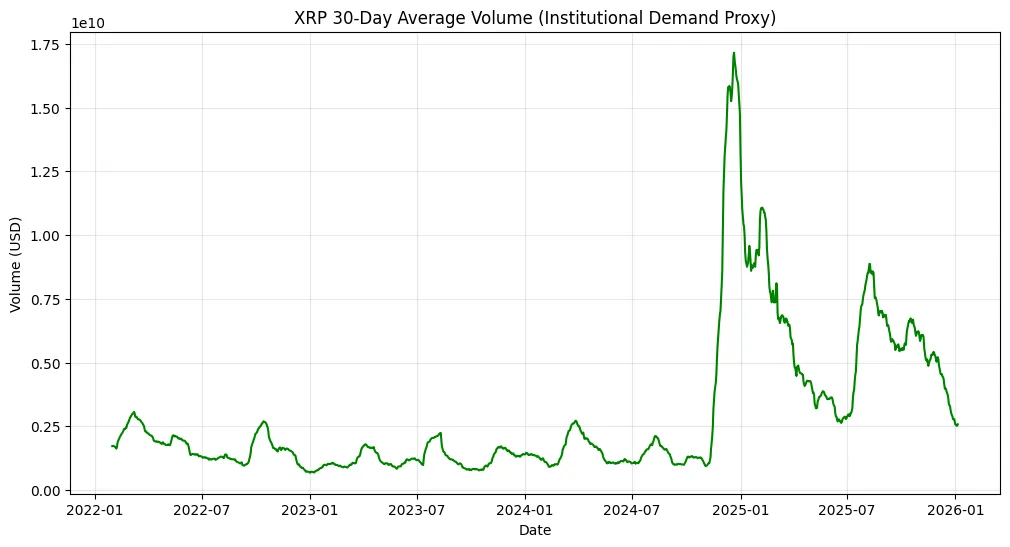
Institutional behavior has reinforced the regulatory narrative. U.S. XRP-spot ETFs have now posted eight consecutive weeks of net inflows, absorbing more than $1.18 billion since launch. The most recent reporting week alone saw inflows exceeding $43 million, underscoring persistent demand.
This stands in stark contrast to Bitcoin spot ETFs, which have experienced sustained outflows since mid-November. The divergence suggests that allocators are not simply increasing crypto exposure broadly but are selectively positioning for assets expected to benefit most from regulatory normalization. In this context, XRP is increasingly viewed not as a speculative token but as a regulated-access play.
Decoupling from bitcoin gains momentum
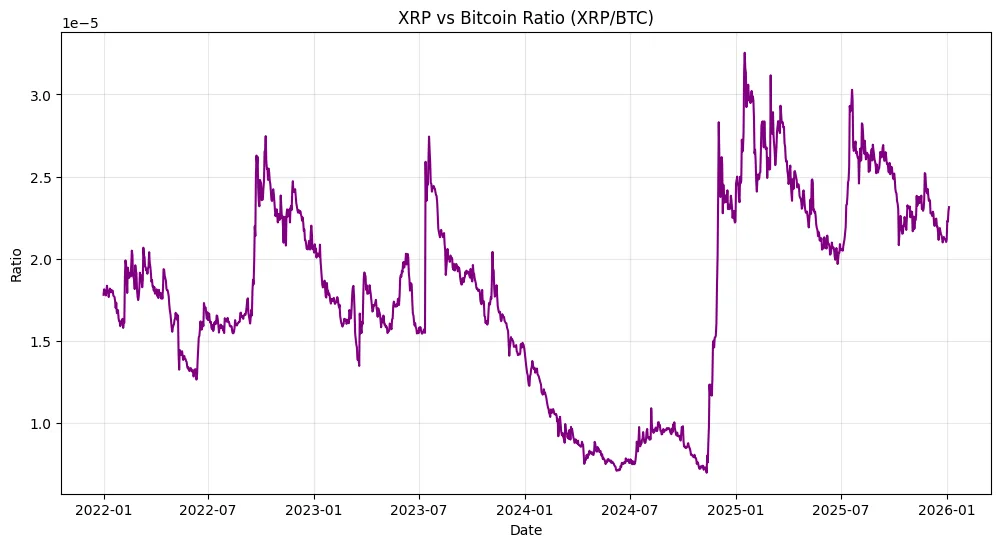
In the wake of these changes, XRP is no longer that closely interlinked with Bitcoin. The trading of Bitcoin still largely depends on macroeconomic factors, while XRP is getting more and more influenced by unique factors like legislation and ETF demand. The strong performance of the XRP/BTC pair at the very beginning of January pointed out this differentiation.
The emerging separation is an indication of a larger market reevaluation. XRP is now being valued more like a separate asset with its own regulatory and institutional demand curve rather than being characterized just as a high-beta extension of Bitcoin. That difference is crucial, especially when the market is becoming picky about where to invest its capital.
On-chain activity signals supply tightening
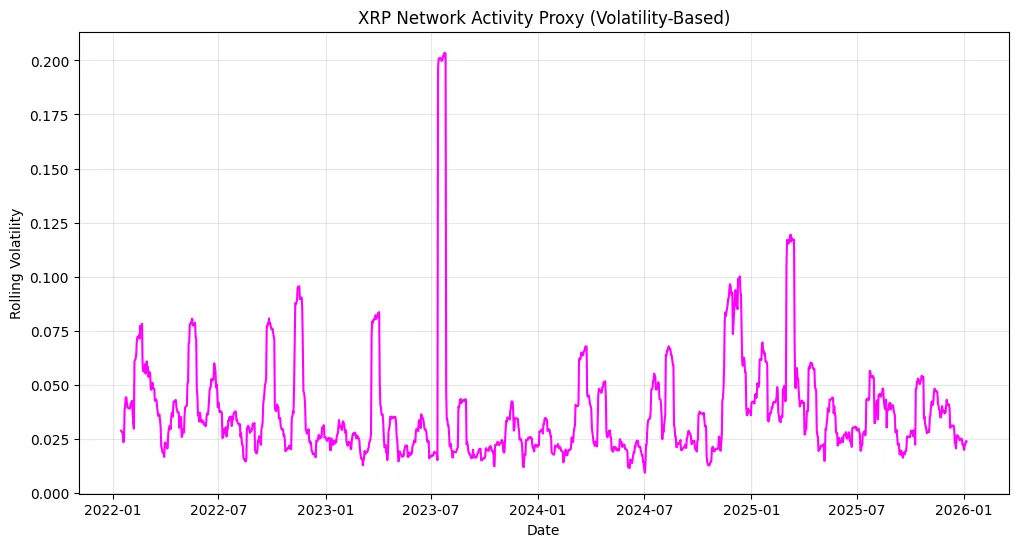
The data recorded on the blockchain backs up the positive view. In the first month of the year, the number of XRP accounts with activity went past 19,500, which was the highest number for the month and one of the most considerable figures since the beginning of December. The increasing number of transactions on the network that usually accompanies a price recovery is a sign of real participation maintaining rather than the intervention of leveraged margin sellers.
The rise in the number of active accounts when placed along with the ETF-driven accumulation suggests that the circulating supply is getting more and more limited. This situation keeps reinforcing the upward trend of institutional demand and is also a reason why retracements have been minor even with the volatility in the overall market.
Technical structure shows early confirmation
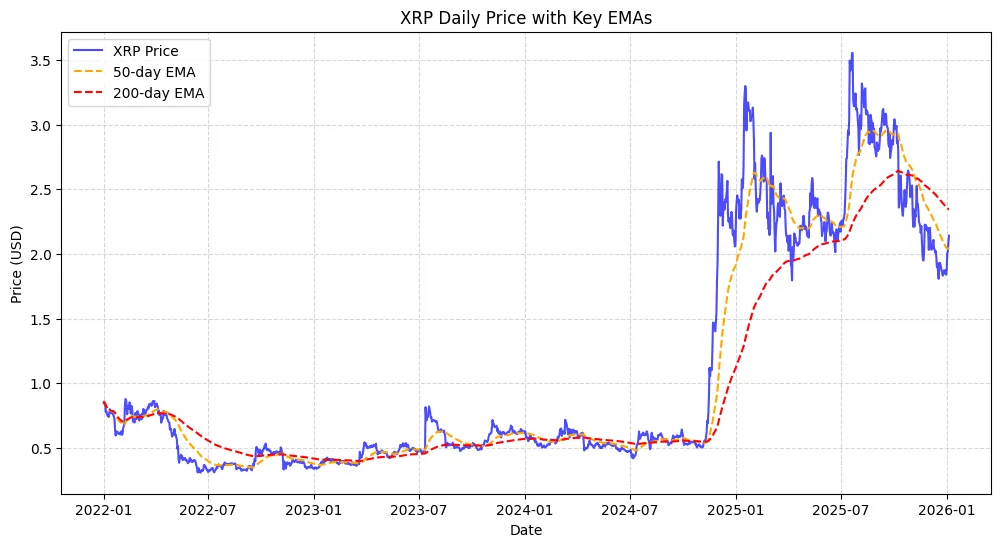
From a technical viewpoint, XRP’s structure indicates early confirmation rather than a surplus. The reclaim of the 50-day EMA serves as a signal for a trend reversal, while the price that stays beneath the 200-day EMA implies that the market has not hit the overbought condition yet. This formation, more often than not, is characteristic of the initial phase of considerable trends, where the fundamentals gradually take control over the old resistance levels.
Along with this, as long as XRP is above the psychologically important $2.00, the bullish pattern is still there. A strong bullish breakout over $2.20 would bring the 200-day EMA and the $2.50 area into the spotlight; conversely, a holding above those levels would confirm the medium-term scenario that is aiming for a climb towards $3.00.
Forward outlook and risk factors
The positive perspective carries with it a certain amount of danger. A move to a more aggressive stance on monetary policy by the Bank of Japan could lead to a reversal of the carry trade and, as a consequence, a destabilization of the global risk markets. Also, longer-than-expected U.S. rate cuts by the Federal Reserve would lead to a tightening of liquidity expectations.
Moreover, a reversal in ETF flows or legislative opposition to the Market Structure Bill would also work against the current demand narrative. In the light of such situations, XRP might retrace down to the $1.75 area, thus making the recent breakout invalid and bringing downside risk back into the picture.