



The Economic trigger: Yield as a competitive weapon
U.S. banks have been operating in a low-interest environment for many years where deposits cost them almost nothing and loan rates were much higher. Even the Federal Reserve’s rate hikes did not change the banks’ attitude towards retail depositors who were kept waiting for rate increases. On the other hand, crypto platforms quickly adapted by providing various ways of earning that were either riskless or even beyond: earning on stablecoins, staking rewards, and treasury exposure via tokenization that were in sync with or even better than the current risk-free rates.In such a scenario where the movement of capital is instantaneous and digital, the contest of yields has taken center stage. The savers have changed their criterion for choosing the bank by putting the return aspect in the first place, as opposed to the safety and convenience factor.
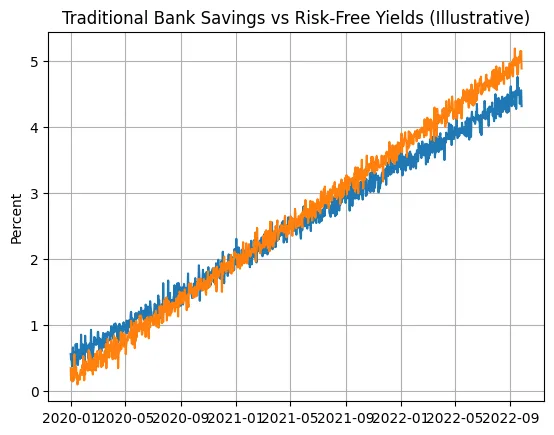
When a stable coin vault can grant 4-6% return with daily liquidity while a traditional savings account is lagging behind, the whole game is turned upside down! This whole thing has been a point of concern for the authorities in Washington, D.C. As a result, the lobbying by the banks has become intense with warnings to the regulators of “systemic risk”, “consumer harm”, and “shadow banking” in the crypto yield area. However, in reality, the banks are getting the competition they do not want: crypto is making them to pricing war, banks are not structurally optimized for it.
Washington’s regulatory pivot
The moves taken in the past few months by the regulators and the legislators show a tougher approach toward yield-bearing digital assets. The Securities and Exchange Commission (SEC)’s investigation into staking services, the banking watchdogs’ interference with those institutions that are favorable to the use of cryptos, and the Treasury’s insistence on cryptocurrencies regulation all suggest that the regulators are trying to come together and assert their control over the financial sector for the digital currencies once more.

The story has been transformed from that of the growth of the new technologies to one of their being restricted. Yield products are not recognized as financial instruments; they are considered as regulatory loopholes. This view enables the traditional financial sector to use its contacts and relations at the regulatory level to hinder the progress of the new financial systems that are based on cryptocurrencies. But the timing of the regulatory campaign is intentional. The banks are under pressure from both sides of the balance sheet as a result of the competition for deposits that is getting fiercer while at the same time interest rates are still high.
Regulators are demanding credit safety nets to be increased while depositors are asking for higher rates on their deposits. The yield products from the crypto market, which are not covered by the traditional deposit insurance and capital frameworks, are posing a challenge to banks as they are offering very attractive rates. Consequently, they are a disruptive force that the banking system cannot easily imitate.
The structural disadvantage of banks
Banks are not designed to be agile yield competitors. Their business model depends on maturity transformation, regulatory compliance, and balance sheet stability. Crypto platforms, by contrast, can route capital directly into treasuries, DeFi lending pools, or staking mechanisms without the same overhead.
This creates a fundamental asymmetry. When the Federal Reserve raises rates, crypto platforms can adjust yields almost instantly. Banks cannot. They are constrained by operational complexity, regulatory approvals, and legacy systems.
As a result, yield becomes a political issue. Instead of competing directly, banks seek regulatory intervention to limit the alternatives. This is not unprecedented. Financial history is filled with examples of incumbents using regulation to preserve market power when innovation threatens margins.
The stablecoin factor
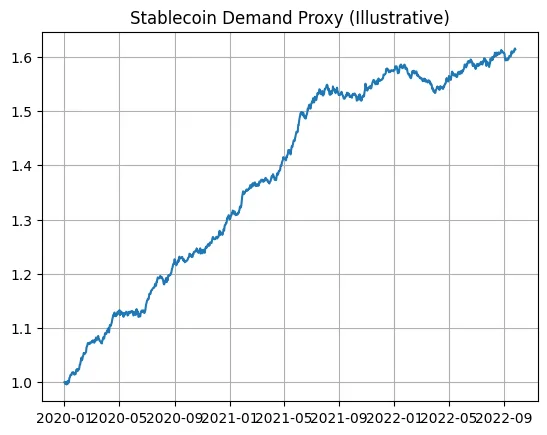
Stablecoins have transitioned from being speculative assets to sources of yield. Tokenized treasuries and the proliferation of earning stablecoin protocols have equally given the crypto ecosystem a yield resembling that of money market funds but with simplicity and speed of settlement as its main characteristics. This has led banks to reconsider their traditional role of accepting deposits and funding allocation which, in turn, has weakened the banking sector’s value proposition.
Regulators take it as a case of clever capital opting for the non-banking route and thus they want heavy supervision clampdown on stablecoins to pre-empt any risk that may arise; Banks argue that stablecoins’ existence is a cause of instability in the financial market while supporters of digital currencies consider it as the next milestone in cash management.All three views contain part of the truth. But it is only the one with the strongest regulatory grasp that can dictate the outcome.
Political economy of financial control
Financial regulation has always been a matter of power rather than risk. Who controls the flow of money? Who determines the rules? Who profited from being forced to incur compliance costs? Over the years, banks have built up their immense power and position in Washington, while crypto has not yet acquired any. The regulatory pressure increases as digital finance starts to openly compete with the traditional banking sector. This is not due to crypto being extremely dangerous, but rather because its being extremely disruptive is what the regulators fear most.
The present policy framework is but a reflection of the war that is going on between the old and the new financial worlds. The old world is based on a legacy system that always prioritizes stability and control, while the new world is based on a programmable, market-driven system that always prioritizes efficiency and yield. Yield is the point of divergence where these two systems meet.
Market implications for crypto
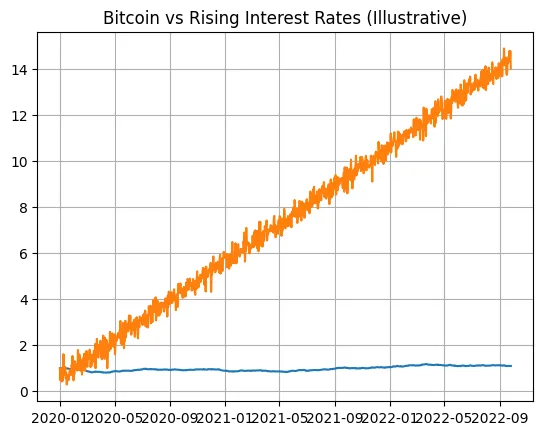
Regulatory pressure, at least from the standpoint of investors, is not a demand killer but a demand shifter. Scrutiny on centralized yield platforms elevates the status of decentralized ones. Restrictions on U.S.-based services lead to the expansion of offshore platforms. Capital is not lost. It changes forms. Regulators are thus presented with a paradox. Their measures against crypto yield could lead to more activity in opaque channels, hence increasing systemic risk rather than reducing it.
Financial repression has not been a stability factor. It has always caused migration.Faced with this yield narrative, crypto markets have no choice but to see the long-term value of decentralized infrastructure being kept alive. The more regulations hit the centralized access points, the more valuable become the financial rails that resist censorship.
The banking revolt
The expression “banking revolt” should be taken literally. The lobbying disclosures, the public statements, and the regulatory testimony all point to a coordinated effort to interpret crypto yield as a danger to the stability of the financial system. The banks are not against the tech. They are against the competition.
This revolt is not the visionary type but rather the defensive one. Its aim is to maintain an economic model that enjoys the protection of regulations. However, the regulatory protection will not be able to stop the technology mixing. It can only delay it. The crypto yield advantage is not a short-term phenomenon. Rather, it is an outcome of a capital allocation system that is more efficient by nature.
The long-term outlook
Yield will be the main point of contest between the conventional financial system and the digital financial system. The battle for the market will go on till the crypto can give the same or even better return with lesser friction. Therefore, there will be constant pressure on the traditional finance from the side of the crypto. Washington’s handling of the situation will probably be through two methods at the same time: One is the stricter regulations for the centralized platforms and the other is the allowed cautious experiments with the regulated digital assets.
The situation thus created is an uneven one where the new technology can still be used but only under strict conditions. The investors’ message is simple. The communication regarding regulation does not affect the basic economic merits. Money follows the path of least resistance, thus, from the least to the most, i.e., around the–efficiency, transparency, and yield. Politics can slow this process down but cannot ultimately stop it.