



The Indiana House and Senate have passed HB 1042, which now goes to Governor Mike Braun. The bill limits taxes on cryptocurrencies and allows retirement accounts to invest in cryptocurrencies.
Indiana senators introduced a bill to Governor Mike Braun that will provide bitcoin users more legal rights and make it such that some state retirement and savings plans have to include a self-directed broking option with at least one crypto investment choice.
Crypto protections and tax limits
Legiscan says that House Bill 1042 (HB1042) for the “regulation and investment of cryptocurrency” passed the legislature on Wednesday, with 59 lawmakers voting in favour and 33 against it.

The measure aims to defend the rights of Bitcoin (BTC $68,189) and cryptocurrency investors, stop unfair crypto taxes, and allow state retirement programmes to own digital assets.
Braun will have to sign the law. If signed, most of the rules will go into force on July. The requirement for a self-directed broker for retirement plans would go into effect later.
Several US states have already passed measures to safeguard crypto investors. Oklahoma did so in November 2024, while Kentucky did so in March 2025.
In October 2024, Pennsylvania’s House Bill 2481 (HB2481) to protect crypto investors’ rights passed with substantial support from both parties. However, it has not yet been signed into law.
The cryptocurrency rights bill in Indiana is different from the others since it is the only one that tries to make self-directed broking accounts available to make crypto retirement plans easier.
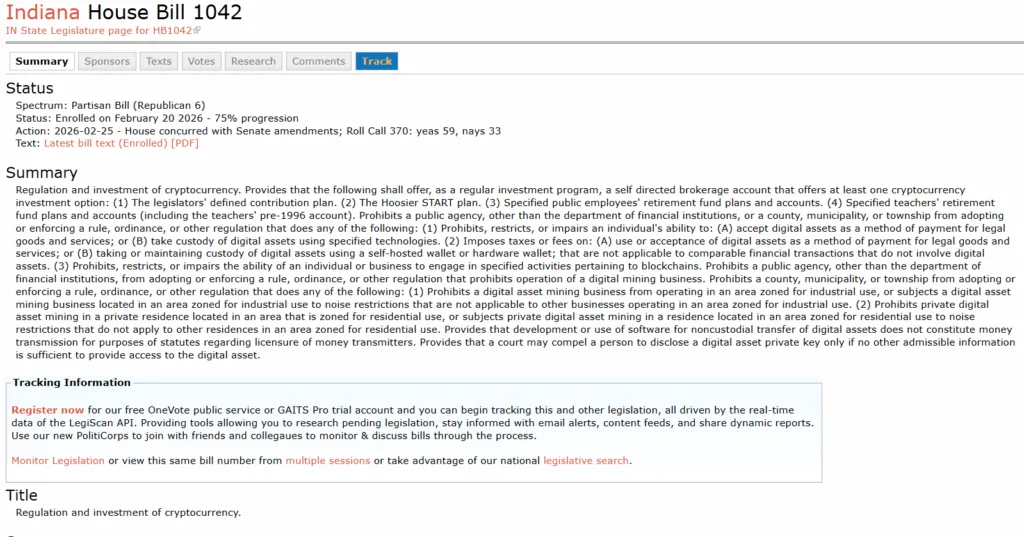
Source: Legiscan
How Indiana compares to other states
For the first time, the law would let people in Indiana include Bitcoin and other digital assets in their retirement plans.
brokerage If the measure is signed, it will force some state retirement and savings plans to offer self-directed broking accounts with at least one cryptocurrency investment choice by July 1, 2027.
This would include the lawmakers’ defined contribution plan, the Hoosier START plan, certain public employees’ retirement funds, and certain teachers’ retirement fund plans, to name a few.
The bill also has other important parts that protect the rights of crypto investors from potential government crackdowns.
Indiana’s measure would stop state and local public entities from making or implementing policies that would make legal crypto payments, self-custody, or mining illegal, save for the bill’s exceptions.
The law says that public agencies, except for the Department of Financial Institutions, can’t make rules that stop people from accepting digital asset payments for legal goods and services, taking care of their crypto holdings, or charging taxes and fees on crypto payments and self-custodied holdings.
The bill also prohibits the enforcement of rules that would prevent firms or individuals from mining cryptocurrencies.