


Intel’s earnings for the quarter have left financial markets in doldrums after the chip maker reported subpar guidance for the coming three months, despite the fourth quarter earnings beating market expectations.
The semiconductor giant expects revenue for Q1 2026 to be around $12.2 billion, down from the market consensus of $12.53 billion. Additionally, it is forecasting a breakeven adjusted earnings per share, which is below LSEG’s expectations of 5 cents earnings per share.
“We exceeded Q4 expectations across revenue, gross margin, and EPS even as we navigated industry-wide supply shortages,” said David Zinsner, Intel CFO.

He further said, “We expect our available supply to be at its lowest level in Q1 before improving in Q2 and beyond.”
Furthermore, Intel reported fourth quarter earnings per share of 15 cents, beating expectations of 8 cents, while revenue came in at $13.7 billion, slightly above the anticipated $13.4 billion.
Intel’s forecast disappoints markets
The drop in future projections show Intel’s shortcomings and challenges in anticipating worldwide semiconductor markets, which in return have hurt the firm’s EPS margins.
Meanwhile, Intel executives said the business was taken by surprise by rising demand for server central processors, which accompany AI chips.
Intel’s factory capacity, however, is insufficient to meet the demand, resulting in unprofitable data centre sales and a stress on margins due to new PC chips.
Lip-Bu Tan, chief executive officer of Intel said, “In the short term, I’m sad that we are not able to fully match the demand in our markets.”
Parallel to the earnings, one of the last legs of hope for Intel investors was the market support that the industry behemoth had received.
Last year, Intel gained high-profile investments, including $5 billion from Nvidia, $2 billion from SoftBank, and a stake from the US government, boosting investor confidence in the company’s resurrection.
Intel investors await signs of recovery
NASDAQ-listed Intel is among the most high profile stocks, making the earnings report a high priority market event.
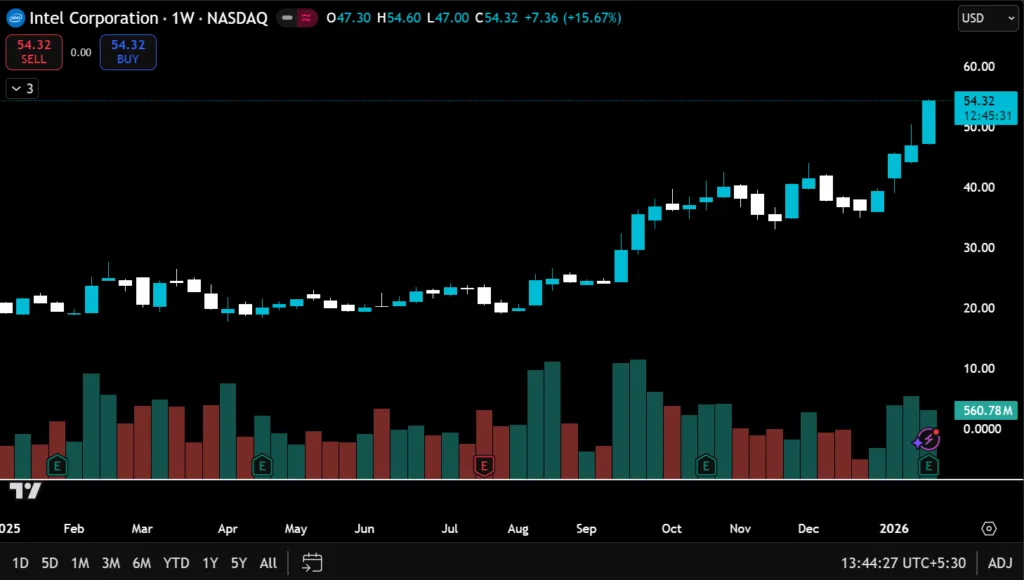
Investors were really excited about Intel, with its stock soaring 147% over the past year, mostly on hopes that it could land its first big customer for its chip-making business.
The latest guidance, however, didn’t quite meet expectations, leaving many feeling a bit let down. With the disappointing outlook and stall in manufacturing, Intel shares saw a sharp decline of over 13% during the after market hours on Thursday.
Still, people are watching closely, hoping for signs that Intel can turn things around. Investor focus has now shifted on whether the company can deliver on its promises, win more clients, show real progress and fix the manufacturing delays.
Additionally, the crunched chip market, which saw a stalling valuation growth in late 2025, is expected to pick pace in the later months of 2026, giving the tech giants the much needed momentum they have been missing.
Intel’s 18A chips stay last resort for earnings turnaround
Intel’s CEO, Tan, recently said that their new 18A chip-making technology performed even better than expected in 2025.
The 18A chips are Intel’s next-generation, advanced semiconductor processors designed for high performance, competing with Taiwan’s TSMC 2nm technology.
As of now, Intel hasn’t disclosed exact revenue from 18A chip sales, but the company is ramping up production to meet strong customer demand, suggesting it could become a significant revenue driver in the coming years.
However, according to Reuters, just a small percentage of the chips produced using 18A are suitable for customer use. Intel has stated that its yields, or the number of good chips per silicon wafer, are improving monthly.
The processor manufacturer’s biggest test is to ramp up production and quality of the chips in case it wants to bank on its sales for a revenue recovery. The firm will also have to produce higher nails at a better price in order to beat competition and maintain market dominance since weak yields frequently put pressure on margins.
During the conference call, Tan stated that 18A yields are consistent with Intel’s internal plans but “still below what I want them to be.”
However, on the bright side, Tan says that the firm is “working aggressively” to increase 18A supply to meet “strong customer demand.”