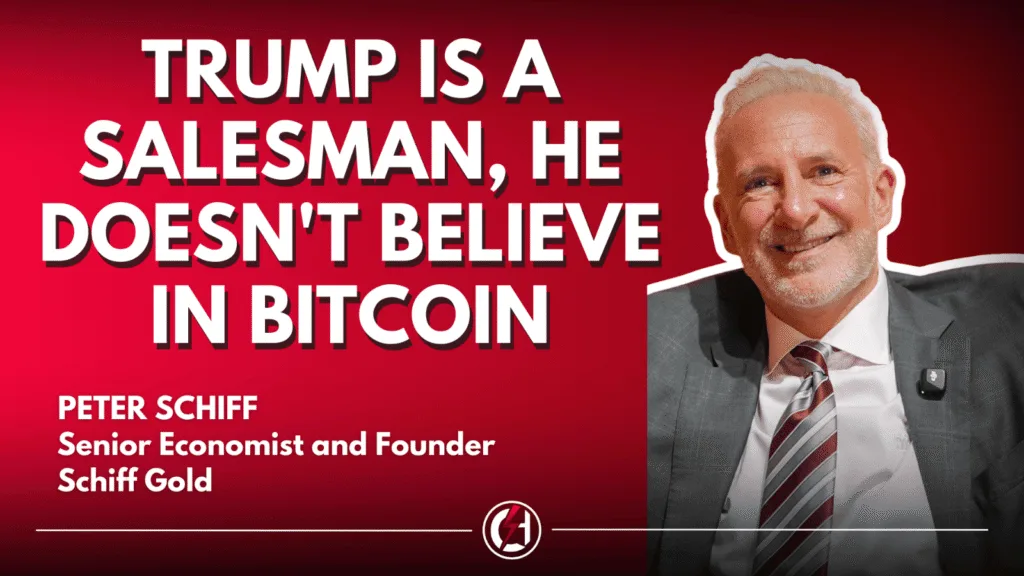



There are few Bitcoin critics as well known, and as outspoken, as U.S. investor and stock broker, Peter Schiff. For someone who has repeatedly gone on record calling crypto a ‘ponzi scheme,’ being at the Binance Blockchain Week event in Dubai was an opportunity to feel first hand the full pulse of the collective optimism of hardcore Bitcoin maxis.
But Schiff was unfazed.
“Well, they’re not all maxis,” he said, gesturing at the exhibition booths. “There’s all kinds of stuff, altcoins, companies involved in one aspect or another of crypto-related industries, blockchain. I’m not sure how many of them are Bitcoin maxis, but there’s certainly a few around.”

Bitcoin is fiction built on hype
Once you get him started on crypto in general and Bitcoin in particular, Peter Schiff doesn’t hold back.
“I think most of the crypto industry is built on the fiction of Bitcoin,” he said. “Without all the hype and all the money that’s been made in Bitcoin and Ethereum. I think the whole industry would not be here.”
Schiff isn’t an optimist, but he’s not a pessimist either. He’s a businessman with realistic views of the market and what needs to be done to make money. Volatility or speculation isn’t an integral part of his business plan.
“Most of the companies exhibiting here are going to go out of business,” he continued. “I don’t think there are real viable business models. I think it’s just a lot of hype that has attracted capital, speculative capital.”
Michael Saylor, and the strategy of Strategy
When I brought up Michael Saylor’s argument that volatility is a feature, not a bug, Schiff cut in without hesitation.
“Volatility is not a positive, especially if you’re marketing it as a store of value or safe haven,” he said. “To say that it’s a feature not a bug is just another lie. And he tells a lot of lies.”
On Saylor, or Strategy, Schiff pulls back no punches.
“He can’t buy Bitcoin anymore,” Schiff said. “The premium is gone. MicroStrategy is out of the Bitcoin-buying business, the whole thing has imploded. The shell game is over.”
What about Donald Trump’s crypto love?
This raises a more serious question. If Bitcoin is a ponzi scheme and Michael Saylor a fraud, what does that make the U.S. President? Donald Trump has been touted as America’s first crypto president, so how does that fit Schiff’s view of the crypto industry?
“Trump is a promoter,” he said. “Crypto was a great industry for his family to get into. It requires very little capital. Look what he lost: Trump coin, Melania coin. Made hundreds of millions of dollars off that crap.”
Then came perhaps his most scathing takedown of the entire conversation:
“Since crypto is all about hype and form over substance, it’s ideal for the Trumps to get involved in. It doesn’t mean Trump believes in any of this nonsense. When he was president the first time he said it was a scam, he said it was a fraud, until he got bought off by the crypto money.”
And Wall Street is following Trump’s lead.
“They’ve only embraced it because they’re making money off it. They don’t believe in it.”
The little guy is getting pushed out
If the president is selling it. The stock brokers are selling it. The hedge funds and institutions are selling it. Then who protects the retail investor?
Schiff, admits that is a problem. Political endorsement has led to resources being put into crypto which might have been better being utilised for something else.
“Resources that might have otherwise gone into something productive are instead going into crypto.”
And he made the point that crypto is perhaps the only industry begging for regulation. It has turned BTC into the very thing it aspired to defeat.
“Crypto is welcoming regulation because they’re looking to get legitimacy. They’re trying to convince people that the government is endorsing it. Bitcoin has become everything the original Bitcoiners hated.”
Bitcoin arms race: Where is the U.S. headed?
All this leads me to the global race for Bitcoin. With unsubstantiated reports suggesting China to be the biggest holder of BTC, where does Peter Schiff see the U.S. headed, especially with Donald Trump calling for America to become the biggest crypto nation.
“The only Bitcoin the Chinese or U.S. government has is the Bitcoin they seized,” he said. “People say it’s un-confiscatable, well, then how did the government seize all this? They should sell it. They shouldn’t be holding onto it. It was supposed to be anti-government. Not dependent on the government.”
The light at the end of the tunnel is tokenization
Yet, unlike many Bitcoin critics, Schiff does believe something in this industry will survive.
“I do think that there’s probably something here for blockchain and tokenization,” he said.
And in classic Schiff fashion, he made the case that the technology’s greatest value leads right back to his lifelong obsession: gold.
“Tokenized gold would be digital gold,” he said plainly. “If you own a token that’s backed by gold, that token is proof of ownership of gold. You can take the token to the issuer and they will give you gold.”
When seen through the Schiff prism the view becomes clear.
“Bitcoin is tokenized nothing. Tokenized gold is what Bitcoin pretends to be.”
Media, money, and the pyramid
Schiff has long argued that mainstream media soft-pedals Bitcoin because of advertising dependency. Here, too, he was unapologetically direct.
“Bitcoin needs more people to buy it to keep the pyramid going,” he said. “The industry spends a lot of money on ads. The more they legitimize Bitcoin to their audience, the more advertisers keep buying.”
It’s why, he feels, critics like him are fighting a lone battle.
“If they were being too critical, the advertisers would run away.”