



According to Bloomberg, Christopher Wood, Jefferies’ Greed & Fear strategist, has cut his Bitcoin holdings by 10% and switched into gold because of the quantum risk to BTC.
Christopher Wood, a long-time “Greed & Fear” strategist at the investment firm Jefferies, has apparently taken Bitcoin out of his main model portfolio. He did this because he is worried that improvements in quantum computing could make the cryptocurrency less secure in the long run.
Institutional unease grows around long-term security assumptions
According to a Bloomberg article, Wood noted in the latest issue of his Greed & Fear newsletter that the 10% Bitcoin (BTC $95,499) allocation he introduced in late 2020 has been replaced with a split position in physical gold and gold mining equities.

He stated that quantum advancements could potentially reduce the reliability of Bitcoin as a value store for pension-style investors.
Wood also said that long-term, institutional investors are becoming more worried about quantum risk. He cautioned that as quantum timelines shorten, some individuals making investment decisions are now doubting Bitcoin’s potential as a value store.
He said he was worried that “cryptographically relevant” machines might show up sooner than expected. This could let attackers get private keys from public keys that are exposed, which would weaken the cryptography that protects Bitcoin balances and mining rewards. In the worst case, the breach could make Bitcoin less useful as “digital gold” for pension-style portfolios.
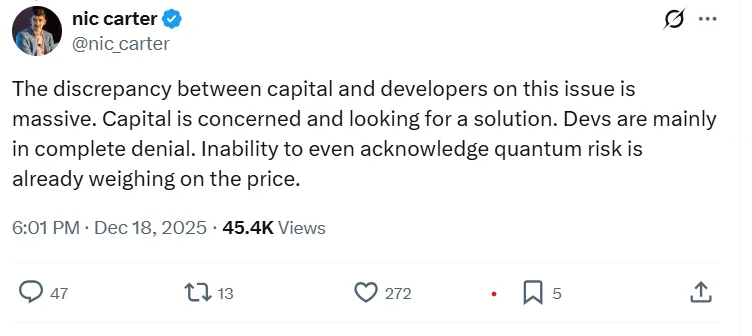
Source: Nic Carter
Quantum risk enters mainstream asset allocation discussions
Developers and commentators have been talking about the quantum issue for years, but Wood’s move highlights how it is now affecting the decisions of large broking and research firms about how to allocate assets.
Nic Carter, a partner at Castle Island Ventures and a supporter of Bitcoin, has talked a lot about the quantum issue. In December, he warned that “capital is concerned and looking for a solution” on quantum risk, even though many developers, including Blockstream CEO Adam Back, don’t think it’s a problem that will happen soon.
In the last several months, macro expert Luke Gromen has also become less bullish on Bitcoin. He says that macro- and technological uncertainties, such as the risk of quantum computing, make him prefer increased gold exposure over BTC for a multi-cycle outlook.
EY and PwC, among other companies, have also pointed out that quantum computing is a major new danger to standard public key cryptography. They warn that financial systems, especially those that support digital assets, need to plan for ways to move to quantum-resistant alternatives.
Bitcoin developers argue the threat remains distant
Bitcoin developers and core infrastructure builders claim that quantum development is not an immediate threat. They say that Bitcoin has time to react.
Adam Back, the CEO of Blockstream, has said many times that it will probably take 20 to 40 years to break Bitcoin’s current signature schemes. He also said that the network would have plenty of time to switch to post-quantum signature algorithms and better key management practices long before a real-world break is possible.
Other researchers, like one from a16z, also agree that it is unlikely that a “cryptographically relevant” quantum computer that can break today’s public key systems would be developed this decade.
They suggest that the biggest threats in the near future come from faults in the system, bad governance, and “harvest now, decrypt later” assaults on encrypted data, not attacks on live blockchain signatures right now.