



Financial markets are rapidly recalibrating expectations for U.S. monetary policy, with new data indicating that investors are no longer pricing in interest rate cuts in the near term.
According to the CME FedWatch Tool, the market now anticipates the U.S. Federal Reserve to hold rates steady throughout much of the year, whereas the prospect of future rate hikes, including as far as 2027, has started to rise. This is because the market is increasingly expecting the U.S. Federal Reserve to hold rates steady as a way to keep inflation under control, a notion referred to as a “higher-for-longer” policy.
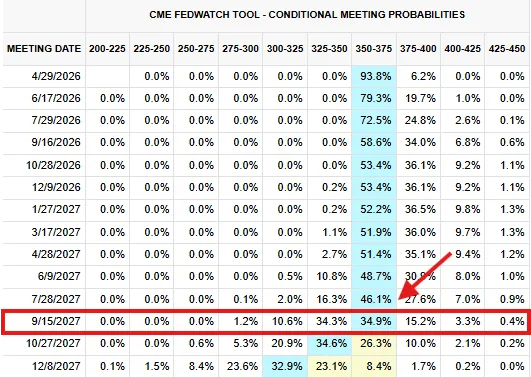
The move is a significant departure from the market’s earlier anticipation that the Federal Reserve would begin to ease rates in 2026.

However, the resilience of the economy, steady labor market data, and sticky inflation rates have prompted market traders to reassess the possibility of the Fed easing rates. As such, the market is now in a conservative state where interest rates are expected to remain high for a long time.
The CME FedWatch Tool, which derives probabilities from federal funds futures trading, is widely used by investors to gauge market sentiment about future Federal Reserve decisions.
Recent data suggests that the chances of rate cuts are dwindling, while the likelihood of keeping rates steady for the rest of the year has risen considerably. Looking further ahead, the data points to a slow uptick in the probability of further tightening in the months ahead. This is fueled by worries that inflation could resurface if rates are lowered too soon.
For policymakers, this shift in expectations is consistent with the Federal Reserve’s message over the past few months. In their view, they have repeatedly stated that they will need to see sustained evidence of declining inflation rates before they will consider cutting rates. Although inflation rates have come down from their highest levels, they are still above the central bank’s long-run target.
How will crypto markets get impacted?
The implications of the policy perspective can be seen extending well beyond the realm of traditional financial markets, particularly in the cryptocurrency sector, which has become increasingly sensitive to macroeconomic conditions in recent years. In the past few years, cryptocurrencies have shown a significant level of correlation with interest rate and liquidity conditions.
In general, higher interest rates tend to decrease liquidity in the market as the cost of borrowing increases and investors begin to allocate more of their capital toward safer investments such as government bonds. In this environment, risk assets such as cryptocurrencies tend to experience downward pressure.
The current trend away from rate cut expectations could therefore impact the bullish trend in the crypto space, especially if rates stay high for longer than expected.
The best time for Bitcoin and the top digital currencies has always been during a time of high liquidity and low interest rates. A high interest rate environment for longer than expected could slow the rate at which money flows into the digital space, especially for institutional investors.
However, the absence of rate hikes in the near term could also provide stability in the market, which is usually a welcome trend. A stable interest rate environment could provide investors with the ability to plan effectively, even if the rates are high.
Another aspect to consider in the current market is the rising US dollar, which usually accompanies high interest rates. The rising dollar could impact the digital currencies because most digital currencies are priced in dollars, making it difficult for investors in other countries to acquire the currencies.
However, in regions experiencing currency depreciation or inflation, cryptocurrencies may still attract demand as alternative stores of value.
Institutional participation also key for crypto markets
The institutional participation in the crypto market also has a crucial role to play in the response of the crypto assets to the changing rate expectations.
If the high rates continue, the institutional investors may take a conservative approach in managing the assets that they hold in the market. However, despite the challenges that the crypto market may be facing in the short term, the overall outlook of the market continues to be influenced by the structural growth drivers that are beyond the monetary policy considerations.
In the recent past, spot Bitcoin exchange-traded funds, stablecoins, and the overall growth in the development of blockchain-based financial services have helped in the participation of new players in the market, which has aided in offsetting the overall negative impact of the tighter financial conditions.
Further, the overall growth in the market has also been influenced by the narrative that Bitcoin and the overall class of cryptocurrencies are a hedge against monetary instability or the overall rise in government debt levels.
If inflation cannot be controlled or growth slows down considerably, the promise of future policy easing could quickly revive, perhaps sparking a new interest in cryptocurrencies.
The trajectory of interest rates will significantly influence the future of cryptocurrencies. Both investors and traders are poised to scrutinize upcoming employment figures and inflation data. They’re searching for hints that might suggest a change in the Federal Reserve’s strategy.
If there are indications that the Fed is gearing up to ease or further tighten monetary policy, the market could quickly react.
The message sent by futures markets today is unequivocal: the days of imminent rate cuts appear to be behind us, and the future looks like it will be characterized by continued monetary restraint.
The environment in which the cryptocurrency industry operates has both positives and negatives in the current climate as the assets continue to mature in the increasingly macro-driven world of finance.