




The Iran war has pushed energy markets and lifted inflation anxiety. That shift forced traders to rethink the path for Fed rate cuts. The Federal Reserve held its target range at 3.50 percent to 3.75 percent in March. Officials said they will assess data, outlook, and risks.
Fed rate cuts repriced as Iran war lifts oil and inflation
War risk hit energy markets through the Strait of Hormuz. Brent surged toward $115 during the disruption. Higher fuel costs can push headline inflation quickly.
Fed minutes from March showed officials wrestling with that shock. A growing group warned that energy may feed into core prices. Some discussed hikes if inflation stayed above target.

Fed Vice Chair Philip Jefferson said the current stance fits the uncertainty. He flagged risks to both inflation and employment after the oil shock.That split helps explain why traders price fewer cuts.
CME FedWatch probabilities moved with each oil headline. According to reports, odds of a December cut rose from 14 percent to about 25 percent. It still called a cut unlikely.
Fed rate cuts depend on CPI as ceasefire cools crude
A two-week ceasefire triggered a sharp drop in crude. As reported, oil fell more than 15 percent to around $92 after the announcement. The move eased near-term inflation fears.
Oil prices then rebounded near $98 as doubts returned. Reuters cited restricted shipping and renewed strikes across the region. Markets also watched Iran control over strait transit.
There has been a debate over tolls and ship vetting in the strait. The push raised legal and trade concerns. Those frictions can keep risk premia in oil.
The next CPI print will shape rate pricing again. The BLS calendar sets the March CPI release for April 10 at 8:30 a.m. ET. Kiplinger expects March CPI to reflect the energy shock. It cited forecasts near three percent year over year.
Banks also outlined higher-risk paths for crude. Goldman Sachs said a severe disruption could lift Brent toward $115 later this year. J.P. Morgan warned oil could top $150 if disruptions persist.
Bitcoin price meets supply near 72,000 as liquidity thins
Bitcoin price rebounded from the 60,000 range to roughly 72,000 during the ceasefire relief. Glassnode said weak spot demand and softer futures activity still limit conviction.
That matters because crypto needs fresh cash during tightening fears. When traders price fewer cuts, they demand proof from spot. Thin spot demand can turn rallies fragile.
Onchain data note a tentative improvement in US spot ETF flows. Its 14-day average flipped back to modest net inflows after outflows. This flags a soft organic demand.
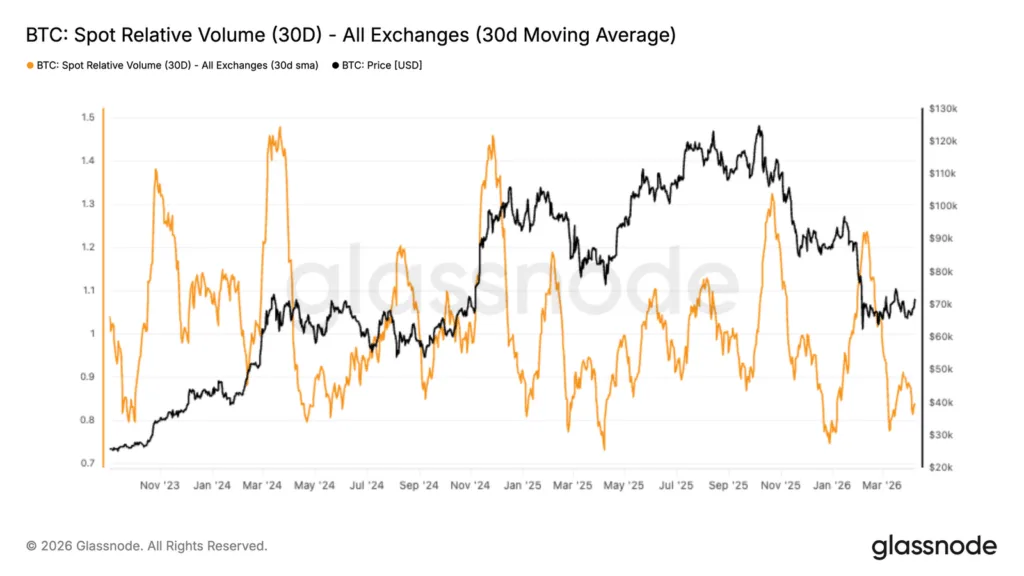
The falling futures participation implies lower volatility. Short-dated implied volatility moved back toward the low 40s.Yet option skew stayed tilted toward puts.
Glassnode data reveals 0.5 percent drop in seven-day average transfer volume, near 660,000 BTC. Lower volume often leaves price sensitive to small flows.
Glassnode maps the 78,000 to 82,000 zone that bulls must clear
Glassnode framed the current range as a bear market value zone. It placed Realized Price near $54,000 and True Market Mean near $78,000. This band often defines bear market trading.
It also flagged the Short-Term Holder Cost Basis near $81.6,000. This level is a key threshold for recovery. Recent buyers can sell into that zone.
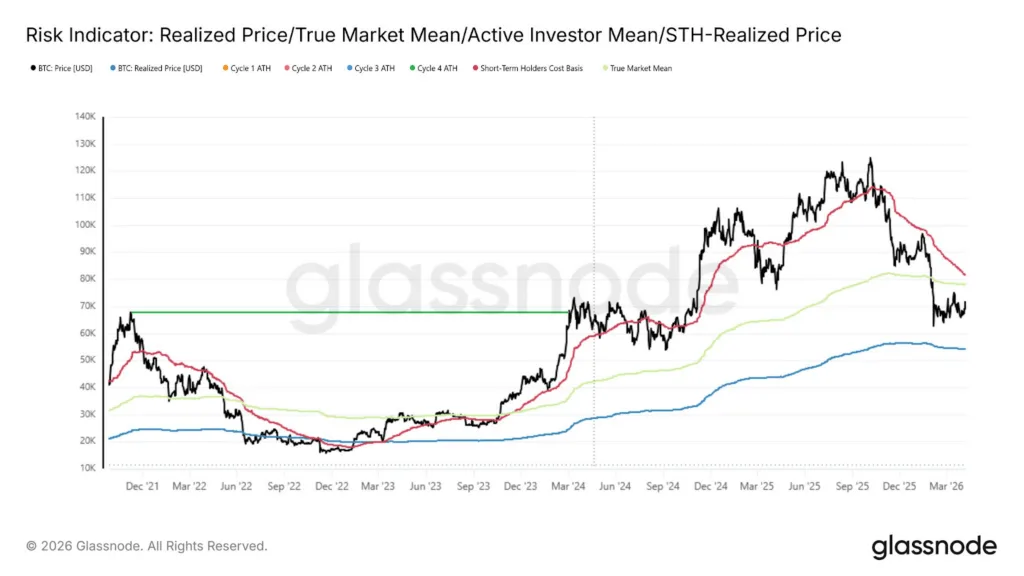
Glassnode added two conditions for a durable shift. It wants a stable short-term holder cost basis and lower realized loss pressure. Those signals can show capitulation cooling.
Options positioning also sketches nearby guardrails. Long gamma between 69,000 and 71,500 and short gamma overhead beyond 80,000.That setup can damp dips and cap breakouts.
Traders also watch nearer order-book zones. Analyst CW8900 highlighted sell walls around the low 70,000 range on X.
Fed rate cuts and leadership transition keep policy path unclear
Fed rate cuts also face a leadership change window in mid-May. Reuters reported that Kevin Warsh confirmation has moved slowly. It said Powell may continue until the Senate confirms a successor.
Barrons noted Powell term as chair ends May 15. It also described legal and political friction around confirmation timing. Brookings said Powell can stay on the Board through early 2028.
The next scheduled Fed meeting arrives April 28 to 29. Kiplinger flagged it as the next major policy waypoint after CPI. Markets will keep trading the same inputs, even as leadership shifts.
Oil prices, CPI surprises, and FedWatch probabilities will steer rates and Bitcoin price each day.