




On Wednesday, oil prices fell dramatically and U.S. stocks rose as a ceasefire between the United States and Iran went into effect, alleviating immediate concerns of further upheaval of the world energy markets.
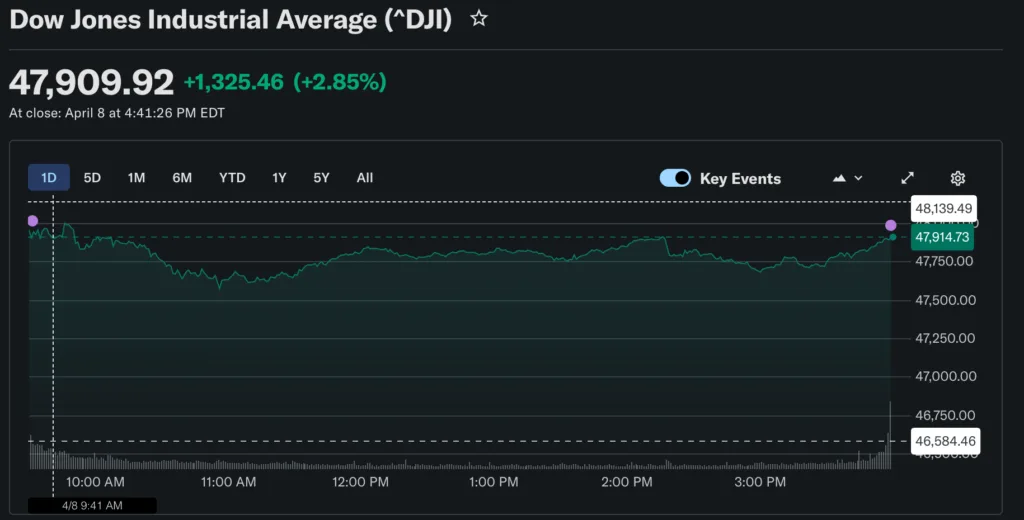
Dow enjoyed its best day in a year as traders reacted on the hope that tanker traffic across the Strait of Hormuz would resume.
The relief was however cushioned by the uncertainty of how long the truce would last and whether shipping would be normal through the waterway.

Oil sinks as traders react to ceasefire
Oil saw the largest single-day decline since April 2020 as the ceasefire lessened the threat of a prolonged supply shock in the Middle East. West Texas Intermediate lost 16.41 percent to close at $94.41 per barrel, and Brent crude lost 13.29 percent to settle at $94.75.
Following that slide, both benchmarks were still way above the levels that were recorded on February 27, prior to the onset of the conflict.
The downward trend was because traders had wagered that additional oil tankers would shortly be capable of going through the Strait of Hormuz. It is one of the most significant shipping routes in terms of energy as approximately 20 percent of the global oil supply passes through the route.
The successful blockade of the strait by the warring countries severed much of the Gulf exports and soared crude oil prices.
The white house mentioned that Iran had assured them that they would allow traffic through the strait to pass through but missions in the region reported that there were still numerous details that were not settled. That maintained a certain degree of caution in the market.
Bob McNally, founder and president of Rapidan Energy Group, told CNN that “the market has been eager to get good news but it remains to be seen if the Strait of Hormuz opens fully.”
That remained the central issue for oil traders. The ceasefire reduced short-term pressure, but tanker movements, export schedules, and passage terms still need to stabilize before the market can fully move beyond the shock.
President Donald Trump agreed to the ceasefire less than two hours before his 8 p.m. ET deadline to destroy a “whole civilization,” and he tied the deal to the reopening of the Strait of Hormuz.
“We received a 10 point proposal from Iran, and believe it is a workable basis on which to negotiate,” he said, in a Truth Social post on Tuesday night.
Dow posts best day in a year
On Wall Street, there was a rally when oil prices dropped and the risk of a broader confrontation was reduced. At press time, the Dow Jones Industrial Average climbed 1,325 points, or 2.85 percent, marking its strongest daily performance in a year (according to Yahoo Finance data).
S&P 500 increased by 2.51 percent and Nasdaq Composite by 2.8 percent as investors returned to risk assets.
The recovery was contagious in world markets. The Kospi in South Korea was 6.87 percent higher, the Nikkei of Japan was 5.39 percent higher and the Hang Seng of Hong Kong was 3.09 percent higher.
Germany (DAX) and France (CAC 40) gained 5.06 percent and 4.49 percent respectively in Europe. The profit was a general relief following days of tension through skyrocketing oil prices and the concerns of a wider regional conflict.
Also, market volatility declined. The fear gauge, the VIX, fell 22 percent and neared its pre-war level. That fall indicated that traders were withdrawing worst-case bets, but were keeping a watch on new events in the Middle East.
Bitcoin also rose as risk appetite improved. The token jumped from about $68,000 to a multi-week high near $72,000 after news of the ceasefire. It later pushed higher again and briefly approached $73,000.
At the time of reporting, Bitcoin traded at $71,550, up 2 percent over 24 hours and almost 5 percent over the past seven days, with daily trading volume at $51.17 billion (per CoinGecko’s data).
Strait of Hormuz still clouds the outlook
Despite the strong market reaction, the Strait of Hormuz remained the main source of uncertainty. The waterway is the key to oil and gas trade globally and any setback in restoring complete access may continue to keep the price of crude oil at elevated levels.
Traders were watching for signs that the large volume of oil trapped in the Gulf had started moving again.
MarineTraffic said there were “early signs” of resumed movement, noting that a Greek-owned bulk carrier and a Liberia-flagged vessel passed through the strait early Wednesday.
Still, the backlog remained large. Kpler estimated that 187 tankers carrying 172 million barrels of crude and refined products were still inside the Gulf as of Tuesday.
That means a full return to normal shipping will not happen at once. Iran also made clear that it viewed the ceasefire as temporary. State media said military branches would follow the order to stop firing, but officials also said the war had not ended.
Iran’s Secretariat of the Supreme National Security Council said Tehran would regulate movement through the strait. That added another layer of uncertainty for shipping companies and oil buyers. Questions also remained over possible transit charges and how those costs would be handled.
Reports said Iran and Oman were planning fees for ships using the route, and Tehran had already charged some companies about $2 million for safe passage in recent weeks.
Neil Shearing, group chief economist at Capital Economics, said fees of $1 million to $2 million per tanker would add about $1 per barrel to the cost of oil moved through the strait.
He described that as a “modest impact on global energy prices,” while also warning it could amount to a “de facto partial nationalisation of the shipping route.”
Gas prices may fall slowly
The fall in crude may eventually bring some relief to U.S. drivers, but analysts said the drop at the pump will not come right away. According to AAA, the average price of a gallon of regular gasoline has risen $1.18, or 40 percent, to $4.16 since the war began.
Retail fuel prices may begin to edge lower in the coming days, but a quick return to earlier levels is not expected.
GasBuddy estimated that it could take one to two weeks for the national average to move back below $4 per gallon.
Oil analyst Andy Lipow said it could take months for prices to return to less than $3 per gallon, since crude remains about $30 higher than it was before the conflict started. He also said gasoline futures were still about 70 cents above their pre-war level.
Lipow said restarting crude production in the Persian Gulf and getting exports flowing again would take time. That view matched the broader tone in the market.