
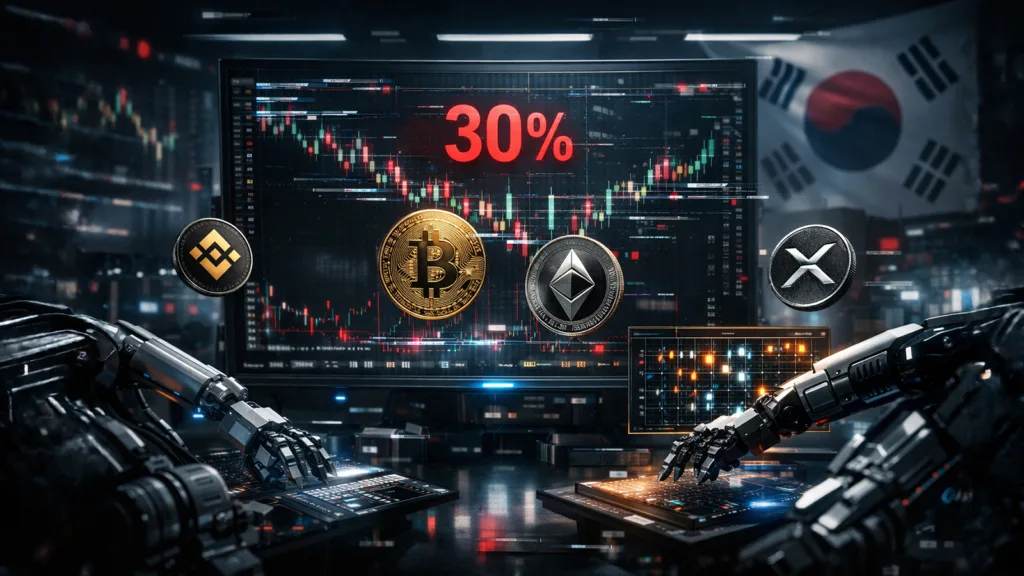



South Korea’s financial watchdog has raised concerns about automated trading tools driving a large share of cryptocurrency transactions. The Financial Supervisory Service (FSS) announced on Monday that it will launch targeted investigations into market manipulation schemes using application programming interfaces, or APIs.
These tools now account for more than 30 percent of total buy and sell orders in the country’s virtual asset markets. Regulators are concerned that some traders misuse these tools to manipulate prices and mislead everyday investors.
An API lets users connect software directly to an exchange. Traders can set rules in advance, and the program executes orders automatically without manual clicks.

This convenience and speed appeal to numerous participants. Nevertheless, the FSS observes that the same characteristics can facilitate unfair practices when exercised inappropriately.
How manipulation happens through automated tools
The FSS described two common schemes linked to API misuse. In one case, a trader used an API to place repeated small market orders worth 5,000 to 10,000 won.
These tiny trades created the false impression of strong demand. At the same time, the trader manually submitted higher-priced limit buy orders to push the asset’s value upward.
Once retail investors joined the rally, the manipulator sold their holdings for a quick profit.
Another method involves setting a target sell price well above the current market level. The trader then uses an API to repeatedly place high-priced buy orders.
This activity pulls the market price toward the preset target. After reaching that level, the trader sells their position.
The FSS also flagged other tactics, such as placing large fake buy orders that vanish before execution, or using multiple accounts to trade back and forth and inflate volume artificially.
Investors urged to stay cautious in volatile conditions
FSS warned API users not to blindly use high-frequency trading codes shared on social media or online groups. These automated trading methods may look useful, but they can be treated as suspicious activity.
In some cases, they may be seen as unfair practices like wash trading or unusual small-volume trades. The regulator also advised everyday investors to stay away from cryptocurrencies that suddenly jump in price or trading volume without a clear reason.
Such sharp moves are often risky and may not reflect real demand. The FSS added that extra caution is needed during certain times, especially when exchanges reset prices and high-frequency API trading becomes more active.
These moments can lead to sudden price spikes that may attract traders. However, the regulator warned that prices can fall quickly after such spikes. If investors buy at these levels, it is often difficult to recover losses in the short term.
The regulator confirmed it will launch targeted investigations when systems detect accounts with abnormal repetitive trading patterns. The goal is to protect market integrity and shield less experienced participants from schemes designed to exploit speed and automation.
The FSC stated, “If accounts are identified that have excessively repeated trading using APIs to induce trading, we will promptly conduct a targeted investigation and take strict measures.”
South Korea tightens crypto rules
The API trading warning comes as South Korea tightens crypto oversight after recent errors and fraud cases.
On 7 April, the Financial Services Commission (FSC) ordered exchanges to match records with actual assets every five minutes.
This followed a major mistake at Bithumb, where users received incorrect Bitcoin amounts. Now, exchanges must use automated systems to detect issues and pause trading instantly. Audits will also move from quarterly to monthly, with full rollout by April 2026.
On 8 April, the FSC tightened scam controls by fixing withdrawal rules. Earlier, unclear exemptions let fraudsters move stolen funds quickly.
Data showed these accounts caused most fraud losses. Now, exchanges must apply strict and clear checks before allowing fast withdrawals.
The Bank of Korea (BOK) has recently requested crypto exchanges to include automatic trading breaks, called circuit breakers. Authority officials stated that exchanges have to enhance internal controls and adhere to standards like traditional banks.
The BOK also collaborated with Banque de France to conduct a two-day seminar in Seoul. They talked about the impact that digital assets and climate risks are having on the global economy.
All these developments indicate that regulators are responding swiftly to risks. Simultaneously, courts remind authorities of the need to abide by clear standards of the law.