



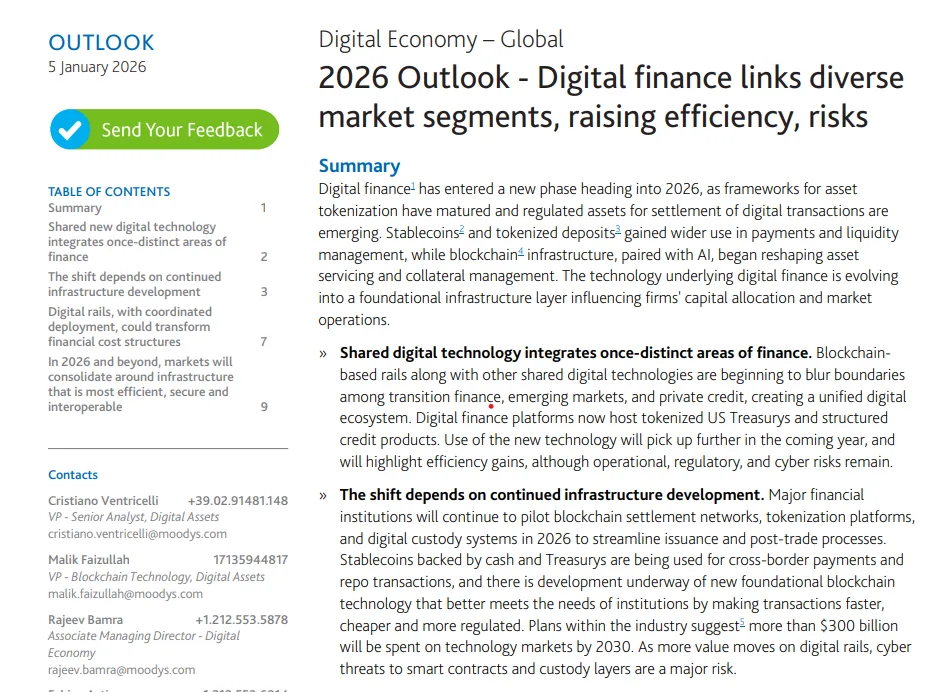
Moody’s has warned that stablecoins and tokenised deposits are becoming “digital cash” for institutions, with trillions of dollars in on-chain settlement volumes and billions of dollars in infrastructure expenditures.
Moody’s latest cross-sector outlook research says that stablecoins are moving from being a tool for crypto natives to being a key part of institutional market infrastructure.
The analysis, which came out on Monday, indicated that stablecoins processed roughly 87% more settlement volume in 2025 than the year before. This means that there were $9 trillion worth of transactions, based on industry estimates of onchain transactions rather than just bank-to-bank flows.

Moody’s noted that fiat-backed stablecoins and tokenised deposits are becoming “digital cash” for managing liquidity, moving collateral, and settling transactions in a financial system that is becoming increasingly tokenised.
Source: Moodys
Stablecoins integrate into institutional rails
As part of a bigger trend towards convergence between traditional and digital banking, Moody’s put stablecoins in the same category as tokenised bonds, ETFs, and credit products.
In 2025, banks, asset managers, and market infrastructure providers will conduct tests on blockchain settlement networks, tokenisation platforms, and digital custody. They wanted to make issuance, post-trade operations, and intraday liquidity management easier.
The report said that, because of these projects, businesses might spend more than $300 billion on digital finance and infrastructure by 2030, as they develop the rails for large-scale tokenisation and programmable settlement.
In that image, stablecoins and tokenised deposits are becoming more and more common as the asset used to settle cross-border payments, repos (short-term secured loans where one party sells securities and agrees to purchase them back later at a better price), and collateral transfers.
Moody’s said that regulated institutions utilised cash and US Treasury-backed stablecoins in 2025 to make it easier for funds, credit pools, and trading venues to move money around during the day. Banks like Citigroup and Société Générale were among those that tried it out.
JPM Coin is an example of a deposit token concept that adds programmable payments and liquidity management to current banking systems. This shows how “digital cash” layers can be added to established core systems.
Regulation advances alongside new risks
Regulation and hazards for “digital cash” Regulation is starting to catch up with this change. The report pointed to the European Union’s Markets in Crypto-Assets Regulation (MiCA) framework, US stablecoin and market structure proposals, and licensing frameworks in Singapore, Hong Kong, and the United Arab Emirates as examples of how the world is moving towards a common set of rules for tokenisation, custody, and redemption.
In Europe, the EURCV and related projects from Société Générale-Forge are examples of bank-issued products that were made possible by the EU’s new stablecoin framework. In the Gulf, banks and regulators are looking into payment tokens linked to the UAE dirham and other digital money systems.
Moody’s nonetheless said that the change is far from risk-free. The paper said that as more value transfers onto “digital rails,” new types of operational and counterparty risk might arise from smart contract problems, oracle failures, cyberattacks on custody systems, and fragmentation across different blockchains.