



The US National Credit Union Administration suggested that payment stablecoin issuers who work through credit union subsidiaries get federal licenses.
The National Credit Union Administration (NCUA) of the United States has put forward its first set of rules under the Guiding and Establishing National Innovation for US Stablecoins (GENIUS) Act. These rules show how federally insured credit unions’ subsidiaries could apply to become federally supervised payment stablecoin issuers.
This proposal from the NCUA lays out the steps and requirements for licensing such issuers and administers more than 4,000 federally insured credit unions with approximately 144 million members and nearly $2.38 trillion in assets as of mid-2025.

The plan says that any payment stablecoin issuer that is a “subsidiary of an insured credit union” would need to get an NCUA-approved payment stablecoin issuer (PPSI) license before they could issue coins.
Federally insured credit unions would also not be able to lend to or invest in payment stablecoin issuers unless those issuers have an NCUA PPSI license.
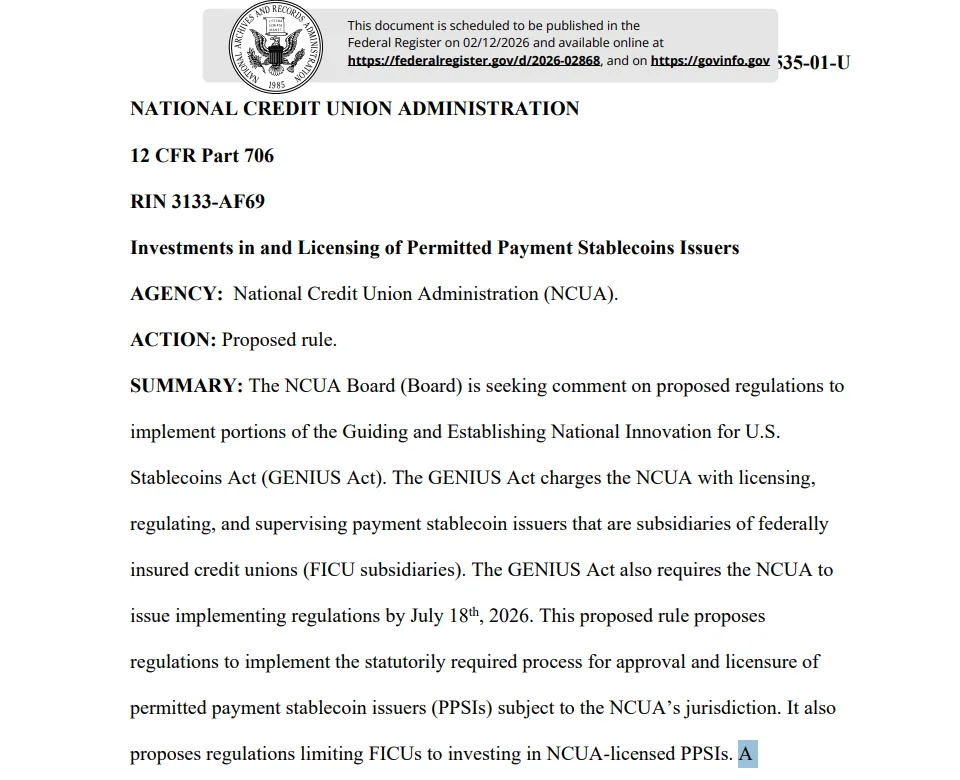
Source: NCUA
Licensing scope and supervisory structure
The proposal is only about licensing and limits on investments. A proposal that will be coming up soon will put GENIUS Act rules and standards into place for PPSIs. These will include rules for reserves, capital, liquidity, illegal finance, and managing IT risk.
For now, the rulemaking is about setting up the licensing and monitoring structure. Any future distribution of stablecoin services to members will depend on getting more approvals and setting more criteria.
“A forthcoming proposal will propose regulations to implement the standards and restrictions imposed by the GENIUS Act on PPSIs,” the preamble states.
Public blockchain neutrality and approval timeline
There are two things that stand out in the larger crypto market. First, the NCUA couldn’t turn down a mostly complete application because the stablecoin was issued “on an open, public, or decentralised network.” This language makes it clear that public blockchain issuance can’t be turned down for that reason alone.
Second, the agency would have 120 days to approve or refuse an application if it is considered “substantially complete.” If the NCUA does not act within that time frame, the application would be “deemed approved” by default.
The idea also puts into action a key design choice from the GENIUS Act. Credit unions and other insured depository organisations can’t directly issue stablecoins for payments. Instead, they have to employ independent businesses that fulfil the same federal regulations.
For credit unions, this usually entails routing activity through credit union service organisations and other qualified businesses that the NCUA considers to be “subsidiaries of an insured credit union.”
The paper is just a notice of a proposed rulemaking. Stakeholders have 60 days from the publication of the Federal Register to comment before the NCUA finalises or changes the licensing system.