



The fifth edition of the NFT Paris conference has been cancelled. The event, slated for February 5 and 6, would have brought together digital assets enthusiasts in Paris. Owing to the historic drop in sales of non-fungible tokens (NFTs) over the last year and a half, the organizers of the event deemed it unnecessary to host it regardless the market fall.
The official handle of NFT Paris that goes by the handle @nft_paris announced the cancellation to over 66,000 of its followers this week.
“The market collapse hit us hard. Despite drastic cost cuts and months of trying to make it work, we couldn’t pull it off this year. After four editions bringing together the global Web3 community in Paris, we have to face reality: NFT Paris 2026 will not happen,” the announcement said.

NFTs can be defined as blockchain-based digital collectibles that can be modelled after a wide array of things including celebrities, music, cartoons, sculptures, and similar artsy valuables. Buyers and owners of these non-fungible tokens receive a blockchain-etched proof-of-ownership — giving them complete autonomy over the property.
While NFTs were once integral, interactive components of metaverse ecosystems, both sectors have since lost their momentum and currently struggle with stagnant engagement.
NFT sales managed to amount around only $5.63 billion in 2025, tracing a 37 percent decline from the $8.9 billion recorded in 2024. Data by CryptoSlam shows that average sale prices also dipped last year, falling to $96 from $124 in 2024. The market for these digital collectibles had hit its highest valuation exceeding $23.8 billion in 2022.
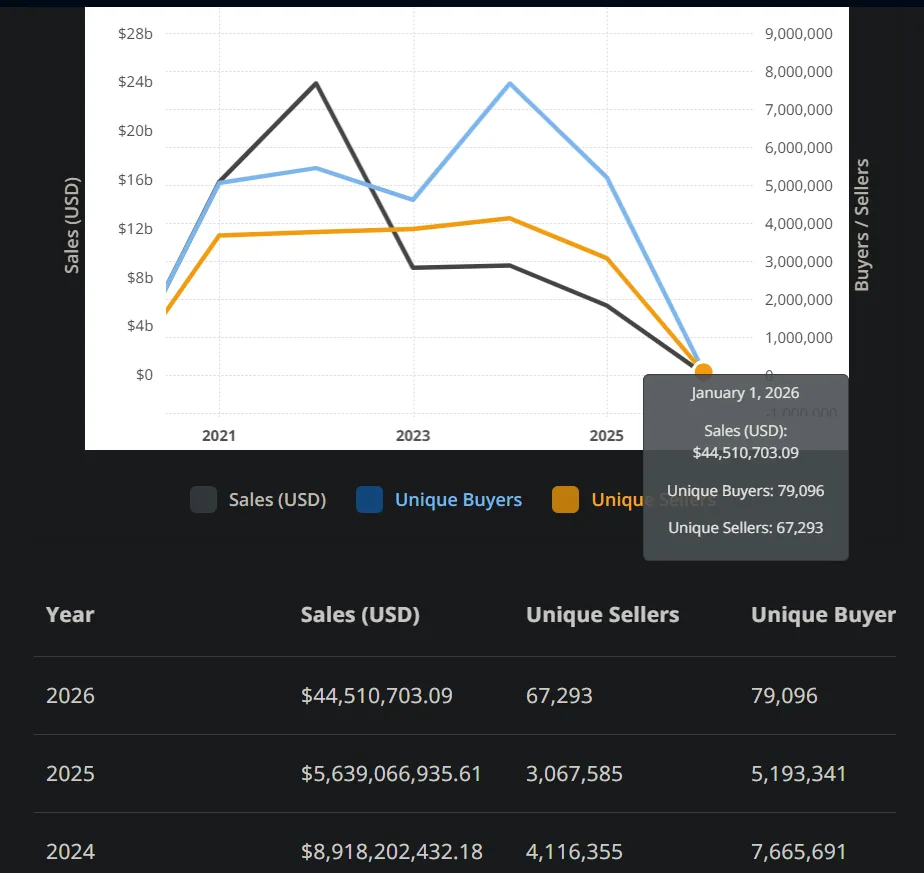
Source: CryptoSlam
As per reports, the general category ticket was priced $231.33 whereas the VIP Access pass was selling for $1,161.30. The NFT Paris team said attendees who had already purchased their tickets will be refunded within the next 15 days.
“We will be doing all we can to close this chapter properly,” the message from NFT Paris noted.
In 2025, the NFT market changed because there were fewer trades and a cultural shift wherein people seemed more interested in how NFTs could be used in the real world. By November last year, digital collectibles were worth less than 66 percent of what they were worth in January.