


The New York Stock Exchange (NYSE) and Securitize have moved closer to bringing tokenized securities into a regulated market structure. While NYSE is a TradFi giant, Sercuritize facilitates the tokenization or real-world assets (RWAs). Essentially, the move adds to a wider push to place traditional financial products on blockchain rails.
As per a press release on Tuesday, the two firms signed a memorandum of understanding (MoU) to support a new digital trading platform that will handle blockchain-native securities for corporate and ETF issuers.
The plan gives Securitize a central role in the early design of the platform’s transfer agent framework.

NYSE and Securitize set framework for tokenized securities
The NYSE, which operates under Intercontinental Exchange, said it will work with Securitize to support the buildout of tokenized securities markets.
Under the agreement, Securitize will serve as a design partner for a digital transfer agent program tied to an upcoming NYSE-affiliated Digital Trading Platform.
The partnership focuses on on-chain settlement for tokenized securities transactions. Both companies said they will work on standards for digital transfer agents and tokenization agents. Their work will cover regulatory, operational, and technical rules needed for institutional market use.
NYSE said Securitize is the first digital transfer agent eligible to mint blockchain-native securities for issuers on the planned platform. That role would allow Securitize to help issuers bring tokenized versions of securities to the market under a structure built for regulated use.
NYSE Group President Lynn Martin said the exchange wants to develop tokenization within established market protections. She stated,
”The NYSE continues to lead the industry in responsible innovation. As we explore how tokenization can enhance capital markets, it is critical that new infrastructure is developed in a way that preserves the trust, transparency, and protections investors expect.”
The agreement does not launch live tokenized stock trading on its own. It sets the groundwork for how tokenized securities could be issued, recorded, and settled through a platform linked to the NYSE. That makes the deal part of a broader infrastructure push rather than a finished product rollout.
Securitize’s role centers records, compliance, and issuance
Securitize comes into the deal with a background in tokenizing real world assets and as an SEC-registered transfer agent. That history permits it a direct role in the determination of how blockchain-based securities can be integrated into the rules that regulate traditional markets.
Meanwhile, transfer agents manage core functions in securities markets. They maintain ownership records, process certain corporate actions, and support issuer compliance. In a tokenized market, those same duties still matter, but the systems used to perform them must work with blockchain infrastructure.
NYSE and Securitize said the project will define how digital transfer agent infrastructure can support official ownership records and tokenized corporate actions. The firms also aim to ensure that tokenized securities meet the same market standards expected in conventional finance.
Subject to applicable requirements, the work is expected to support Securitize’s approval as a digital transfer agent on the platform. That step would place the company inside a regulated flow for blockchain-native securities rather than leaving issuance and recordkeeping to separate, less connected systems.
Securitize Markets is also expected to join the platform as a broker-dealer participant. That addition would expand Securitize’s role beyond transfer agent functions and into the broader market structure around issuer-sponsored tokenized securities.
Securitize Co-Founder and CEO Carlos Domingo described the effort as a regulated path for blockchain-based assets. He said,
”Securitize has spent years building the regulated infrastructure needed to bring real-world assets on-chain. We are proud to support NYSE in helping design the foundational transfer agent infrastructure for tokenized securities markets.”
Tokenized securities move closer to mainstream finance
The NYSE-Securitize agreement comes as tokenization gains more traction across financial markets. Firms in both traditional finance and crypto continue to build products that place conventional assets on blockchain networks for faster settlement, broader access, and round-the-clock transfer capability.
NYSE had already signaled this direction in January when it outlined plans for a digital platform that could support both trading and blockchain-based settlement for tokenized securities. That plan opened the door to a market where U.S. equities and exchange-traded funds could trade on a more continuous basis, including outside standard exchange hours.
Multiple other large firms are also moving in the same direction. This week itself, Nasdaq announced a partnership with crypto infrastructure company Talos to develop a system for tokenized collateral management for institutional users. Nasdaq said many assets held as collateral remain locked in accounts that do not move efficiently, and tokenization could improve how institutions use them.
In the offshore market, several crypto exchanges have already pushed tokenized stock exposure through derivatives. Coinbase rolled out 24/7 stock perpetual futures for non-U.S. users, while Binance and Kraken also launched tokenized perpetual futures tied to equities. These products differ from direct tokenized stock ownership, but they show growing demand for blockchain-based access to traditional market exposure.
Intercontinental Exchange has also stayed active in the digital asset space. As we reported earlier this month on March 5, reports said ICE was preparing to enter the U.S. tokenized stocks market. Separate reports also said ICE made a strategic investment in OKX, though the financial terms were not disclosed.
Market data shows rising demand for tokenized assets
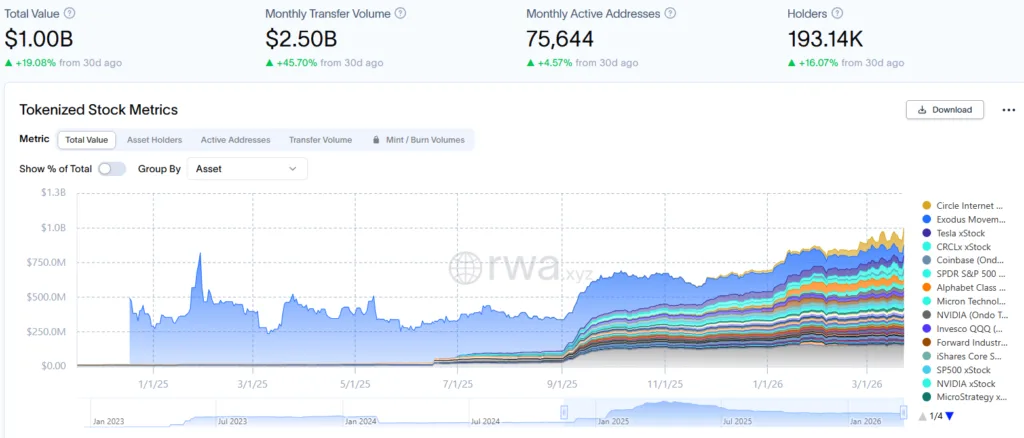
Demand for tokenized stocks has also increased in recent weeks. Data from RWA.xyz showed that the total value of tokenized stocks passed $1 billion on March 10. Over the previous 30 days, the number of tokenized stockholders rose 16 percent to 193,140, while monthly transfer volume climbed 45 percent to $2.5 billion.
Source: RWA.xyz
Even with that growth, tokenized stocks still account for a smaller share of the broader tokenized real-world asset market. RWA.xyz data placed tokenized stocks as the sixth-largest segment in a sector valued at about $26 billion. Tokenized U.S. Treasury debt ranked first with $11.8 billion, while tokenized commodities held the second position with more than $5 billion.
Research firms also expect further growth across the sector. Presto Research projected that tokenized assets could approach $490 billion by the end of 2026. The report pointed to demand for tokenized Treasury bills, credit products, and stablecoin-based payment activity as key drivers of that growth.