
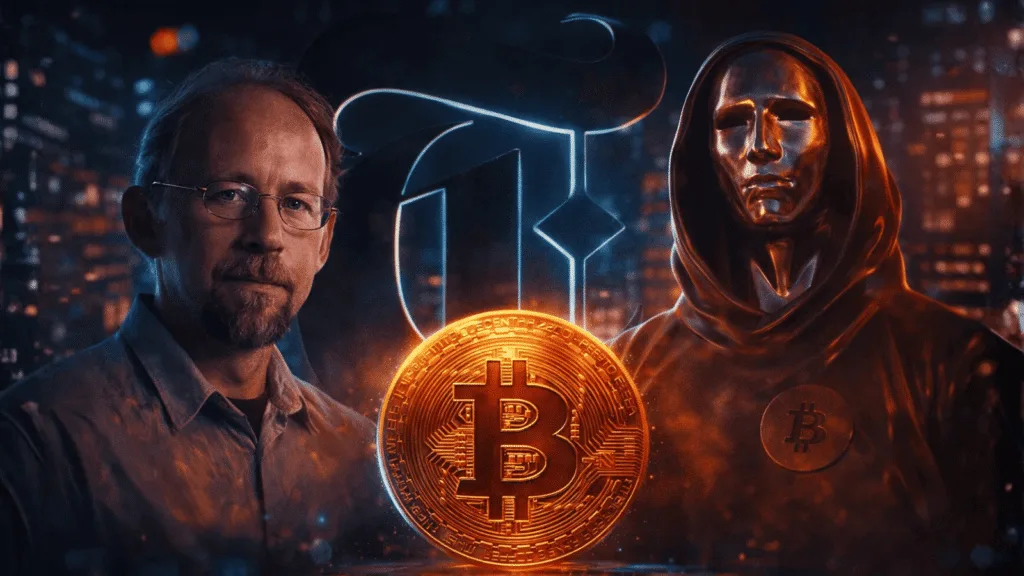



Seventeen years after Bitcoin’s mysterious creator vanished from the internet, the question of who Satoshi Nakamoto really is remains one of the most enduring unsolved puzzles in technology. On Wednesday, The New York Times published what may be the most extensively researched attempt yet to answer it, and the finger points, again, at Adam Back.
The investigation, written by John Carreyrou, the reporter who exposed the Theranos fraud, spent a year building the case that Back, a 55-year-old British cryptographer currently based in El Salvador, is the man behind the pseudonym. Back has denied it. Clearly and repeatedly. But the evidence Carreyrou assembled is detailed enough that even those who find it unconvincing would have a hard time calling it lazy.
Back is genuinely one of the most important figures in Bitcoin’s prehistory. In 1997, he invented Hashcash, a computational puzzle system that forced computers to do measurable work before sending an email, as a way to combat spam. Satoshi Nakamoto directly cited Hashcash in the Bitcoin white paper as the inspiration for Bitcoin’s own proof-of-work mining mechanism.

Back was also one of the first two people Satoshi ever emailed. He was a prominent voice on the Cypherpunks mailing list in the 1990s, where much of the intellectual groundwork for digital cash was laid. He has a PhD in distributed systems. He has spent the last decade running Blockstream, a Bitcoin infrastructure company that raised over $1 billion in funding.
In short: if someone were designing a profile of the kind of person who could have built Bitcoin, Back fits it almost perfectly. The Times investigation argues that he did exactly that.
What the investigation found
The centerpiece of the Times’ case is stylometric analysis, a technique that identifies writers through unconscious linguistic patterns rather than what they write about. The paper commissioned computational linguist Florian Cafiero, who previously helped identify the people behind the QAnon movement, to compare texts from 12 Satoshi suspects against the Bitcoin white paper.
Cafiero found Back the closest match. He also said the results were inconclusive, and that Hal Finney, who died in 2014, was nearly tied for the top spot. Beyond the statistical analysis, Carreyrou identified 67 shared hyphenation patterns between Back’s writing and Satoshi’s, nearly double the next closest suspect.
Specific phrases like “proof-of-work,” “partial pre-image,” and “burning the money” appeared identically in separate writings from Back and Satoshi spanning years. The investigation also flagged a mix of British and American spellings in Satoshi’s writing that matches Back’s documented style, along with stylistic tics like using two spaces after a full stop.
The behavioral timeline adds to the circumstantial picture. Back largely went quiet on the Cryptography mailing list during the exact period Satoshi was most active. Then, precisely six weeks after Satoshi sent his final message and disappeared in April 2011, Back became conspicuously vocal about Bitcoin again.
Carreyrou confronted Back in person at a Bitcoin conference in El Salvador in late January. Over two hours, Back denied being Satoshi more than six times. He offered no explanation for the writing analysis results and declined to provide email metadata Carreyrou had requested.
The article’s most dramatic moment involves audio: Carreyrou quoted Satoshi saying he was “better with code than with words.” Before Carreyrou could even finish the sentence, Back jumped in to note that for someone who preferred code, Satoshi sure wrote a lot. Carreyrou found the interruption revealing. Back would likely call it an obvious response to an obvious quote.
The Times also addressed what looked like counter-evidence: emails between Back and Satoshi from August 2008, released during the Craig Wright fraud trial in London, that appeared to show Satoshi reaching out to Back before the white paper’s release, as if they were two separate people. Carreyrou suggests Back could have sent those emails to himself as cover. He acknowledges he has no evidence that this happened.
Back’s denial and the community’s reaction
Back responded on X shortly after the article published. “I’m not Satoshi, but I was early in laser focus on the positive societal implications of cryptography, online privacy and electronic cash,” he wrote. He described the linguistic overlap as “a combination of coincidence and similar phrases,” explaining that people who spend decades working in the same technical field naturally develop shared vocabulary.
He also made a broader point about why he thinks Satoshi’s anonymity is good for Bitcoin. “I also don’t know who Satoshi is, and I think it is good for Bitcoin that this is the case, as it helps Bitcoin be viewed as a new asset class, the mathematically scarce digital commodity,” Back added.
The crypto community’s response to the Times piece was broadly skeptical, and in some corners, openly hostile. Bitcoin contributor Jameson Lopp wrote: “Satoshi Nakamoto can’t be caught with stylometric analysis. Shame on you for painting a huge target on Adam’s back with such weak evidence.”
Galaxy Digital’s head of research Alex Thorn was blunter still: “Another journo oneshotted by the Satoshi mystery. The New York Times continues to publish garbage, never ceases to amaze.”
This is not the first time Back has faced these accusations. A 2020 YouTube documentary named him as Satoshi. The Financial Times raised his name in 2016. Each time, he has denied it.
Why It matters beyond the speculation
Satoshi is estimated to hold roughly 1.1 million Bitcoin, worth over $100 billion at current prices, that have never moved. If Back were confirmed as Satoshi, the market would immediately have to grapple with whether those coins might eventually be sold. Even a rumor of movement from Satoshi’s known wallets has historically triggered significant price volatility.
There are also real legal complications. Back is currently taking a Bitcoin treasury company public through a merger involving a Cantor Fitzgerald shell entity. If he held Satoshi’s Bitcoin, that would almost certainly constitute material information requiring disclosure in SEC filings. It would also hand regulators a human target for questions about whether Bitcoin’s launch constituted an unregistered securities offering.
Beyond market mechanics, naming a creator would strike at something deeper. Bitcoin’s cultural power has always rested partly on its leaderless origin story. A known inventor, particularly one still active in the industry, running a major infrastructure company, would fundamentally change how governments, journalists, and critics relate to the asset.
After 17 years, a year of investigative reporting, and a two-hour in-person confrontation in El Salvador, Satoshi Nakamoto remains exactly as anonymous as the day he sent that first email to Adam Back.