


Marc Boiron, the CEO of Polygon Labs, said that the purchases make the network a regulated payments platform that can transport stablecoins onchain at scale.
Fortune reported on Monday that Polygon Labs has agreed to buy Coinme, a US-based crypto payments startup, and Sequence, a wallet infrastructure provider, for more than $250 million.
The purchases give the Ethereum scaling blockchain access to Coinme’s licenses for sending money in the US and its systems for converting between crypto and regular money, along with Sequence’s wallets and payment solutions that work across different blockchains for banks, fintechs, and businesses

Polygon said on X that the two firms will assist build the “Polygon Open Money Stack,” which will combine blockchain rails, regulated money flow, and wallet infrastructure into a unified platform for onchain payments.
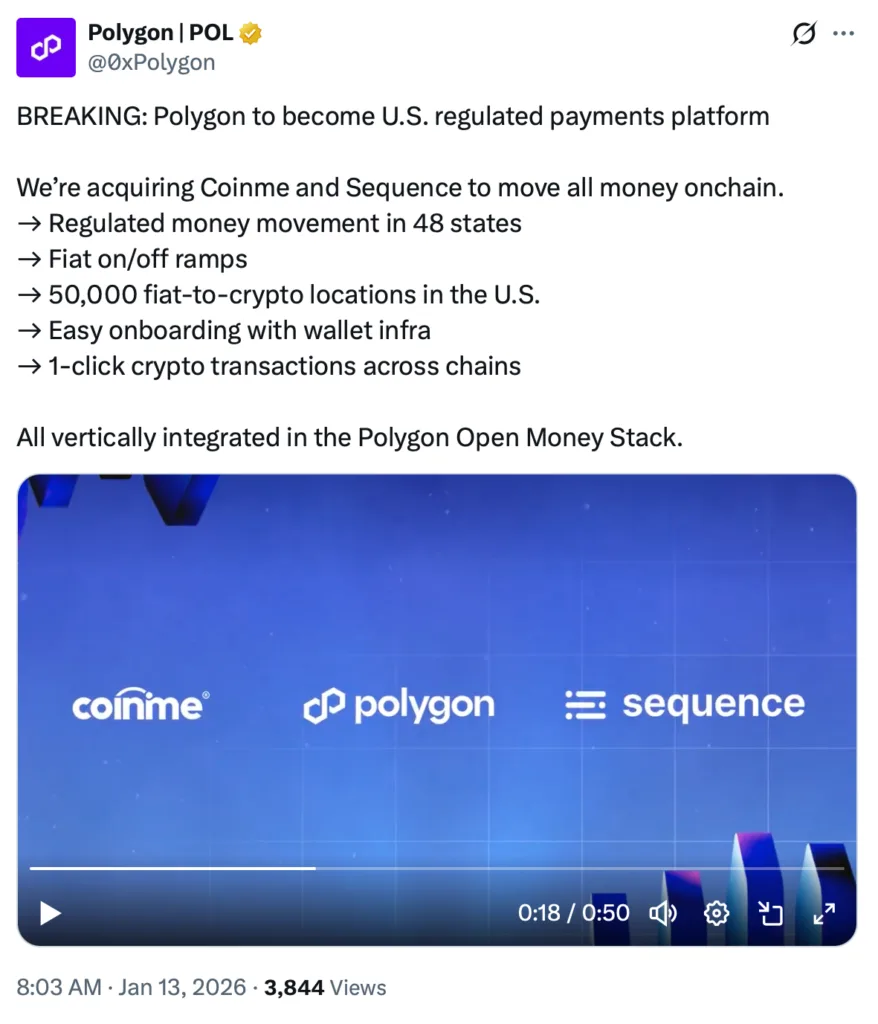
Source: Polygon
Building a full-stack onchain payments platform
Ultimately, we will transform into a regulated payment platform. And our goal is to give everyone a fully integrated stack that lets them use stablecoins to send money anywhere.
Polygon reported that the system combines Coinme’s state-level licensing in 48 states with wallet infrastructure and transactions on several blockchains. According to the company’s website, Coinme has over 50,000 retail cash-to-crypto kiosks and ATMs in the US.
Polygon said that adding Sequence is meant to make things easier for users by including wallets and its Trails orchestration layer, which makes it possible to do cross-chain transactions while hiding activities like bridging, token exchanges, and gas management.
Positioning amid intensifying stablecoin competition
Boiron downplayed parallels between Polygon and big payment companies like Stripe, saying he doesn’t see Polygon as direct competition. He went on to say that most businesses are still in the early stages of looking into stablecoins and that Polygon’s goal is to engage with existing companies as usage grows.
Fortune said that Polygon Labs did not say how much each acquisition cost or whether the deals were made with cash, stock, or a mix of the two.
Stablecoins gain momentum across payments and finance
The GENIUS Act passed in July 2025, and since then, stablecoins have become a major focus in crypto, fintech, and traditional payments. This is because US corporations are getting ready to handle tokenized dollars on a large scale.
In September, Stripe and Paradigm announced plans for Tempo, a layer-1 blockchain that focuses on payments. Less than two months later, Tempo got $500 million in Series A funding, which put the company at a $5 billion valuation.
PayPal was the first big global payments corporation to establish a stablecoin with PayPal USD in 2023. Since then, the company has worked to make the token more useful and available, adding Solana to its list of supported networks in May 2024.
In December, Fortune reported that YouTube had begun allowing creators to receive payments in PayPal USD. This might greatly increase the use of stablecoins because the platform is so big.
Visa and Mastercard, two major global payment networks, are also starting to position themselves around stablecoins.
In August, Circle said it would work with Mastercard to let businesses in Eastern Europe, the Middle East, and Africa settle transactions in USD Coin and Euro Coin.
Rain, a US-based stablecoin infrastructure provider and a key member of the Visa network, said on Friday that it has raised $250 million in a Series C fundraising round headed by ICONIQ to help it grow around the world.