




The nationwide RateFi program lets borrowers use their crypto holdings to meet mortgage underwriting requirements without having to sell them.
Rate, a US mortgage lender, has started a countrywide program that lets qualifying borrowers utilize verified cryptocurrency holdings to assist meet underwriting standards without selling their assets. This is a formal step toward incorporating digital assets into traditional house finance.
RateFi is the name of the product. It works within the lender’s existing non-qualified mortgage framework and lets borrowers use confirmed crypto assets as qualifying reserves and, in some situations, as an income source.

RateFi allows borrowers to use digital assets without selling
RateFi uses a proprietary valuation methodology to look at digital asset holdings for underwriting reasons. This framework takes into account market price, liquidity, and asset-specific volatility. The method allows certain crypto assets to contribute to a borrower’s eligibility without necessitating their sale, all while adhering to standard mortgage risk criteria.
The company says that more than 10% of Americans own digital assets, but most traditional mortgage programs don’t accept cryptocurrencies as collateral unless it is first sold.
When you sell or liquidate assets, it usually leads to a taxable event or other tax consequences. This means that borrowers can only use pledged-asset loan structures.
RateFi is meant to function with a small number of well-known, high-liquidity large-cap cryptocurrencies and major US dollar-backed stablecoins, but she didn’t say which ones.
The programme is about recognising how wealth is actually built today and modernising access to homeownership accordingly, not promoting crypto for its own sake. Crypto is a big element of financial planning for a lot of younger Americans.
Rate added that the initiative uses conventional know-your-customer (KYC) and anti-money laundering (AML) checks and is offered through its current digital mortgage platform.
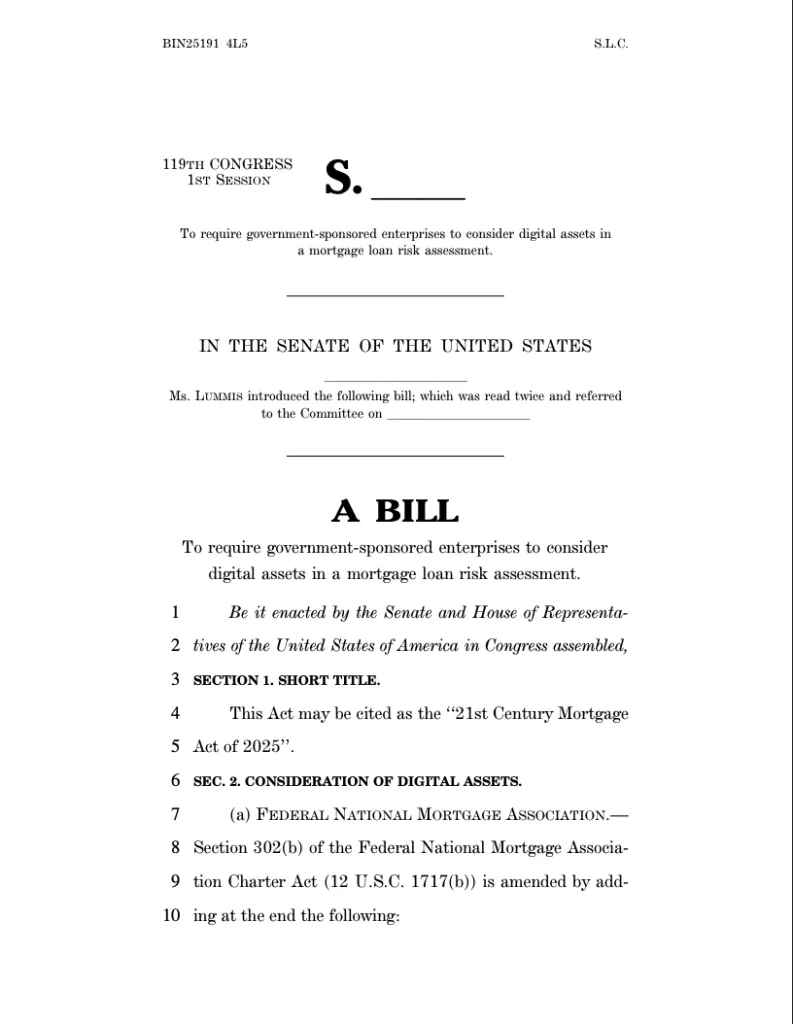
Source: Senator Cynthia Lummis
Crypto wealth enters the housing policy debate
Housing affordability is still a big problem for the US economy, especially for younger Americans. In the last few months, the Trump administration and lawmakers have paid more attention to it.
Without any laws that would make crypto-backed mortgage loans available to more people in the US, officials are looking into how digital assets could be used in housing finance systems.
William J. Pulte, the head of the Federal Housing Finance Agency, told Fannie Mae and Freddie Mac, two government-backed mortgage buyers, to come up with plans for how to treat cryptocurrencies as a reserve asset in single-family mortgage risk assessments in June 2025.
In July, Senator Cynthia Lummis introduced the 21st Century Mortgage Act to codify that directive into law.
There is already a small industry for real estate loans backed by cryptocurrency. Nexo and Ledn are two lenders that offer loans backed by more than 40 digital assets. Ledn also offers Bitcoin-based mortgage solutions that let customers pledge Bitcoin BTC$65,802 as security.
A study of 1,000 Americans in January for the OKX Insights series discovered a clear generational split in how people feel about digital assets. Younger people were much more inclined to see crypto as credible and important for the future of finance.