


Ripple, the issuer of the XRP token, has added digital asset tools to its treasury management platform. The aim behind this is to expand its product for corporate finance teams that wish to manage crypto and fiat in one place.
The update introduces Digital Asset Accounts and Unified Treasury inside Ripple Treasury. This will give firms a way to view balances, track liquidity, and record transactions across bank accounts, custodians, and onchain wallets.
Meanwhile, the launch places digital assets inside a system that treasury teams already use for cash management. Ripple said the goal is to remove the need for separate crypto platforms, manual reconciliation, and fragmented reporting.

The company also tied the rollout to growing corporate demand for stablecoins and other digital assets in treasury operations.
Ripple adds crypto to treasury workflows
Ripple mentioned the new release embeds digital asset capabilities directly into Ripple Treasury. The platform now allows finance teams to hold, receive, track, and manage digital assets alongside fiat balances.
This setup gives treasury staff a single view of liquidity across systems, instead of asking them to switch between banking, custody, and wallet tools.
The update includes support for assets such as XRP and Ripple USD, known as RLUSD. Ripple said balances appear in the same account structure as cash and update in real time.
The platform also records crypto transactions with the same controls used for fiat activity, which gives finance teams one operating system for both types of assets.
Ripple described this product launch as a step beyond standard crypto access. Most treasury systems still treat digital assets as external items that require separate platforms or manual data handling.
Ripple stated its new design keeps digital assets inside the treasury environment itself, which may reduce extra workflows for reporting and reconciliation.
Renaat Ver Eecke, senior vice president at Ripple Treasury, noted the conversation among finance leaders has changed.
“Digital assets have arrived at the CFO’s desk, and the question has shifted from whether to engage to how to do so advantageously without disrupting existing operations,” he noted.
Digital asset tools lead the launch
In addition, Digital Asset Accounts let treasury teams create and manage a regulated Ripple-native digital asset account inside the platform. The company mentioned users do not need separate external setup, third-party custody relationships, or another system to begin using the feature.
That structure is meant to simplify access for firms that want digital asset exposure without rebuilding their treasury process.
According to Ripple, the accounts include real-time fiat valuation using live exchange rates from market data providers. The platform also offers 15-decimal precision for native onchain amounts, which Ripple stated helps reduce rounding gaps in financial records.
Each transaction records native notional, fiat value, and market price at the time of the event, creating an audit trail for finance and control teams.
The second feature, Unified Treasury, brings together digital asset and cash positions on a single dashboard. Customers that hold assets across multiple custodians can connect those providers through ClearConnect, the company’s connectivity layer.
The same layer already supports bank integrations, and it now extends that function to digital asset providers as well.
Furthermore, Unified Treasury uses direct API connectivity and real-time market rates to show balances in the reporting currency chosen by the customer. Transaction data also syncs into the platform as activity occurs, rather than relying on manual imports or delayed batch files.
“Treasury teams shouldn’t have to think about whether a balance is onchain or in a bank account — they should simply see their position,” noted Mark Johnson, vice president of global product at Ripple Treasury.
Ripple Builds on GTreasury Deal
The launch follows Ripple’s 2025 acquisition of GTreasury, an enterprise treasury management provider with a long operating history.
Ripple said the business brings more than 40 years of treasury management experience and processed $13 trillion in payments volume in 2025 for customers ranging from small and medium-sized firms to Fortune 500 companies.
Moreover, this matters because many firms still do not have a clear starting point for digital asset use inside existing treasury systems. Ripple pointed to its 2026 survey of more than 1,000 global finance leaders, which found that 72 percent believe companies must offer a digital asset solution to stay competitive.
Ripple also tied the launch to the growth of stablecoins. The company noted stablecoins processed $33 trillion in volume last year, up 72 percent from 2024.
Even so, Ripple noted that only a small share of that activity has so far gone into payment use cases such as payroll and remittances.
That theme also appears in outside research cited in the broader coverage around the launch. McKinsey estimated that end-user stablecoin payments reached around $390 billion in 2025, more than double 2024 levels, while much of total stablecoin volume still came from trading and internal blockchain activity.
Standard Chartered also mentioned this week that stablecoin market capitalization could pass $2 trillion by the end of 2028, with velocity rising over the past two years.
One system for fiat and crypto
Ripple said the new product is already live for beta users ahead of a wider global rollout. The company added that service availability will vary by geography, product type, and regulatory requirements.
That means adoption may move at different speeds depending on the market and the entity providing the service.
Ripple sees the shift as part of a broader move in financial infrastructure. More institutions now want to place digital assets inside core systems rather than manage them as separate products.
In addition, that trend has also appeared in settlement and banking. Visa has expanded stablecoin support in its settlement work, while JPMorgan has widened access to JPM Coin for real-time institutional transfers on blockchain rails.
Future additions to its digital asset framework will connect treasury functions with more of the company’s existing products.
Those planned features include cross-border and intercompany settlement, as well as 24/7 yield on idle cash through overnight repo powered by stablecoins and digital assets.
Ripple said organizations will be able to adopt these features on their own timeline without changing approval processes, audit trails, or compliance controls.
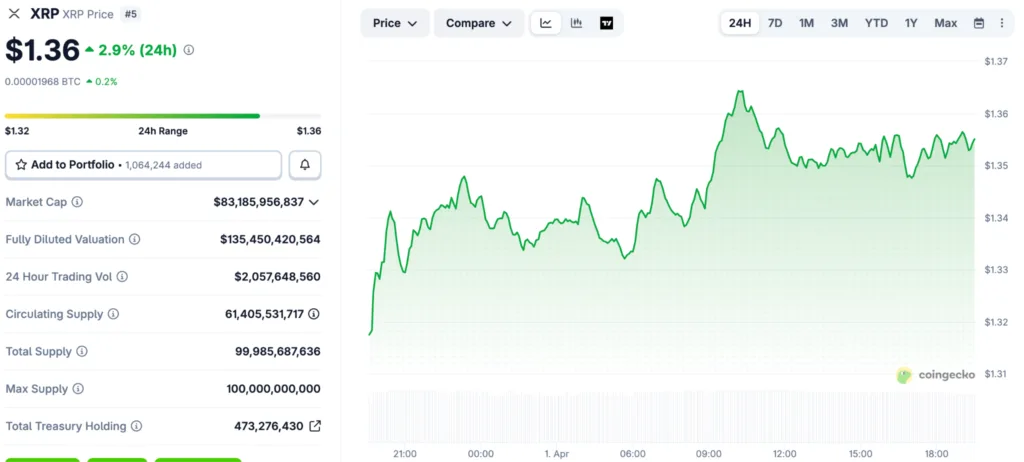
Meanwhile, Ripple’s native token traded at $1.36 at the time of reporting, indicating a 3 percent increase in the past 24 hours and almost 4 percent decline in the past week.