



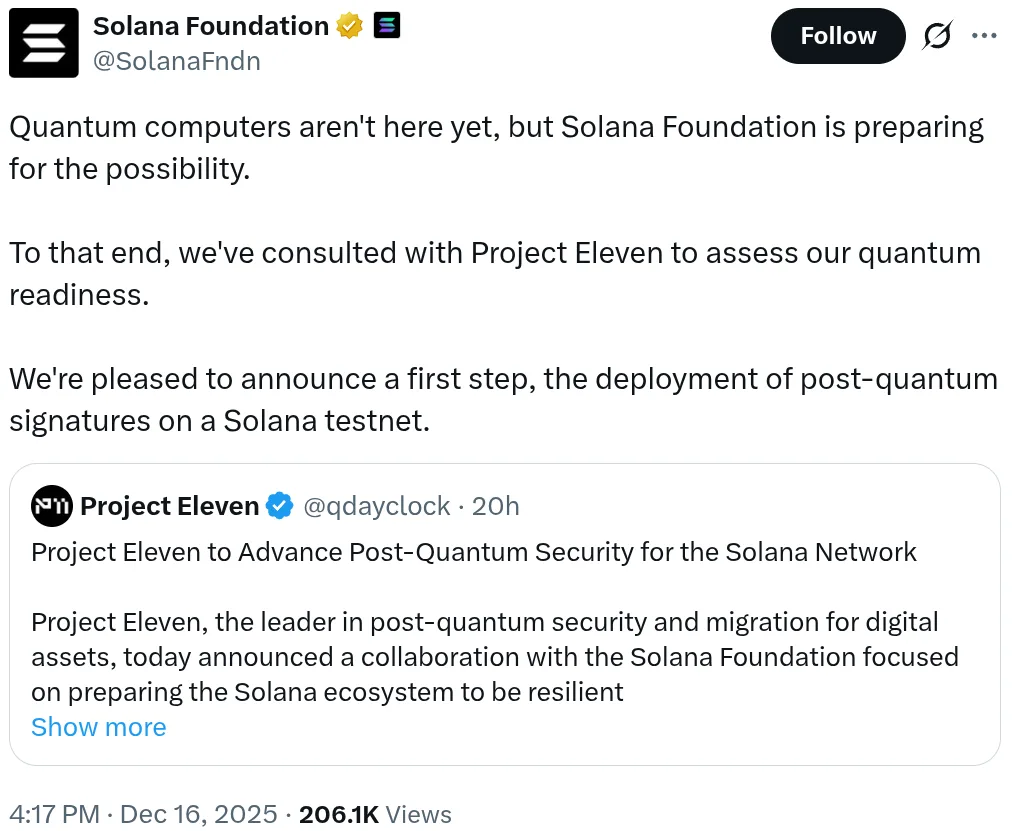
Solana has teamed up with a post-quantum security startup to test quantum-resistant technologies on a Solana testnet. They say this will provide them a scalable end-to-end solution.
To get Solana ready for the arrival of quantum computing, the Solana Foundation has teamed up with Project Eleven, a business that protects cryptocurrencies post- quantum computing.
On Tuesday, Project Eleven said that they have conducted a thorough assessment of quantum computing risks for Solana and constructed a working Solana testnet using post-quantum digital signatures. The release says that their testnet revealed that “end-to-end quantum-resistant transactions are practical and scalable.”

This is a big assertion because post-quantum cryptography is thought to be far pricier to compute than other types of encryption.
In August 2024, the US National Institute of Standards and Technology (NIST) adopted three post-quantum encryption standards. The Federal Information Processing Standards (FIPS) 203, 204, and 205 are the rules that apply.
Cloudflare, a big company that builds the internet, looked into FIPS 204, Ed25519 (used by Solana), and RSA-2048 in 2024. Tests showed that FIPS 204 was almost five times more expensive to sign but twice as fast to verify as Ed25519. RSA-2048 was slower to sign than both but a little faster to verify than FIPS 204.
Source: Solana Foundation
Getting ready for a future threat
Matt Sorg, the Solana Foundation’s vice president of technology, said that the company’s “mission is to protect the world’s digital assets from quantum risk.” Most, if not all, big crypto ecosystems are focused on the same thing.
The comment comes after Ethereum co-founder Vitalik Buterin said that there is a 20% probability that quantum computers might overcome current cryptography before 2030. However, not all experts agree with that timescale. Adam Back, a cryptographer and cypherpunk included in the Bitcoin BTC$87,047 white paper, said in November that Bitcoin is not expected to face a quantum danger for another 20 to 40 years.
Still, Ethereum’s developers are fairly rapid and active, which helps them deal with problems like this. James Check, the founder and chief analyst at the Bitcoin onchain analysis service Checkonchain, said in late November that this is not the case for Bitcoin.
At the time, he said that the technology challenge of quantum resistance is mostly solved, but Bitcoin’s governance will have a hard time dealing with the problems that come up. Check said, “There is no chance we come to consensus to freeze” Bitcoin that is not moved to quantum-resistant addresses. If this fails, a lot of lost Bitcoin would flood the market since old addresses that didn’t move would be hacked.