



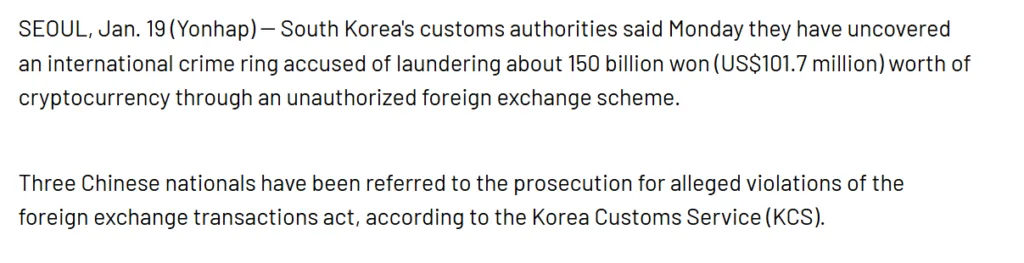
South Korea has nubbed an alleged international crypto money laundering network that has wiped nearly $101.7 million (148.9 billion won).
Authorities have referred three individuals to prosecutors for allegedly violating the country’s foreign exchange regulations, Yonhap News reports.
The case comes at a time when South Korea has constantly increased efforts to curb illegal crypto activities.

Modus operandi of the network
According to the Korea Customs Service, the group operated their scheme in September 2021 through June 2025 by transferring funds overseas using the pretense of legitimate spending such as cosmetic surgery or tuition payments.
In order to remain anonymous, sources reported that they purchased the crypto in several nations, moved the assets to the wallets in South Korea, exchanged them into the local currency, and then distributed the funds in various accounts.
This is a classic example of how digital assets have been used for circumventing financial laws and how crypto-related money flows have caught the attention of financial regulators.
South Korea cracks down on illegal money transfers amid FX flow gaps
South Korea’s crackdown on illegal money transfers comes as authorities grow increasingly concerned about gaps in the country’s foreign exchange flows.
Last year, the difference between trade proceeds handled by banks and the value of goods reported to customs hit around $290 billion, making it the largest in five years, according to the Korea Customs Service (KCS).
The discrepancies raise fears of illicit capital moving under the radar. In response, the KCS has launched year-round “intensive inspections” on January 13th, targeting underground money exchange operations that could threaten exchange rate stability.
The move shows the government is serious about tightening oversight, ensuring compliance, and preventing financial crimes.
South Korea’s crypto ecosystem faces increased scrutiny over illegal activities
While governments move in to shut down illegal actions, the South Korean crypto scene is facing greater scrutiny.
Regulators are getting increasingly worried regarding the improper use of digital assets for money laundering, drug trafficking, evasion of taxes, and undeclared cross-border money transfers.
The recent incident where three individuals were prosecuted for using crypto to facilitate overseas funds transfer is just one of the few instances revealing the potential of cryptocurrencies to bypass the traditional banking system and foreign exchange controls.
Moreover, the authorities are also trying to spot not only the operating wallets and exchanges but also the activities behind them in order to ascertain compliance with the anti-money laundering laws.
Even though South Korea’s cryptocurrency market is still growing, vigilant enforcement actions have been deployed to ensure that the ecosystem must operate transparently and that operators and users are under pressure to comply with stricter legal and regulatory requirements.