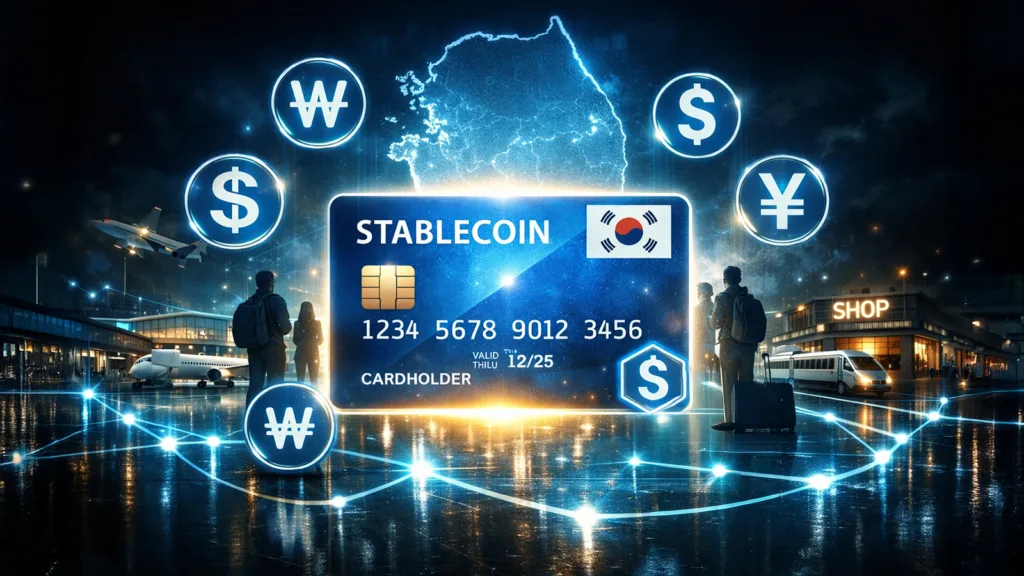



BC Card, a South Korean payment processor, has finished a trial project that let foreign consumers pay local retailers with stablecoins.
On Tuesday,BC Card revealed its pilot project, which was done with the help of blockchain company Wavebridge, wallet provider Aaron group, and cross-border money transfer operator Global Money Express. The companies enabled customers from various countries to convert their stablecoins, stored in wallets compatible with BC Card, into digital prepaid cards.
The company indicated that this experiment was not a short-term initiative but part of getting ready to set up a stablecoin payment system. It added that the adjustment was made because South Korean stablecoin rules have changed.

BC Card is one of the biggest payment providers in South Korea. It handles more than 20% of the country’s card transactions and serves 3.4 million domestic merchants. KT Corp, one of the three biggest telecom corporations in the country, owns most of it.
Regulatory uncertainty slows domestic stablecoin framework
In late July, it was reported reported that credit card companies were rushing to deal with what they thought were concerns from stablecoins. Local officials, discussing the introduction of won-based stablecoins, reportedly organised a joint task group within the country’s credit card industry.
Reports indicate that BC Card established an internal team to monitor developments in stablecoin marketplaces both domestically and globally. Still, it is taking longer than expected for local stablecoin rules to be put in place.
The Financial Services Commission (FSC) of South Korea did not send in a draft proposal for stablecoin rules by the time set by the country’s ruling Democratic Party earlier this month. The delay was due to arguments between the FSC and the Bank of Korea (BOK), which is the country’s central bank, according to lawmakers.
The main point of the discussion seems to be that the BOK wants banks to have to own at least 51% of any stablecoin issuer that wants to get regulatory approval. It looks like other regulators are striving for a more varied ecology.
Stablecoins are becoming more popular as a way to pay for things instead of or in addition to traditional methods like credit cards and bank wire transfers.
Adoption is happening swiftly. Earlier this month, YouTube let US content creators get paid in the dollar-pegged PayPal USD PYUSD $1. Visa also started offering USD Coin (USDC) $1 settlement services to some US-based banks and other financial institutions.