



The European Union (EU) regulators have reached out to Meta asking why third-party AI bots are not given access to its WhatsApp messaging platform.
WhatsApp is often used by businesses to connect with their clients — and several businesses are presently deploying AI to automate the communication, order placement, and financial transaction processes. With Meta restricting third-party AI agents to access WhatsApp, businesses using the platform in the EU are possibly facing issues.
The EU has sent Meta CEO Mark Zuckerberg a “statement of objection” to which the Menlo Park, California-based social networking giant can reply to. This move by EU can be perceived as an initiation of another anti-trust probe over Meta.

“On 15 October 2025, Meta announced an update of its WhatsApp Business Solution Terms, effectively banning third-party general-purpose AI assistants from the application. As a result, since 15 January 2026, the only AI assistant available on WhatsApp is Meta’s own tool, Meta AI, while competitors have been excluded,” the European Commission (EC) said in an official statement.
As per the EC, this policy change by Meta “appears to be in breach” of the EU competition rules.
For now, the EC has decided to levy interim holds on Meta’s implementation of this AI policy change, giving the company a window to explain its side of the story.
Announcing the development on X the EC said, “In Europe, dominant tech companies cannot be allowed to abuse their market power for unfair advantage.”
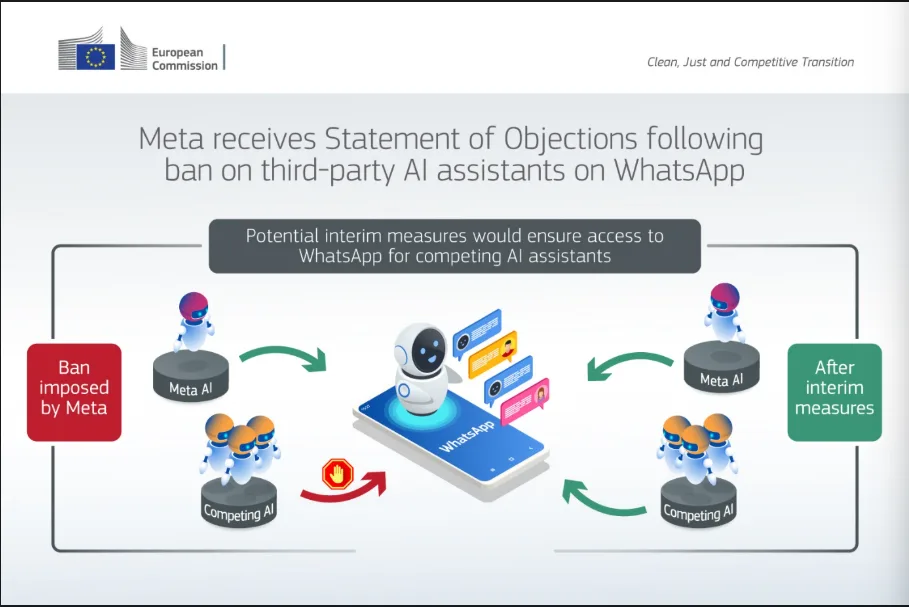
Source: ec.suropa.eu
This development brings Meta under the EU’s scanner for possibly abusing its established position in the European Economic Area (EEA) to curb competition in the AI sector. The European regulators believe that WhatsApp’s popularity should not give Meta the impression that it can make smaller AI competitors to create a userbase.
It is notable that Meta has consistently been opposing EU’s approach on AI.
In October last year, Meta declined to comply with EU’s guidelines dubbed the European Commission’s Code of Practice for general-purpose AI (GPAI) models. These guidelines lay down rules around the transparency, copyright, safety, and security requirements for AI firms — which Meta found to be suffocating to the development of the technology.