




xAI’s newest model, Grok-4.20 Beta, has claimed the number one position in medical AI rankings on Arena. The benchmarking platform is a key player, assessing AI models’ effectiveness in healthcare.
According to reports from Friday, two versions of the Grok model secured spots in the top three places. The ranking is a significant accomplishment, hinting at the company’s progress in a field where precision and accuracy are paramount.
The Arenas ranking is particularly relevant to the AI and healthcare sectors, as it assesses model efficacy in medical contexts. This assessment usually measures an AI’s ability to understand symptoms, analyze scientific research about health conditions, answer clinical questions, and explain its conclusions.

Therefore, good performance on this test suggests that the Grok-4.20 Beta is more advanced than a typical language model, showing its potential for use in healthcare.
Another implication of the successful performance by two variants of Grok is the rapid advancement of healthcare-focused AI systems. Over the past few years, many technology firms have been in competition to create solutions that can help physicians diagnose their patients more efficiently and cut down their workload.
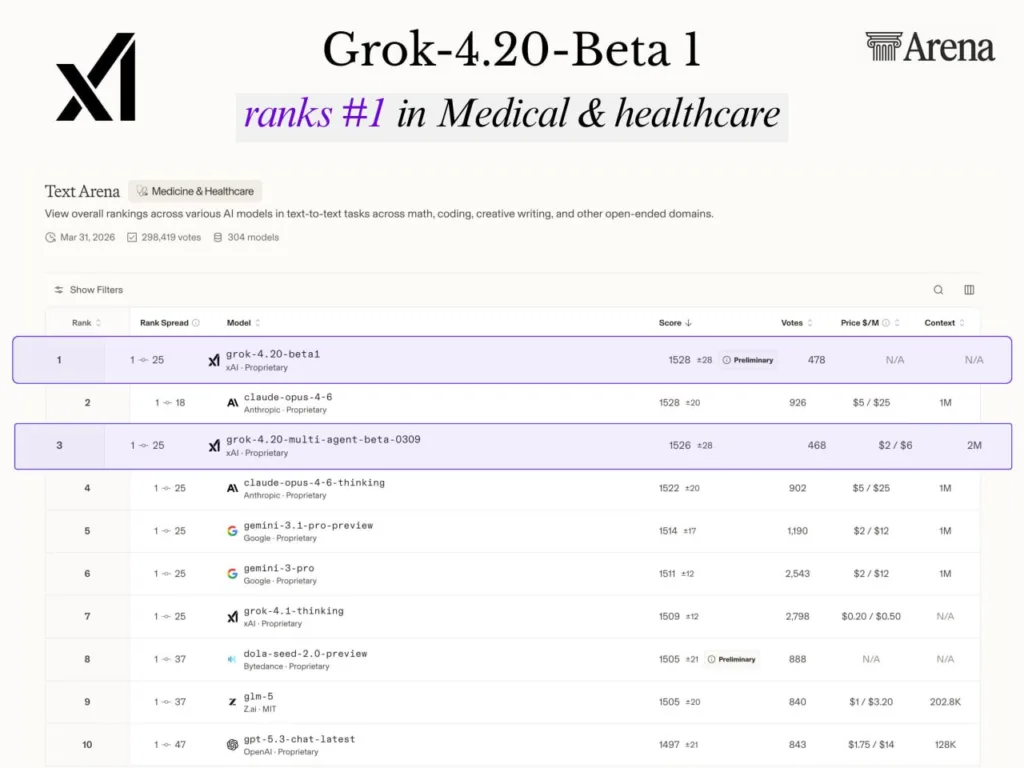
Grok’s strong showing signals xAI’s growing push into healthcare AI
The use of artificial intelligence is increasing in hospitals and clinics to speed up the process of processing information about patients and their health problems. Therefore, the high position taken by Grok on the xAI test demonstrates that xAI is trying to become a leader in this area of development.
It is worth mentioning that the development of healthcare-specific AI technology is much more difficult than other applications.
In particular, it is necessary to develop systems that operate at a high level of accuracy since errors may lead to adverse health outcomes for the population.
Therefore, when creating AI systems for medical applications, you need not only to ensure that models have excellent accuracy but also that models show proper reasoning and can convey their conclusions in simple language.
Accordingly, high results on medical datasets are usually seen as evidence that a system is becoming closer to practical applications.
The situation in the field of healthcare is deteriorating all over the world, as there is a shortage of doctors and nurses, as well as an increase in the number of patients who require medical assistance. To solve these issues, hospitals and clinics are trying to introduce new technologies into their infrastructure.
Nonetheless, there are experts who believe that even high benchmark scores do not necessarily equate to readiness for use by clinicians.
In most cases, medical devices pass through several tests and regulatory measures prior to their deployment within medical facilities.
Data privacy, accuracy, and accountability will always be a key issue when considering AI applications in health care.
It should also be noted that the presence of two Grok models among the top three indicates the competitive environment in the AI market.
There are constant updates to improve the functionality of their devices and software as companies compete to develop more advanced products.
Why is the ranking beneficial?
Achieving the ranking for xAI is a milestone both from a technical point of view and from a business standpoint. High-ranking AI in the medical industry can create many opportunities for cooperation with hospitals, research organizations, and technological firms.
In addition, high ranking is very useful for the firm because the AI industry is competitive, and a high ranking in specific industries can distinguish the product from other platforms.
In general, the high ranking of Grok-4.20 Beta is an indicator of rapid development of artificial intelligence into various industries, in particular the health care sector.
As AI becomes more advanced, it will become increasingly common in medicine as a supportive tool.