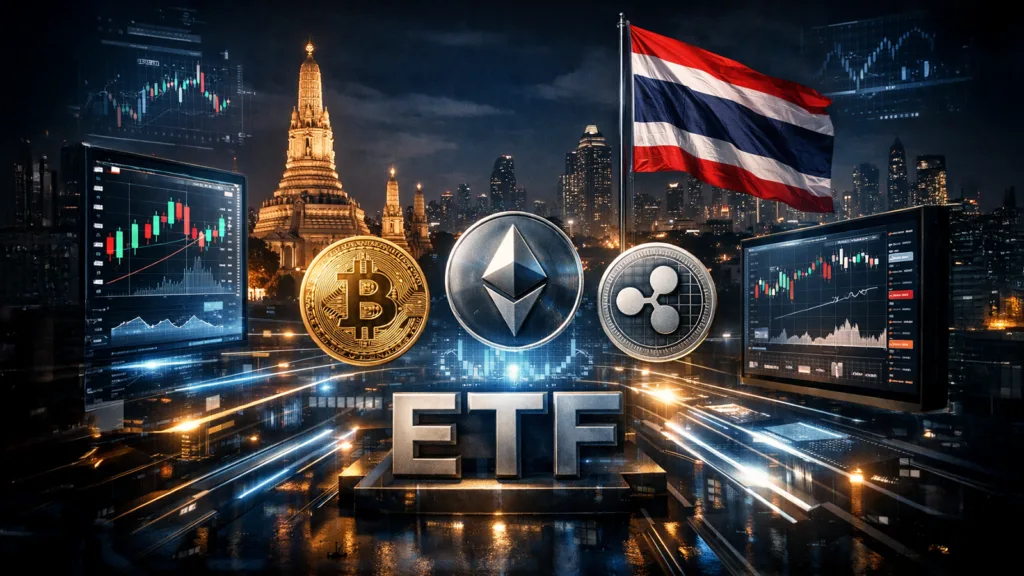



The Thailand crypto economy is set to see an uptick in the coming future as the Securities and Exchange Commission (SEC) is setting a timeline for crypto ETFs and futures trading rules.
According to a report from Bangkok Post, Thailand’s Securities and Exchange Commission is set to roll out new regulations early this year to support the fast-growing digital asset market.
The proposed rules will cover crypto exchange-traded funds, crypto futures trading, and a wider range of tokenised investment products.

The move comes at a time when Thailand’s capital markets have seen large-scale diversification with regulators aiming to provide clearer oversight for next-generation markets.
Further, the Southeast Asian nation is hoping to align with global trends in crypto adoption while offering investors more regulated and structured investment options.
Interestingly, the 2026 timeline for ETF and futures trading rules comes in parallel to the Thai Bath appreciating against the dollar.
The Bank of Thailand (BOT), however, has ruled out digital-asset trading as a direct cause of the baht’s recent appreciation, saying the activity does not constitute cross-border capital flows and therefore cannot move the exchange rate, even as lawmakers scrutinise whether Thailand’s crypto market is being used to launder proceeds from online scams.
Thai SEC banks on crypto ETF’s ease of trading
Thai SEC’s decision to bring formal rules and regulation for crypto ETF trading comes as an aftermath of increased digital asset adoption in the nation.
The regulator claims that crypto ETFs could make it much easier for Thai investors to gain exposure to digital assets, especially those who already invest in similar products overseas.
Crypto ETFs provide greater advantage than investing directly, eliminating the need to open digital wallets or manage private keys, avoiding security concerns like hacking that have kept many on the sidelines.
Instead, they provide a way to invest through familiar, regulated market products, lowering operational and cybersecurity risks.
After the rules are determined, the Stock Exchange of Thailand will be able to list a product that has been jointly designed by asset managers and licensed exchanges.
At the same time, the regulators are also in the process of officially recognizing digital assets as an underlying asset class under the Derivatives Act.
This would allow the crypto futures to trade in Thailand Futures Exchange (TFEX). It would thus provide investors access to a variety of hedging instruments and sophisticated risk management strategies.
Thai SEC views crypto as asset class
The SEC has also proposed that crypto must not just be seen as a speculative bet, but rather as an asset class. The regulator suggests that people who have a greater risk appetite must include 4% to 5% of their portfolio in crypto while keeping their portfolios diversified.
Thailand launched a spot ETF on Bitcoin in 2024 through One Asset Management, which provided a regulated environment for institutional investors to invest in the digital currency.
The nation is now planning to enter the altcoin ETFs market. Bloomberg reported in October 2025 that the SEC is working on rules to permit crypto ETFs, not limited to Bitcoin, with a wider variety of digital tokens.
Meanwhile, market participants have been quick to point out that Thailand’s decision to set the timeline comes just after Vietnam commenced crypto exchange licensing with the highest capital threshold ($400M) in the region.
Thailand SEC partners with central bank for tokenisation sandbox
Thailand’s SEC is also planning to collaborate with the Bank of Thailand in setting up a regulatory sandbox which will focus on tokenisation and distributed ledger technology.
The aim is to test new digital asset products and related infrastructure in a safe manner, but under regulatory oversight.
The SEC is of the view that tokenization has the potential to reduce barriers to entry for retail investors by way of better accessibility and efficiency in investments.
This may help digital assets play a more significant role in the long-term generation of Thailand’s economic output and, consequently, contribute to capital market growth and broader-based investor participation.