



Insider trading concerns have been raised among blockchain researchers because the top eight wallets on Polymarket earned over $1.2 million by wagering on ZachXBT’s investigation into Axiom.
A small number of crypto wallets won over $1.2 million betting on a Polymarket contract linked to an on-chain investigation into the decentralized finance (DeFi) trading platform Axiom. This has raised new worries that prediction markets can reward people who know about market-moving news ahead of time.
According to trade data on Dune, the eight wallets that made the most money on the market together made roughly $1.2 million. The same dataset also showed that more than 50 wallets lost a total of nearly $1.23 million, while two wallets lost over $366,000.

Onchain researcher Defioasis says that eight of the top ten wallets are probably insider addresses based on how they move money around on the blockchain. “There are three addresses that made more than $100,000 in profits, and all of them are insider addresses that only traded in this one market,” the researcher wrote in a post on Friday.
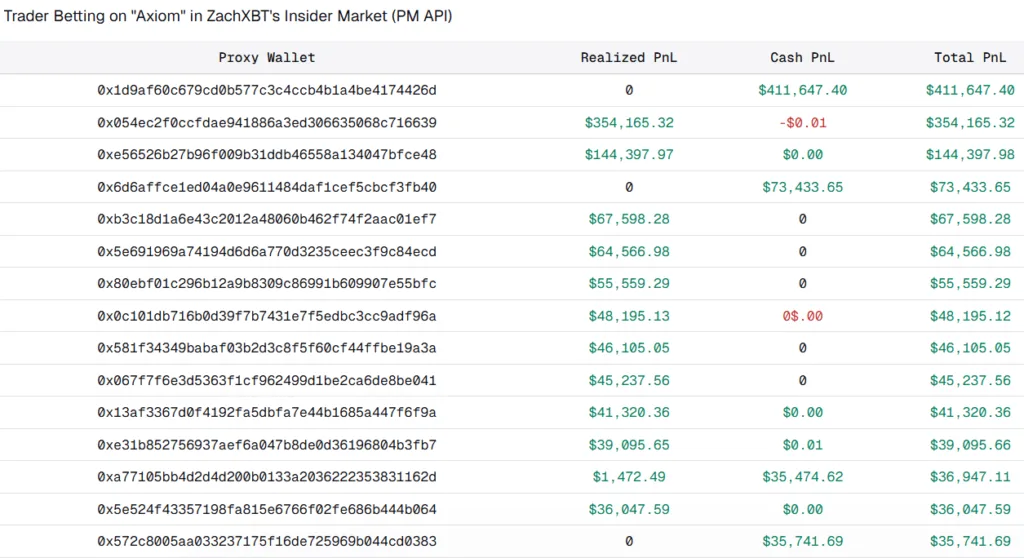
Source: Dune
Maduro contract also raised questions about information asymmetry
On Thursday, ZachXBT revealed the long-awaited investigation, which claimed that Broox Bauer, an employee of Axiom, and others had been involved in insider trading since early 2025.
Axiom said in its X response to the incident that it was “shocked and disappointed” and had removed access to the tools used in the alleged insider trading.
In early January, worries about insider trading in prediction markets grew after a very profitable bet that the US would remove Venezuelan President Nicholas Maduro raised eyebrows.
A Polymarket account placed a wager on a contract that said Maduro would be ousted from power on January 3. This was just hours before US forces took him in a military operation, and the user made almost $400,000 in profit.
Since then, US lawmakers have suggested laws that would limit government officials’ ability to trade in political prediction markets. This has brought even more attention to the sector from regulators.
Regulatory pressure rises as countries restrict Polymarket access
Polymarket, the biggest decentralised prediction market, has been under more and more regulatory pressure in a number of nations where officials say the site offers gambling without a licence.
In January, Hungary and Portugal stopped access to the platform because they were worried about illegal gaming activity.
A week before this, Ukraine blocked Polymarket because it thought its activities were illegal gambling under national law.
Polymarket has also been limited or outlawed in several other countries because of worries about gambling. These nations include France, Belgium, Poland, Singapore, and Switzerland.