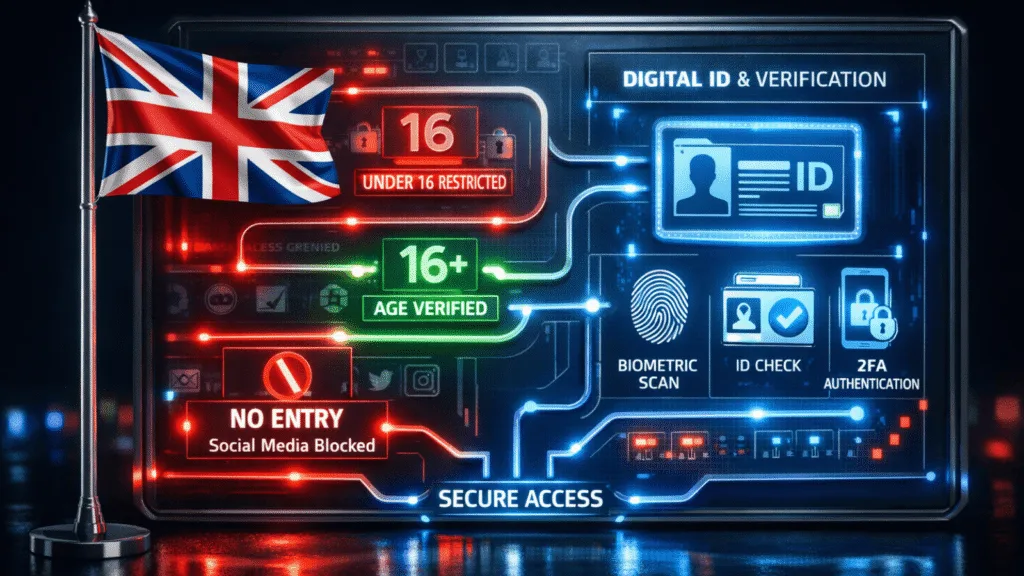



The United Kingdom is considering an Australia‐style prohibition on social media for individuals under 16, as regulators intensify the enforcement of the Online Safety Act.
The UK is thinking about new rules that might keep kids under 16 from using popular social media sites.
The Online Safety Act already says that services with minimum age limitations must explain how they implement them and utilise “highly effective” age assurance techniques when minors are at danger of seeing hazardous information.

Prime Minister Keir Starmer said he is watching how Australia’s ban on those under 16 works in practice and is “open” to an Australian-style approach, even though he has maintained in the past that he doesn’t like the idea of a blanket ban on juveniles.
David Davis, a Conservative Party Member of Parliament, wrote on X that it was “the right move” to prohibit social media for kids and that “mobile phones don’t belong in schools either.”
Regulatory pressure mounts under the Online Safety framework
UK governments and regulators are already at odds with Elon Musk’s X platform over the Online Safety Act (OSA) and the duty to take down illegal or dangerous content.
Ofcom, the UK’s online safety regulator, is getting ready to give itself the right to punish firms that don’t do their job of keeping kids safe and keeping illegal information off the internet. These punishments could include big fines and even blocking access to the services.
Some people have claimed that strict enforcement may hurt free speech, and Musk’s platform has said that the OSA could “seriously infringe” on free speech.
The UK’s actions on digital liberties were “concerning” and they were going down the “same failed route as China, Russia, and Iran.” Sentinel’s decentralised virtual private network (dVPN) lets people access the internet without restriction.
Restricting young people’s access to social media and the internet “stifles their ability to learn digital literacy and develop critical thinking,” which makes them “less prepared for adulthood in a connected world.”
Global momentum toward stricter online identity checks
Other countries are doing the same things. The eSafety commissioner of Australia registered an industry code that says major search engines must utilise age verification technologies for logged-in users. The guidelines will go into effect on December 27, 2025.
Companies like Google and Microsoft now have to check the ages of their users using various ways, including government IDs, biometrics, and credit card checks. They also have to deploy the strictest safety filters on accounts that are thought to be under 18.
Ireland aims to use its incoming presidency of the Council of the European Union in the second half of 2026 to advocate for social media accounts that are confirmed by identity across the EU.
This week, the UK government decided to scrap plans for a single, centralised digital ID system for right-to-work checks, which would have been required by 2029.
Implications for digital identity and crypto compliance
Crypto exchanges and trading applications still have to follow the same Know Your Customer (KYC) and biometric verification regulations as before. These rules usually require users to submit official IDs and take live selfies or facial scans to prove who they are.
Policymakers are focusing on age and identity verification in social media, search, and other consumer services. This shows that similar technologies are being looked into and used more and more outside of financial situations.