



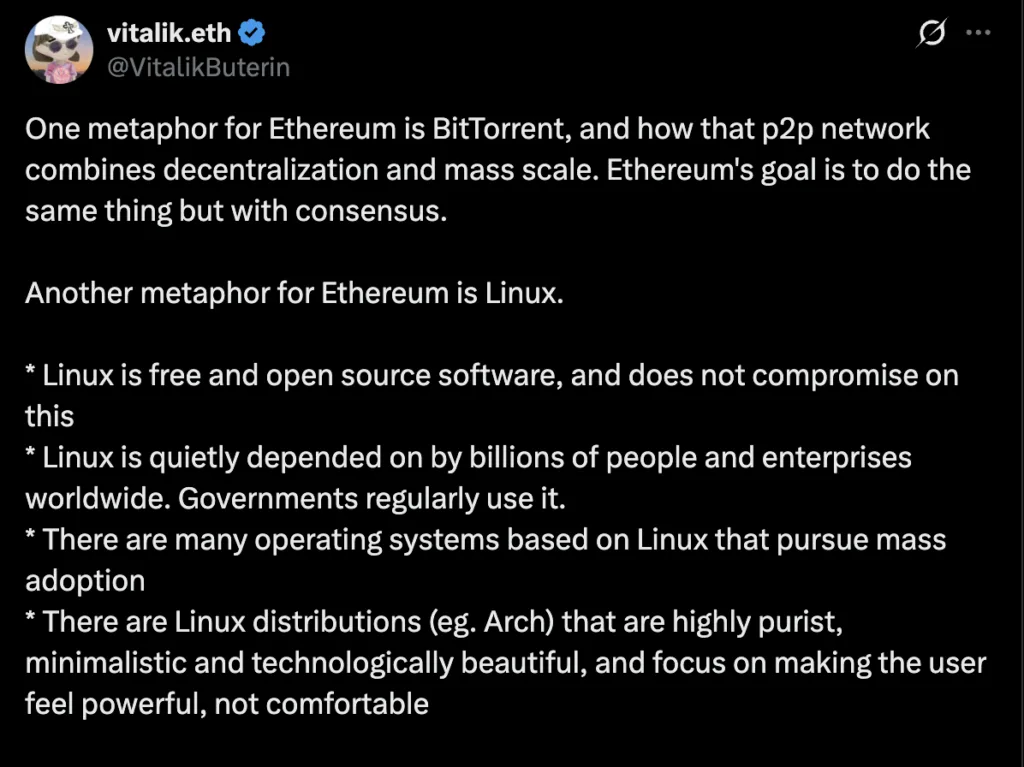
Vitalik Buterin, one of the founders of Ethereum, says that the Ethereum network is like the open-source operating system Linux since it is a decentralised layer-1 blockchain that runs smart contracts.
Both Linux and Ethereum are open source and have bespoke implementations. Buterin stated that Linux does this by letting developers make their own changes to software, while Ethereum does it through its layer-2 (L2) scaling networks.
Buterin said, “Linux has helped billions of people, businesses, and state governments without giving up its open source philosophy or decentralisation.” He went on to say, “We need to make sure that Ethereum L1 works as the financial, and ultimately identity, social, and governance home for individuals and organisations who want a higher level of autonomy, and give them access to the full power of the network without dependence on intermediaries.”

Source: Vitalik Buterin
Ethereum’s long-term vision beyond payments
The parallel makes clear the Ethereum Foundation’s long-term aims of turning Ethereum into an operating system for the Internet that lets people do distributed computing, move value and risk, and agree on things on the Internet.
L2Beat says that as of this writing, the Ethereum ecosystem had 127 layer-2 networks. Critics of Ethereum’s layer-2 scaling method believe that there are too many layer-2 networks that compete with Ethereum and eat into the base layer’s revenue, which fell sharply after the Dencun upgrade in March 2024.
Supporters of Ethereum’s scaling method believe that the wide range of layer-2 networks makes it easier for Ethereum users to choose what they want and have a better experience.
Developers defend the modular scaling approach
Anurag Arjun, co-founder of Ethereum L2 Polygon, told Cointelegraph that the modular scaling technique might let Ethereum have a lot more high-throughput chains constructed on top of the base layer.
The under-appreciated beauty of this rollup-centric roadmap architecture is that it lets different teams try out different execution environments and block times.