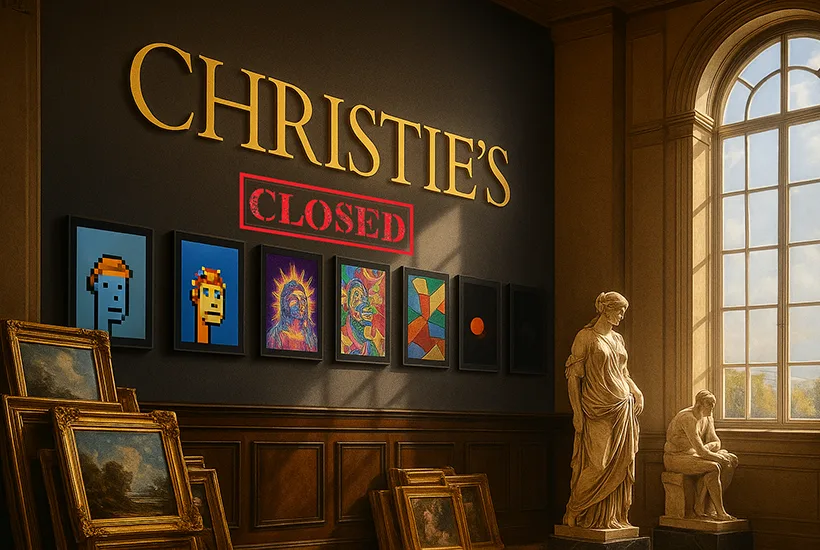



Christie’s has officially closed its dedicated digital art department, marking a major reversal in its push to integrate NFTs into its auction offerings. Christie’s had been active in the digital art space, for example, selling one of the first AI-generated portraits in 2018 for ~$432,500, including fees. It also made waves with the $69 million sale of Beeple’s Everydays: The First 5000 Days in 2021, which helped drive mainstream attention to NFTs and digital art.
According to reports, two staffers, including Nicole Sales Giles, who had been vice president of digital art, were let go at the end of August. Specialist Sebastian Sanchez remains in New York in a digital art role. For now, Christie’s is folding digital art into its broader 20th- & 21st-century sales / contemporary art sales channels rather than having a standalone department.

Art market under pressure
The NFT or digital art trading volume has dropped sharply, from $2.97 billion in 2021 to roughly $197 million in 2024, per analysis from platforms like DappRadar. In the last quarter before Christie’s announcement, NFT trading volume dropped about 45%, highlighting instability and low activity. In fact, Christie’s “fine-art” sales in H1 2025 were nearly $1.5 billion, which was down ~1.9% year-over-year, and around 25% lower than the same period in 2023.
Reasons behind the stagnation
Some of the reasons for the NFT market’s shrinking activity could be attributed to the hype created in 2021, which drove many high-profile sales, but much of that was speculative. Once the supply increased and many collections failed to maintain secondary market demand, prices fell.
Many NFT projects failed to deliver ongoing value, artist royalties, strong community support, or clear paths beyond “drop & resell.” Over time, many owners lost interest when utility or engagement waned. Moreover, the secondary market or resale market for many NFTs collapsed, which eroded confidence in NFTs as investment or collectible assets.
Auction houses and galleries that jumped into NFTs during the boom are now rethinking their strategies, scaling back dedicated teams or integrating digital art back into more traditional categories. Christie’s closure is part of that trend.