



The global economy is undergoing a tectonic shift. Conventional markets are moving to blockchain rails faster than ever before.
The International Monetary Fund (IMF) stated that tokenisation has the potential to reduce friction and increase transparency in finance, but cautioned that the technology may pose challenges to financial stability.
IMF identifies four risks in tokenised finance
According to the IMF’s 23-page report released Thursday, the impact of tokenisation on financial stability remains uncertain. The report adds that atomic settlement and enhanced transparency reduce some traditional risks, but speed and automation introduce new ones. The first risk concerns interoperability and fragmentation. Multiple platforms without shared standards may spread liquidity across digital silos, diminish netting efficiency, and undermine asset parity.

Second, the IMF warns that tokenised systems exacerbate financial stability risks. Automated margin calls, continuous settlement, and algorithmic feedback loops reduce the time available for intervention during stress events.
Third, cross-border resolution becomes increasingly difficult. Tokenised transactions are recorded on common ledgers across various jurisdictions, but resolution authorities remain national.
Fourth, emerging and developing economies (EMDEs) are acutely exposed. Dollar-denominated stablecoins may hasten currency substitution, erratic capital flows, and the weakening of monetary sovereignty in countries with weaker financial institutions.
Productivity through online property
The report concludes that while the opportunity to mould tokenised finance is open, it will not be so indefinitely. This comes as the tokenisation business continues to expand rapidly.
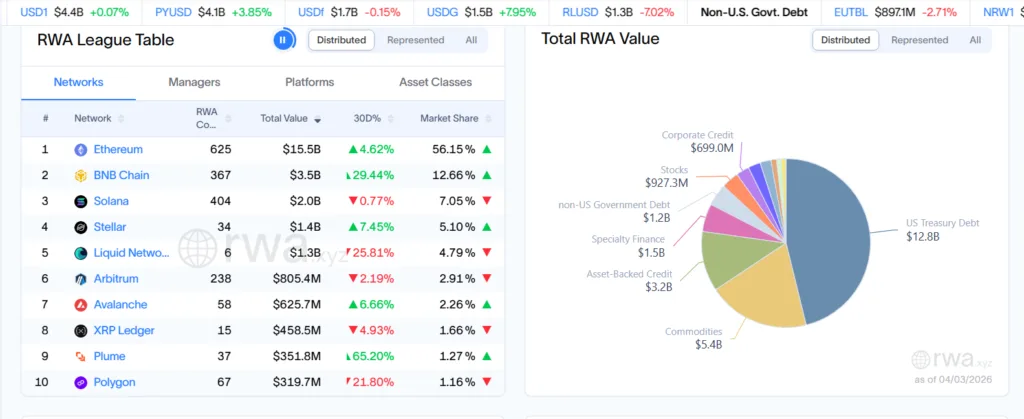
The overall on-chain distributed RWA value has risen 4% in the last month to $26.7 billion. The represented asset value increased by 31.61% throughout the same period. The number of asset holders rose to 710,792, up 5.56%. Additionally, Midas landed $50M to bring instant liquidity to RWAs even as China issued new stablecoin and tokenisation guidance.
The IMF’s five-pillar policy roadmap includes anchoring settlement in safe money, implementing consistent regulation across equivalent activities, establishing legal certainty for tokenised assets, promoting interoperability standards, and adapting central bank liquidity tools to 24/7 automated environments.