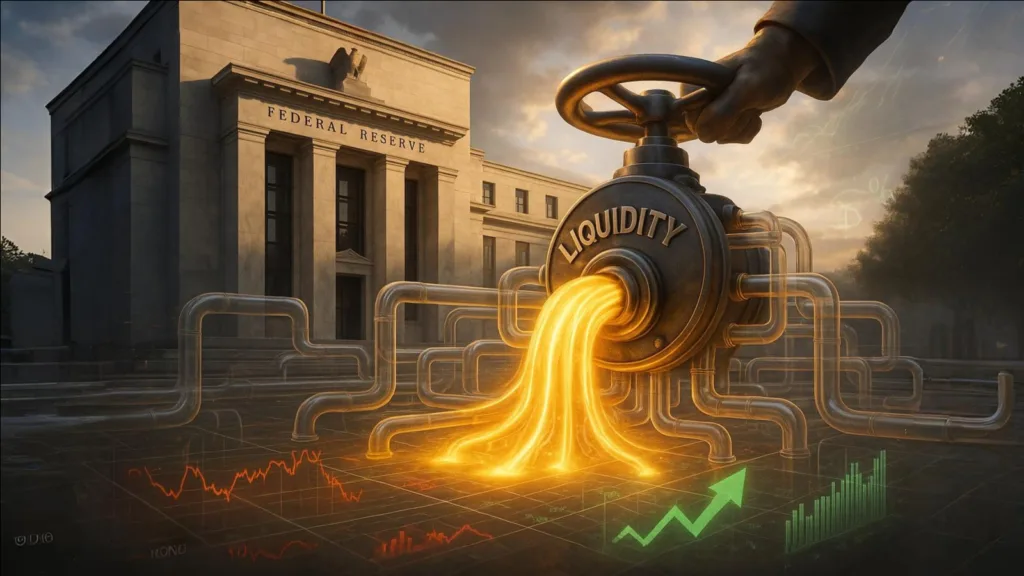



In a move that could change liquidity positions in the U.S., the Federal Reserve, on Wednesday, announced that it will end its Quantitative Tightening (QT) program on December 1, 2025. Addressing the media after a 25-basis-point rate cut, Chairman Jerome Powell said that there were enough signs to believe that the economy had reached a point where bank reserves are ‘somewhat above ample’ levels. And hence the Central bank must avoid a repeat of past liquidity crunches.
The winding down of this program will put an end to the three-year battle that the Fed has fought against post-pandemic inflation. This led to the $2.3 trillion drawdown by the Fed, shrinking its balance sheet from a colossal $9 trillion peak in 2022 to $6.6 trillion today.
But what exactly is QT, and how do central banks wield it in monetary policy?
Quantitative Tightening is the Fed’s toolkit for draining excess money from the financial system when the economy overheats. Unlike traditional rate hikes, which tweak short-term borrowing costs, QT targets the money supply itself by shrinking central bank balance sheets. It can be looked at as an antidote to Quantitative Easing (QE), the stimulus blitz that floods the market with cash during a crisis.
How does Quantitative Tightening work?
Remember, Central banks hold massive bond portfolios from prior QE, this is in the form of U.S. Treasuries and mortgage-backed securities (MBS). Now, instead of reinvesting proceeds once the bond matures, ideally, the agency would buy new bonds; however, this time, the Fed lets them roll off. So, the money used by banks to buy those bonds flows back to the Fed, removing reserves from circulation.
For faster impact, outright bond sales flood markets, pushing up yields. And this has a ripple effect, where fewer reserves mean banks lend less; bond supply surges, hiking long-term rates; spending cools, taming inflation.
Simply put, Central banks deploy QT post a boom to normalize policy, prevent asset bubbles, and combat inflation without solely relying on rates.

The Fed’s QT marathon
Launched in June 2022 amid 9% inflation, the Fed’s QT was imperative at that time. It allowed $60 billion/month in Treasuries and $35 billion in MBS to mature without reinvestment. This equated to a rate hike’s punch every quarter. By late 2025, reverse repo usage plummeted from $2.6 trillion to near zero, mopping up pandemic excess.Yet, the Fed will have to strike a narrow balance. Powell wouldn’t want a repeat of the 2019’s brief QT stint, when reserves dipped too low, spiking repo rates and forcing an abrupt halt.
Why the timing matters
The timing is key because the Fed will soon need to shift from shrinking its balance sheet to gradually expanding it again. Not in a way to stimulate the economy, but to maintain enough liquidity as the economy grows. Chair Powell and other analysts expect the Fed to start buying bonds again to keep pace with the size of the banking system and overall economic activity.
One estimate suggests this could mean adding about $20 billion in assets each month to match GDP growth. At the same time, the Fed will need to rethink the mix of its holdings, aiming for more short-term Treasury securities and finding ways to reduce its mortgage bond exposure, which has been tough due to a sluggish housing market.
For now, retail investors should watch out as this move to end QT could influence short-term interest rates and bond yields.