



Something specific and interesting caught the Crypto community’s attention this week, and it’s more technical, and more alarming, than the usual complaints about locked tokens and opaque governance.
Onchain data has surfaced a pattern that analysts are describing as one of the most brazen examples of insider extraction they’ve seen from a project with this much political cover.
The short version: World Liberty Financial deposited nearly half a billion dollars’ worth of its own governance token as collateral on Dolomite, borrowed tens of millions in stablecoins against it, and sent a large chunk straight to Coinbase Prime, all while running high-APY incentives to pull in more outside liquidity to the same pool.

The Dolomite scheme, explained onchain
Onchain analyst Mlm Onchain flagged the transactions first. According to the data, WLFI’s strategic reserve wallet transferred 3 billion WLFI tokens, roughly $295 million, to a newly created multisig, also controlled by the WLFI team, over the past few days.
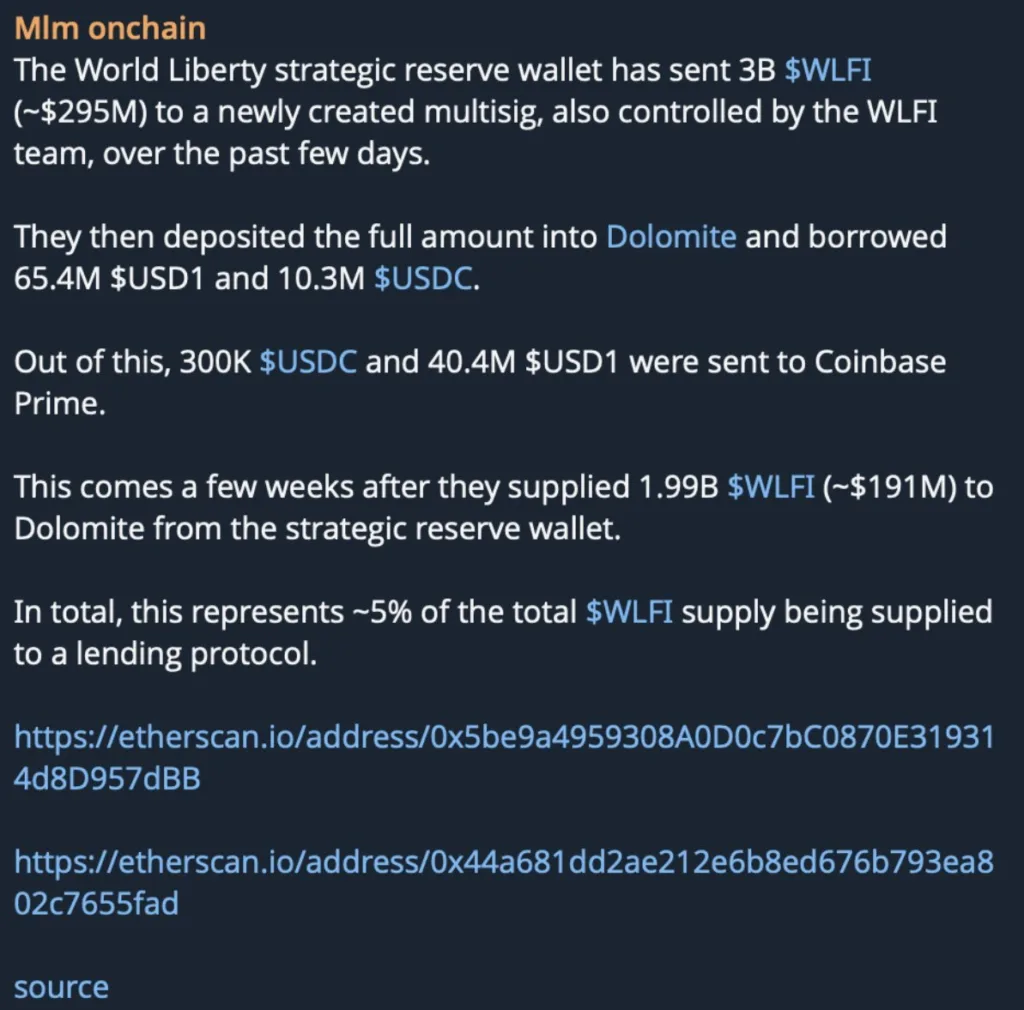
That multisig then deposited the full amount into Dolomite and immediately borrowed $65.4 million USD1 and $10.3 million USDC against it. Of those borrowed stablecoins, $40.4 million USD1 and $300,000 USDC were sent directly to Coinbase Prime.
This came weeks after the same strategic reserve wallet had already supplied 1.99 billion WLFI, about $191 million, to Dolomite. Combined, that’s roughly 5% of WLFI’s total token supply now sitting as collateral on the platform, with real stablecoins borrowed against it.
Ethereum Daily (@ETH_Daily) on X laid out exactly what that means for anyone currently supplying USD1 or USDC to the pool, lured in by the advertised 14-23% APY with WLFI and oDOLO rewards:
“WLFI team is the only major supplier of $WLFI and the dominant borrower of the stables you’re being incentivized to supply. They’re essentially using their own governance token to pull liquidity from the pool you’re funding. High APY? It’s mostly artificial utilization from one whale position.”
DeFi researcher Ignas (@DefiIgnas) was more direct: “Don’t be exit liquidity for Trump’s cartel. They deposited $484M of $WLFI tokens to borrow USDC. Those loans will likely never be repaid.”
His argument is that the repayment calculus for WLFI is tied to political timeline, not protocol economics, when Trump leaves office, or Republicans lose the midterms, the political value propping up WLFI collapses, and so does the collateral. Dolomite would be left holding the bad debt.
Another analyst, Ethan DeFi (@EthanDeFi_), pointed to a detail that makes the liquidation risk even more acute: WLFI has an almost $10 billion fully diluted valuation, but it is not a liquid asset.
On Binance, the most liquid exchange in the world, attempting to sell $500,000 worth of WLFI reportedly sends the chart straight to zero. So the question is whether 5 percent of its total supply could ever be sold fast enough to clear the position before lenders absorb the loss. The answer, multiple analysts suggest, is almost certainly no.
@totofdn, another onchain user, added a detail that makes the whole structure feel less like an accident and more like a design: the WLFI CTO and Dolomite’s founder are reportedly the same person.
That would explain why supply caps on WLFI collateral keep getting raised, and why high APY incentives are being pushed to attract more outside capital into the same pool that WLFI is borrowing from.
The Iran timing and the super node pay-to-access model
There’s another layer to this that the crypto community found particularly unsettling. Ethan DeFi noted that just a few hours before Trump announced the Iran ceasefire, a market-moving event, WorldLibertyFi sent $40 million-plus in borrowed stablecoins to Coinbase.
The question he raised publicly: did they use those stablecoins to take long positions, knowing what was about to be announced? “No one knows,” he wrote, “but I wouldn’t be surprised.” Although, it’s a question, it’s the kind of question that, in a regulated market, would trigger an investigation. However, in the current environment, it’s just a tweet.
Meanwhile, Ignas separately resurfaced a governance proposal that passed in March, the “Super Nodes” mechanism, which critics have been calling a pay-for-access scheme in barely-disguised form. Under the proposal, staking 50 million WLFI tokens (roughly $5 million) grants “guaranteed direct access to the WLFI team for partnership discussions.”
The proposal passed with 99.12 percent of the vote. Ignas’s read: “those who want to bribe Trump need to lock their tokens for 6 months. They literally put access to the team as a benefit of staking.” The timing, introduced just as token unlocks begin and midterms approach, drew its own round of criticism.
The recent treasury activity on Dolomite catapulted deposit rates for USD1 suppliers to 35.81 percent annualized returns, while borrowers faced costs of 30 percent, both highly unusual rates.
The situation arose as outstanding loans overtook available liquidity, a condition triggered directly by the organization’s own actions on the platform. Half of the total value locked on Dolomite now represents WLFI’s own collateral position, according to onchain data.