




World said it will reduce the daily unlock rate of its WLD token by 43 percent starting July 24, 2026.
The project said on Friday that the change will apply to community, investor, and team allocations under its existing unlock schedules.
The update from World comes as WLD trades near $0.28 after a small rebound, while on-chain and market data show mixed signals around supply, momentum, and exchange flows.

Unlock pace will slow from July 24
World said the new schedule will lower the total daily unlock rate from about 5.1 million WLD to about 2.9 million WLD tokens. The project added that tokens will continue to unlock each day in a linear manner and that there will be no unlock cliff. That keeps the current structure in place while reducing the amount of new supply entering the market each day.
Community-owned tokens will see the sharpest reduction. Their daily unlock pace will fall by 50 percent, from 3.2 million WLD per day to 1.6 million WLD per day. Investor and team allocations will also slow, with their daily unlock rate dropping by 32 percent from 1.9 million WLD to 1.3 million WLD per day.
”At launch on July 24, 2023, 500 million WLD from the World Community allocation were unlocked,” noted World, in a statement. ”The remaining 9.5 billion tokens were made subject to continuous daily unlock schedules, with the final tranche unlocking 15 years from the launch date.”
As of April 10, 2026, World said 4.9 billion WLD tokens had already been unlocked, equal to 49 percent of the total 10 billion supply. Out of that amount, 3.3 billion tokens were already in circulation.
The project said its total supply was allocated across four stakeholder groups, with 75 percent assigned to the World Community and the remaining 25 percent split across the team, TFH investors, and a small TFH reserve.
WLD price analysis
WLD traded near $0.278 at press time, with daily trading volume above $114 million. The token was also up 4 percent over the past 24 hours and 3 percent over the past seven days, according to CoinGecko data. The market cap stood at roughly $900 million at the time of the update.
Although that was a short-term movement, the overall trend on the daily chart remained a downward trend. Price had recovered between the $0.25 and $0.26 range to about the 0.278 range, though the trend was more indicative of stabilization than a complete reversal.
The technical indicators also showed a modest recovery. The RSI stood near 45, which showed momentum had improved from weaker levels but was still below the 50 mark. That suggested buying strength had improved but remained limited on the daily timeframe.
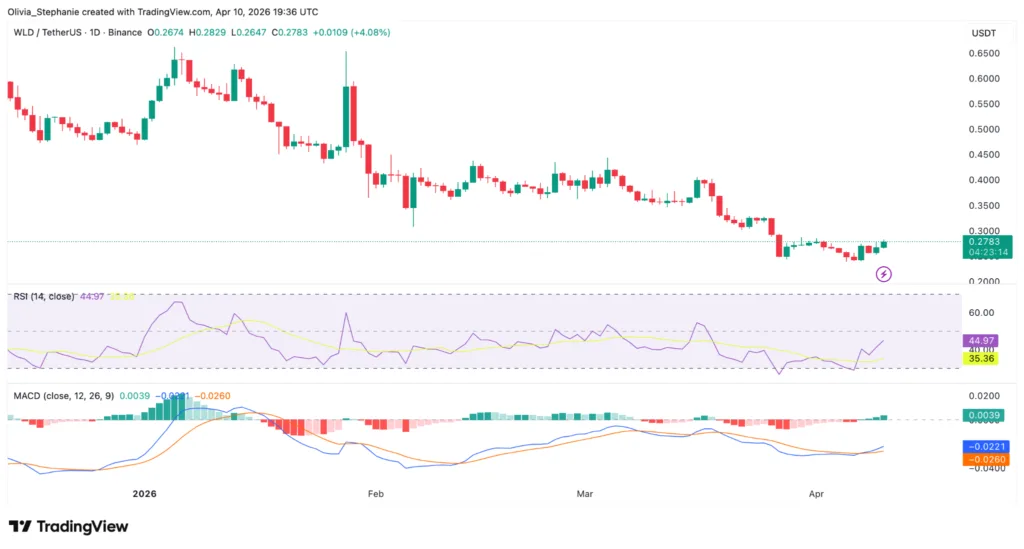
MACD data pointed in the same direction. The MACD line was rising and the histogram had turned slightly positive, which suggested bearish momentum was fading.
Even so, the indicator remained close to neutral, which kept the signal in the range of a relief bounce rather than a confirmed breakout.
Flows and derivatives stay mixed
Coinglass data showed an increase in both trading activity and derivatives positioning. Volume rose more than 50 percent to about $292 million, while open interest climbed nearly 8 percent to about $180.5 million.
That showed traders were becoming more active as the token reacted to the latest supply update and short-term market conditions.
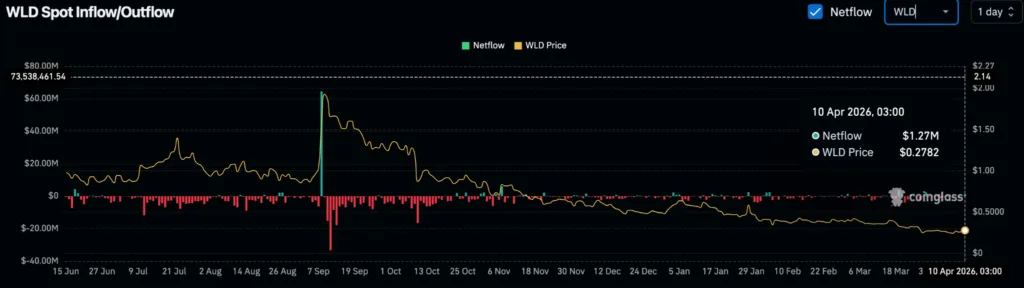
Spot flow data added another layer to the picture. The WLD spot inflow and outflow chart showed a long pattern of net outflows, with red bars appearing more often than green ones over time. That usually means tokens are leaving exchanges rather than moving onto them for immediate sale.
There were still brief inflow periods. On April 10, the chart showed a positive netflow of about $1.27 million. However, those inflows appeared short-lived and did not change the larger pattern.
World expands its AI-linked identity push
The supply update also came as World continued to expand its product focus beyond token economics. The project, which is tied to Sam Altman through Tools for Humanity, has positioned itself around human verification and digital identity.
Its core idea is to build infrastructure that can distinguish real humans from AI-driven activity online.
In March, World introduced the beta version of AgentKit, a developer toolkit linked to that broader goal. The company said the product is meant to verify whether an AI agent is being controlled by a real human.
As we reported, AgentKit is designed to support AI agents as economic participants while connecting them to World ID.
Furthermore, that wider product push keeps WLD tied to both token supply mechanics and the project’s identity-based use case. Nearly one year ago, World sold $135 million worth of WLD to prior backers Andreessen Horowitz and Bain Capital Crypto.
Now the latest change to the unlock schedule puts fresh attention on how the project plans to manage supply while continuing to build around digital identity and AI-related tools.