
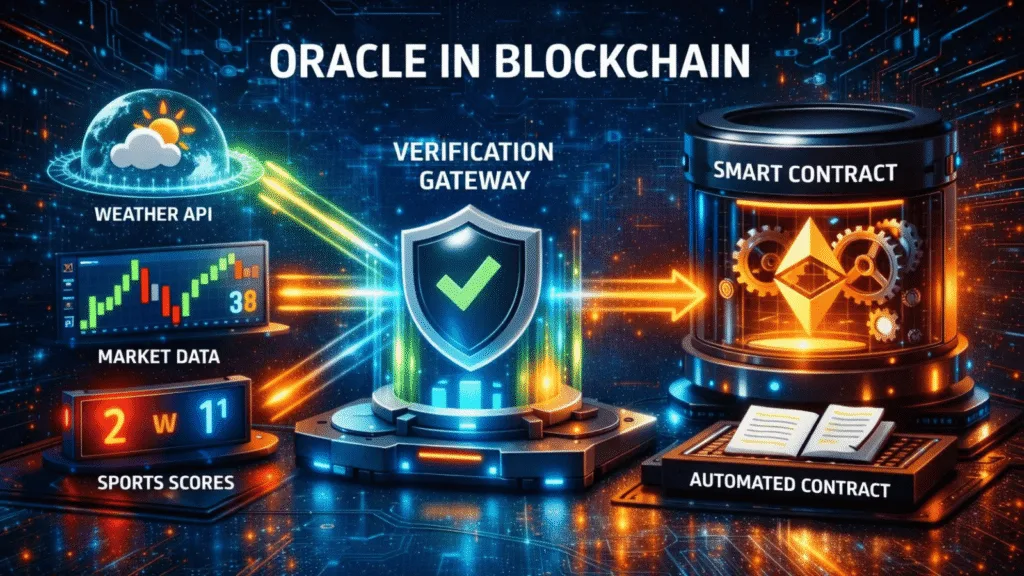



Blockchains, that are often praised for being transparent, secure, and advanced in data storage, do lack the ability to connect to real-world information independently. They have no knowledge of what the weather is like, how much is gold trading for, or how a football game turned out. Here’s where Bitcoin oracles enter the chat.
A blockchain oracle, as the name suggests, is a service that wires data from outside the blockchain into its network letting smart contracts work with genuine data. In simpler terms, oracles bridge the gaps between the outside and inside ecosystems of blockchain networks.
Diving deeper into oracles
The value of smart contracts depends on the data they have an access to. They rely on oracles to provide confirmed data like asset prices, weather conditions, interest rates, or election results because blockchains are meant to be separate for security and agreement.

Smart contracts could only use information that is stored in the blockchain and not in any oracles. Oracles are the key link that connects blockchains to information outside of their separate settings, but they are often forgotten. They are necessary for many smart contracts to work.
More crypto-friendly platforms are being powered by oracles than we realize. Prediction markets, insurance systems, gaming platforms, and decentralized finance (DeFi) — all use oracles to fetch details from outside the blockchain systems they are build atop.
What is the purpose of oracles in blockchain?
When you build a blockchain, you make sure that every node uses the same data to reach the same conclusion. If blockchains was allowed to freely access information from the internet, it would mess up this consensus model.
Oracles solve this problem by being dependable data sources that give smart contracts steady, checked data. Additionally, they let blockchains:
- Use live price information to make decentralized markets better
- Allow forecast markets and places to bet
- Pay out insurance claims automatically
- Hold on to stablecoins and loan systems
How do oracles in the blockchain work?
The process of using an oracle usually follows a simple path:
- A smart contract wants specific data
- The oracle gets its information from different external sources
- Data is verified, aggregated or validated
- Data is submitted on-chain by oracle
- Based on the data, smart contract is executed
Cryptography proofs and decentralized networks of data providers are among varied oracle systems used to keep the blockchain data accurate.
Different kinds of blockchain oracles
Not all oracles are the same. Some of the main categories include:
1. Software oracles: To get data, these use online sources such as APIs, websites, and databases to obtain financial reports.
2. Hardware oracles: Devices that you can touch, like sensors, RFID chips and Internet of Things (IoT) systems, give hardware oracles the required information, particularly around supply lines and organizing logistics.
3. Inbound vs. outbound oracles: Inbound oracles add information to the blockchain, and outbound oracles send information from the blockchain to systems outside of the blockchain.
4.Centralized oracles: These are easier to understand because they are managed by a single source, but they do create a single point of risk.
5. Decentralized oracles: These use multiple nodes to collect and check data, which makes them more reliable and less likely to be hacked.
The Oracle problem explained
It can be hard to make sure that external data added to a blockchain is accurate, safe from changes, and reliable (the “oracle problem”).
There is still a chance of losing a lot of money, even with smart contracts in place, if a source gives you wrong or changed information. Decentralized oracle networks and secure proof methods are very important in the world of blockchain.
If you trust an oracle, you trust where the information came from, how it was delivered, and the people who worked on it.
Well known blockchain oracles
Several oracle networks have emerged as industry standards:
- Band protocol is known for focusing on cross-chain data
- Chainlink is famous for its decentralized price feeds
- API3 focuses on first-party oracle solutions
The goal of these systems is to make data more precise and reliable while minimising trust assumptions.
Risks and challenges with oracles
While oracles can prove to be of great value, they also carry unavoidable risks like:
- Manipulation of data, when the source isn’t stable
- Attacks that aim to mess up oracle’s motivations
- Risks of centralization in single-provider oracles
- Data loss can take place when transfers are delayed
These risks and challenges explain why oracle design is just as critical as smart contract design.
Best practices to keep in mind while using oracle-based applications
For users and coders alike:
- Learn how to pick and choose data sources you can trust
- Favor dApps using decentralized oracle networks
- Keep an eye on systems of government and incentive mechanisms
- Do not avoid software that relies on a single data source
A strong oracle framework in DeFi and Web3 reduces systemic risk to a minimum.
Conclusion
In smart contracts, oracles are like a secret framework that makes them work better. By linking blockchains to real data, they turn static code into dynamic apps that can respond to things that happen in the real world.
As the usecases of blockchains continue to evolve, oracles are likely to become a crucial part of the Web3 ecosystem. Afterall, oracles ensure that decentralized systems are linked to the traditional world Web3 enthusiasts want to change.