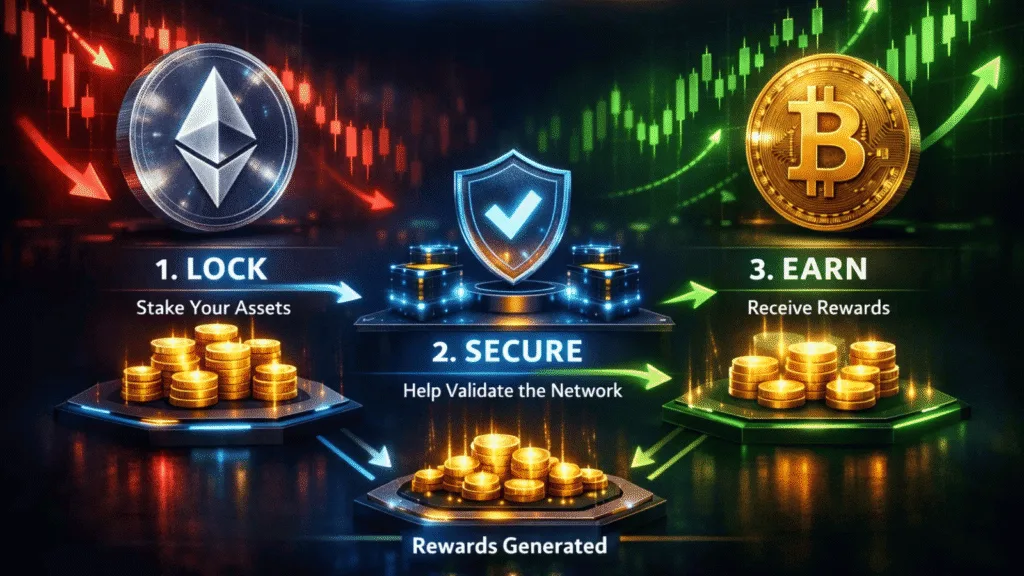



Crypto staking has silently become one of the most favored methods for long-term investors to generate a passive income through their existing crypto holdings. While regular trading is the go-to strategy to boost asset holdings and returns, staking is becoming a popular way to generate passive income through these assets driven by engagement instead of speculation.
In simple terms, staking offers users a way to earn rewards by contributing to the security of blockchain networks and earn rewards in return.
Staking has seen significant growth with the shift of many blockchains towards energy-efficient consensus models. Ethereum’s shift to Proof of Stake (PoS) in September 2022 acted as a milestone for bringing staking under the spotlight.

In the present day, countless members from the crypto industry engage in staking crypto via wallets, exchanges, and decentralized platforms, establishing it as a fundamental aspect of the contemporary blockchain infrastructure.
What is crypto staking?
Staking cryptocurrency means locking up your digital assets to support the operations of a blockchain network. Participants earn rewards -in the form of tokens- in return, usually in the same cryptocurrency they have staked.
Staking is primarily associated with Proof of Stake (PoS) and similar consensus mechanisms. Validators are selected based on the quantity of cryptocurrency they have staked and other network-specific factors, instead of depending on miners to validate transactions through computing power. The more you invest and the longer you stay engaged, the greater your chances of reaping high rewards. Rewards are usually given out on a daily or weekly basis, varying from blockchain to blockchain.
Some of the popular well known staking coins include Ethereum (ETH), Solana (SOL), Cardano (ADA), Polkadot (DOT), among others.
How does crypto staking work?
When you start staking crypto, your digital assets are held in a smart contract or staking pool for a certain period of time. Think of it like putting your money in a high-yield savings account. Just like a bank uses your deposits to give out loans, in staking a blockchain network uses your assets to keep the network running smoothly.
These staked tokens are used by the network to:
- Check transactions
- Create new blocks
- Make sure the network stays completely safe.
Different ways to stake crypto
You can stake your cryptocurrency in a number of different ways. Some of the most common ones are:
- Direct Staking: Users take part by handling a validator node directly. Usually, one does need to have a certain set of skills and be willing to spend a lot of money up front.
- Staking Pools: Let users in a group pool their resources to meet the staking standards. When they’re done, everyone in the group gets an equal share of the benefits. This is an easy hack for beginners to understand and learn staking.
- Staking on an exchange: Staking services on centralized platforms are easy to use and can be accessed with a click. Even though this is an easier method, users must feel safe about the site when it comes to their money.
- Liquid Staking: Users can stake and get a ticket that can be traded, which gives their claimed assets some liquidity in return.
Advantages of Crypto Staking
Staking provides a range of benefits for those who hold assets over the long term:
- Source of income without the need for active trading
- Building rewards by reinvesting those assets
- Engaging in the network, fostering a decentralized approach
- Reduced energy usage in comparison to mining
For investors who have faith in a project’s long-term value, staking can be a seamless extension of holding.
Disadvantages of Staking
While it has its charm, staking comes with certain risks:
- Lock-up periods can limit access to funds
- Market fluctuations can impact staking rewards
- Reducing penalties for validator mistakes
- Risks associated with platforms, particularly in centralized services
Grasping these risks is crucial before investing money.
Best practices for Secure Staking
Some of the best practices you can follow to stake responsibly:
- Choose only trustworthy networks and platforms
- Always begin with small quantities if you’re just getting started
- Understand the lock-up and unstaking durations
- Spread your staking across various assets
- Keep long-term price movements in mind
Staking is meant to enhance, not substitute, a well-rounded crypto strategy.
Conclusion
Crypto staking signifies a move towards a more inclusive and sustainable blockchain environment. By securing assets to support networks, users receive rewards while aiding in decentralization. While staking carries certain risks, making informed choices and implementing appropriate safeguards can transform it into a valuable asset for those holding crypto for the long term. With the ongoing rise in blockchain adoption, staking is expected to stay a fundamental aspect of the functioning of decentralized networks.